- Free your hamstrings and your lower back gets a rest. They are three muscles running from the sitting bone to just below the knee [1]. When they are short, your lower back does the bending for them.
- Your back pain is very likely the kind you can change. About nine in ten cases of low back pain have no identifiable structural cause [2][3]. That pain lives in muscles, posture and movement.
- Stretching your hamstrings eases back pain. A systematic review found reduced hamstring flexibility in people with low back pain [4], and a 2024 analysis of 14 trials found that stretching the hamstrings reduced pain and improved function [5].
- Two minutes a day covers it. The guideline is about 60 seconds of total stretch per muscle group, at least two to three days a week, to mild tightness and never pain [6][7].
- If you sit for a living, this is for you. In a year-long trial of office workers, daily stretching plus twice-weekly endurance training cut new episodes of low back pain from 19.7% to 8.8% [8].
- You feel it within days. The first gains come from your nervous system learning to allow more stretch [9], which is why a short daily habit beats a long weekly one.
- One rule makes it work: a straight back. FlexBuddy® holds it for you. One bar under your feet, one in your hands, and the stretch lands in your hamstrings and calves.
What your hamstrings are, and why your back cares
The word covers three muscles on the back of each thigh: biceps femoris, semitendinosus and semimembranosus. All three start at the ischial tuberosity, the bony point you sit on, and run down to attach just below the knee, on the fibula and the tibia [1]. So the hamstrings cross two joints. At the hip they pull the thigh backwards; at the knee they bend the leg [1]. And because they anchor on the pelvis, their length decides how far your pelvis can tip forward.
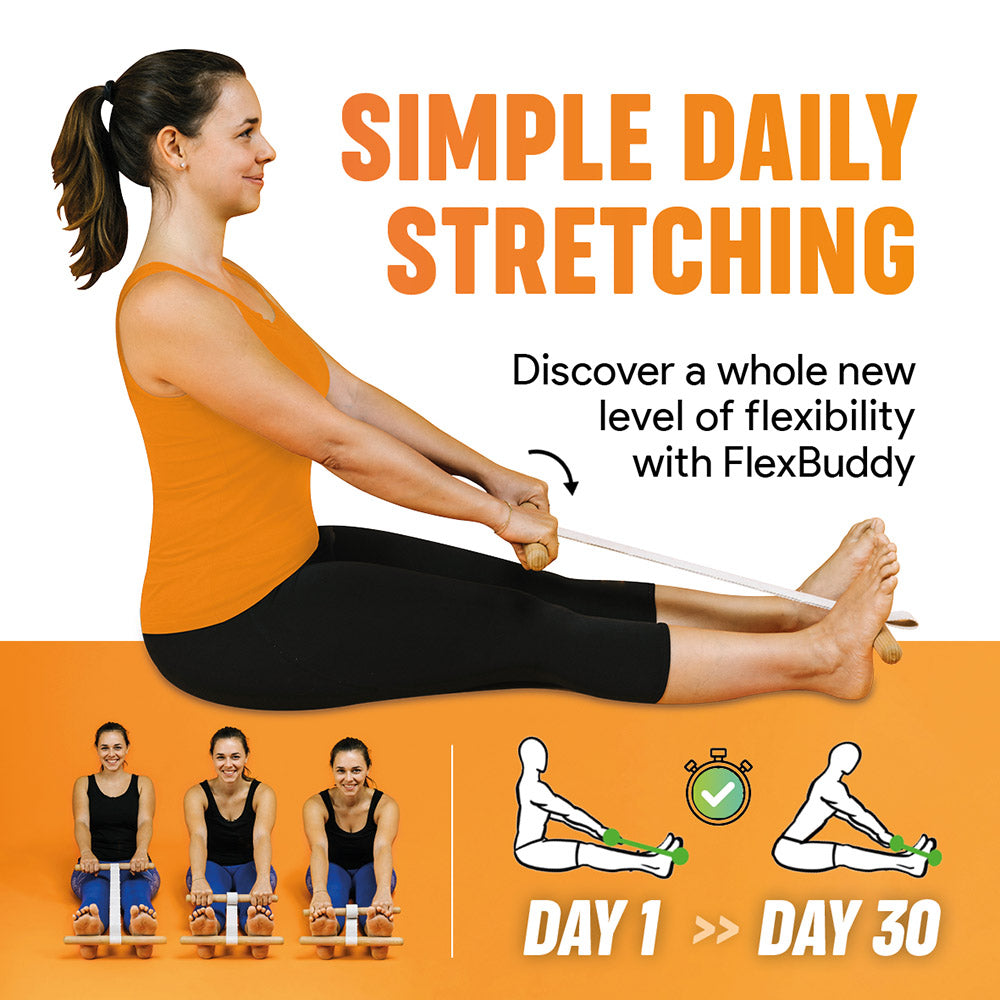
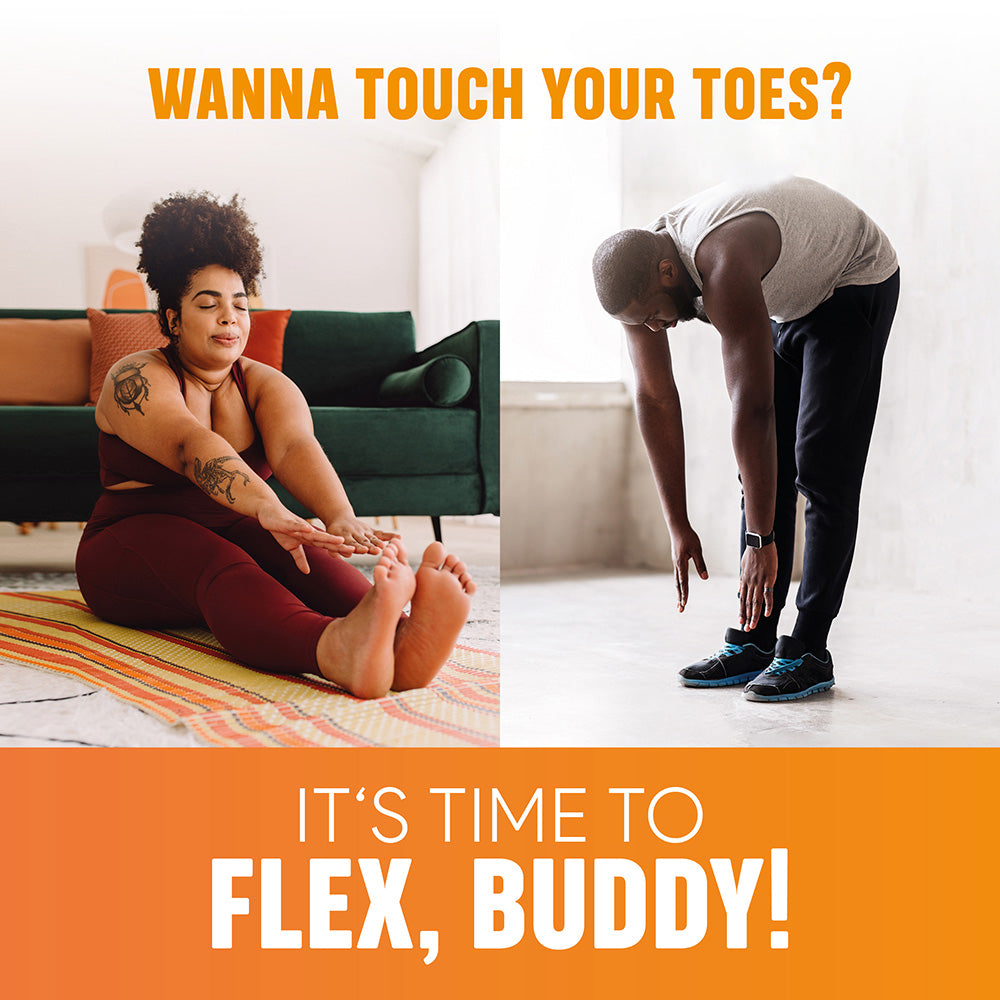
Try it now. Sit on the floor with your legs straight and reach for your feet. With long hamstrings, the pelvis rolls forward and your chest travels towards your knees with a straight back. With short ones, the muscles hold the pelvis back, and the only way to get closer to your feet is to round the lumbar spine. You call that "I can't touch my toes". Your lower back calls it a bend it has to take hundreds of times a day.
Give the hamstrings their length back and the bend returns to the hips, where it belongs. Your back gets to rest.
One fact for later: the hamstrings are supplied by the sciatic nerve [1], which runs right behind them down the leg. Some "hamstring tightness" is the nerve talking, not the muscle, and it wants a gentler approach.
Why hamstrings get short, and why you can reverse it
Sitting
In a chair, the knee is bent and the hip is flexed. That is the hamstrings' shortest position, and a muscle held short for hours adapts to it. Eight hours at a desk, a commute, an evening on the sofa: your hamstrings spend most of their life short. The answer is just as simple: show them the long position every day. Office workers with reduced trunk flexibility are exactly the group in whom daily stretching has been shown to prevent new back pain [8].
Sport
Running, cycling and most gym training load the hamstrings hard and often without ever taking them through their full length. Cyclists spend hours with hips flexed and knees bent, which is sitting with effort (there is a separate guide to stretching for cyclists). The result is a strong, short muscle. Strong is good. Add length and you keep the power and gain the range.
Age and disuse
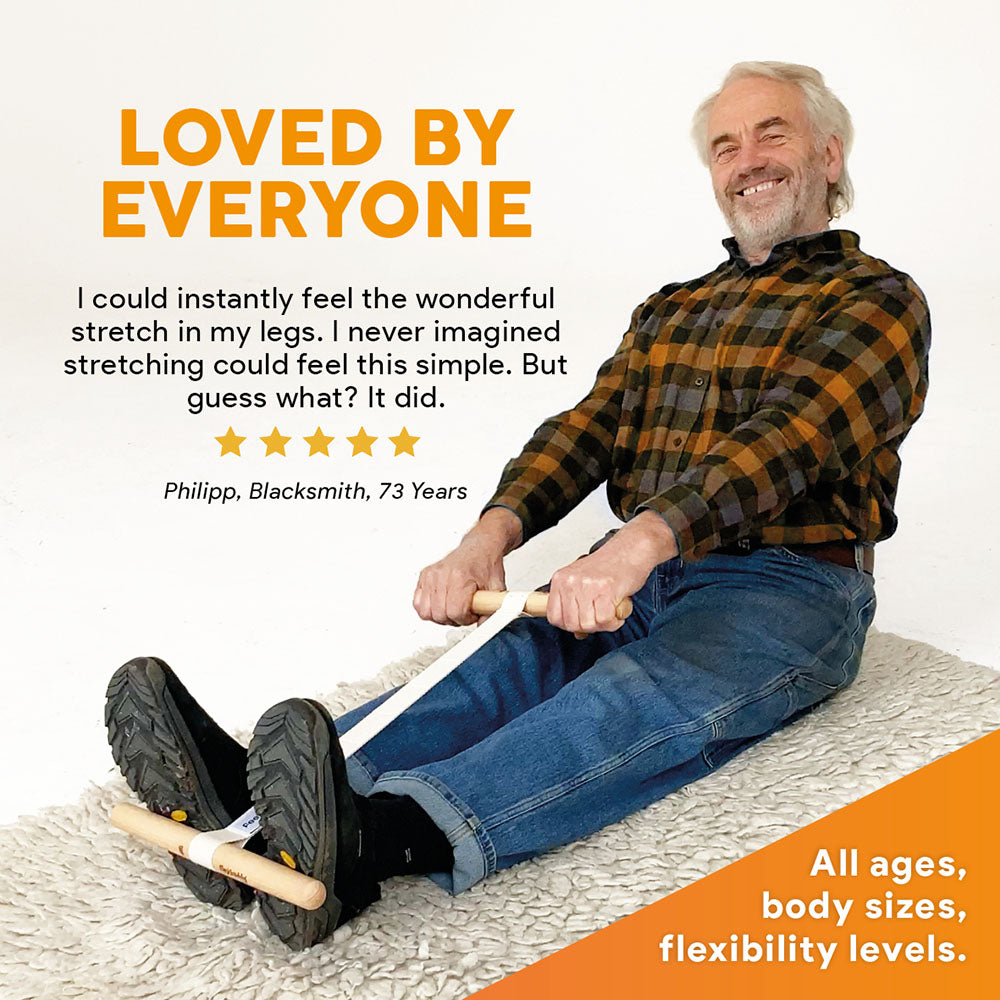
Flexibility leaves quietly. Nobody notices that the floor got five centimetres further away over ten years, until putting on socks becomes a small negotiation. The good news is in the same sentence: the range went because you stopped using it, so using it brings it back, at any age. Bob J. wrote: "I am 64 and have never touched my toes. FlexBuddy changed that in a week!" Philipp, a blacksmith of 73, said: "I never imagined that I would regain my flexibility. But I did!"
Protection
A muscle can feel tight without being short. After an injury, during a back-pain flare, or when the sciatic nerve is irritated, the nervous system raises the hamstrings' resting tension to protect the area. That kind of tightness eases when the thing it protects calms down, not when you pull harder. If your "tightness" came on suddenly, is one-sided, or burns down the leg, read the section on when not to stretch before you start.
Tight hamstrings and lower back pain: the link and the fix
Start with the big picture, because it is better news than you expect. Low back pain is the leading cause of disability in the world [2]. Yet for nearly all people with low back pain it is not possible to identify a specific cause in the spine [2]. In primary care, about 90% of back pain is "non-specific", with compression fractures in about 4% of patients, cancer in 0.7% and infection in 0.01% [3]. Nine in ten back pains are not a slipped disc or a disease. They come from how the body is used, and how you use your body is something you can change, starting tonight.
The link. A systematic review compared hamstring flexibility in people with and without low back pain and found reduced flexibility on several measures in the back-pain group [4]. The mechanics make sense of it: short hamstrings hold the pelvis back, so the lumbar spine rounds to make up the distance, bend after bend. A sore back also makes the hamstrings guard, so the two feed each other until you break the circle.
The fix. Stretching the hamstrings is how you break it. A 2024 systematic review pooled 14 randomised controlled trials and found that hamstring stretching reduced pain intensity in people with low back pain (standardised mean difference −0.72) and improved function by 7 points on the Oswestry Disability Index [5]. In people whose pain radiated down the leg, straight-leg-raise range improved markedly [5]. Two to six weeks of stretching was the most common programme [5]. Weeks, not years.
No gym, no pills, no appointment: a few minutes of the right stretch, done regularly. The routine below is simple enough to do every day.
The self-test: find out what is stopping you
Three checks, two minutes, no equipment, and you know exactly where you stand. For more ways to measure, see the hamstring flexibility tests you can do at home.
- Standing toe touch, knees straight. Note where your fingertips stop relative to the floor. Now bend your knees slightly and repeat. If you suddenly reach much further, the hamstrings (and calves) are the limit. If bending the knees changes little, look at the hips and the lower back.
- Seated reach. Sit on the floor, legs straight, and reach. If you can get closer seated than standing, calf tightness and balance were part of the standing problem. Watch your back in a mirror or on your phone: does it round at the lumbar spine before your chest moves forward? That rounding is the habit you are about to replace.
- Lying knee extension. Lie on your back, bring one thigh vertical and hold it with both hands behind the knee, then straighten that knee as far as it goes. A knee that stops well short of straight, with the pull felt in the back of the thigh, is a short hamstring. A pull that runs into the calf or buttock, or a burning line down the leg, points to the nerve.
Write the first result down in centimetres. In four weeks you will enjoy comparing it.
The one mistake that sends a hamstring stretch into your back
Here is what most people do when told to stretch their hamstrings: they stand or sit, reach for their toes, round the back as far as it will go, bounce a little and hold their breath. In that position the hamstrings are barely longer than when standing, because the pelvis never tipped forward. The extra distance came from the lumbar spine. That is why the stretch "doesn't do anything" for the legs and why the back is sore afterwards.
The fix is one rule. The spine stays long and the movement comes from the pelvis tipping forward over the thighs. Chest up, sitting bones back, the fold happens at the hip crease. You will not get anywhere near your toes at first. That is correct. You feel the stretch exactly where it belongs, in the back of the thigh, and your back feels nothing at all. Hold that honest position and the toes come to you over the weeks.
This is the position FlexBuddy was built to hold for you. The strap carries the pull, your arms stay relaxed, and your back stays long without effort.
Two more rules. Stretch to the point of mild tightness, never pain: a muscle that is being hurt contracts against you. And breathe: ten slow breaths is a better clock than counting, because it keeps you from bracing.
The best hamstring stretches, with hold times
The American College of Sports Medicine recommends flexibility exercises for each major muscle-tendon group totalling about 60 seconds per exercise, on at least two days a week [6], and its expert panel is usually summarised as two to three days a week, with daily stretching most effective [7]. Sixty seconds can be fifteen seconds four times or twenty seconds three times [7]. The trials that reduced back pain used holds of about 30 to 40 seconds, several repetitions, two to five days a week, for a few weeks [5]. Everything below fits inside those numbers.
| Stretch | Position | Hold | Reps | Best for |
|---|---|---|---|---|
| Seated, straight back | Sit tall, legs straight, FlexBuddy, a strap or hands around the feet; tip the pelvis forward, chest up | 10 breaths (~30 s) | 3 | Everyone; the foundation |
| Lying, one leg | On your back, other knee bent; raise one straight leg with FlexBuddy or a strap round the foot, keep the lower back on the floor | 10 breaths | 2–3 per leg | Beginners, back-pain flares, in bed |
| Standing, heel on a step | Heel on a low step, knee straight, hinge at the hips with a long spine until the thigh pulls | 20–30 s | 2–3 per leg | At work, after sport |
| Dynamic leg swings | Hold a wall, swing one straight leg forward and back, relaxed, growing the range | No hold | 15–20 per leg | Before running or training |
| Doorway stretch | Lie in a doorway, one leg up the frame, knee straight, other leg through the door | 30–60 s | 2 per leg | Evenings; a strong, passive hold |
In bed works too. Lying stretches with the lower back supported are the safest version for anyone whose back is already sore, and for the first weeks they are all you need. Over 65? Hold a little longer, 30 to 60 seconds.
What to skip: bouncing (ballistic stretching) in a cold muscle, any stretch that produces pain rather than pull, and loaded forward bends with a rounded back, for example touching your toes with a weight in your hands.

The four FlexBuddy hamstring exercises, step by step
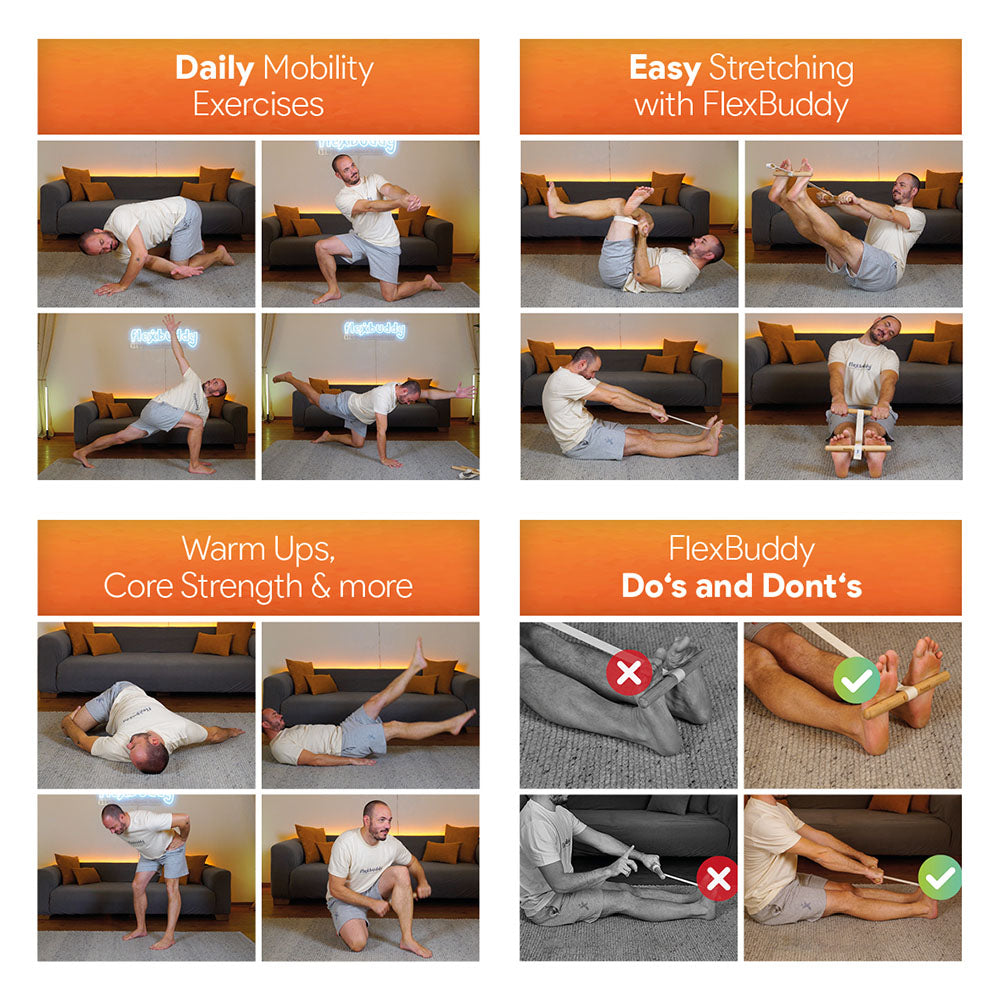
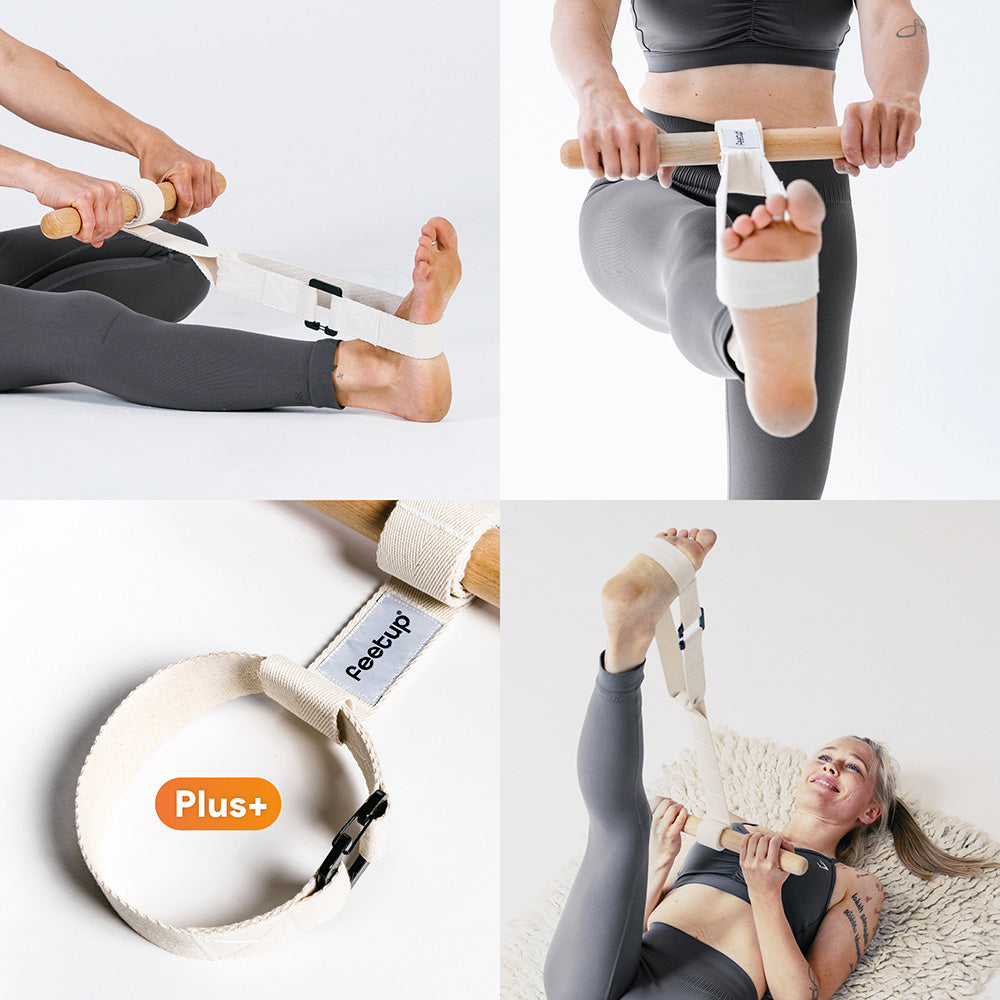
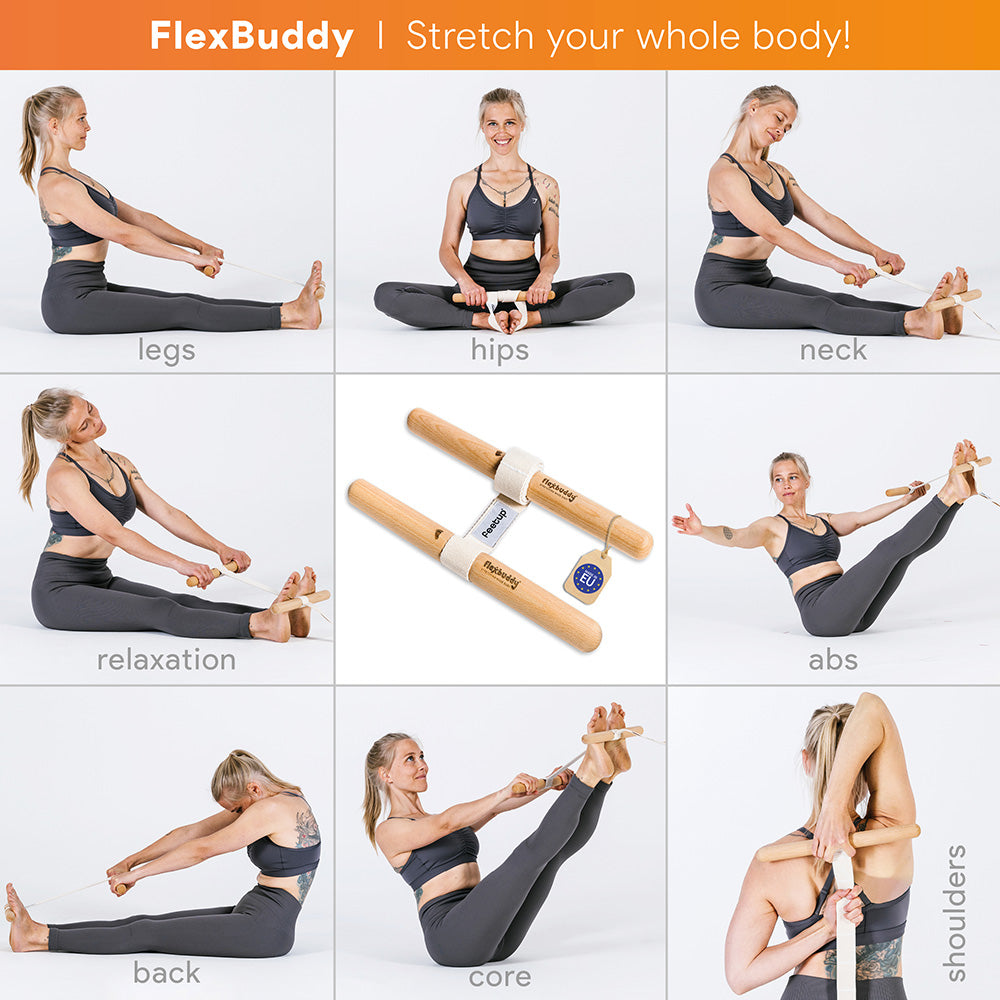
This is the FlexBuddy routine from the guide, in the order that works best for stiff beginners. You do each one sitting or lying down, with the strap hooked around the soles of your feet and the wooden handles in your hands. The strap does the reaching; you sit tall and breathe.
1. Hamstrings Warm Up (30–45 seconds)
Sit on the floor with your legs extended and hook FlexBuddy around the soles of your feet. Hold the handles with a relaxed grip and sit as tall as you comfortably can. Gently rock forward and back in a small range, letting the strap guide the movement, breathing slowly. You feel a light, moving pull along the back of the thighs and almost nothing in your lower back. Slightly bent knees are not cheating; they keep the stretch in the hamstrings instead of behind the knees.
2. Static Stretch (20–40 seconds, twice)
Same position. Inhale and lengthen your spine; exhale and hinge forward from the hips, arms long on the handles. Stop at mild tension, the point where you can still breathe slowly, and stay. If your lower back complains, you have rounded: ease up and re-lengthen the spine. Measure success by how calm the stretch feels at the depth you chose, not by how far forward you got.
3. Single Leg Stretch (20–30 seconds per side)
Sit with one leg extended and the other knee bent, foot resting inside. Hook FlexBuddy around the extended foot, inhale tall, exhale and hinge gently towards the straight leg. Very often you will find that one side is tighter. Uneven hamstrings pull the pelvis unevenly too, so give the tighter side one extra round.
4. Lying Thigh Stretch (20–30 seconds per side)
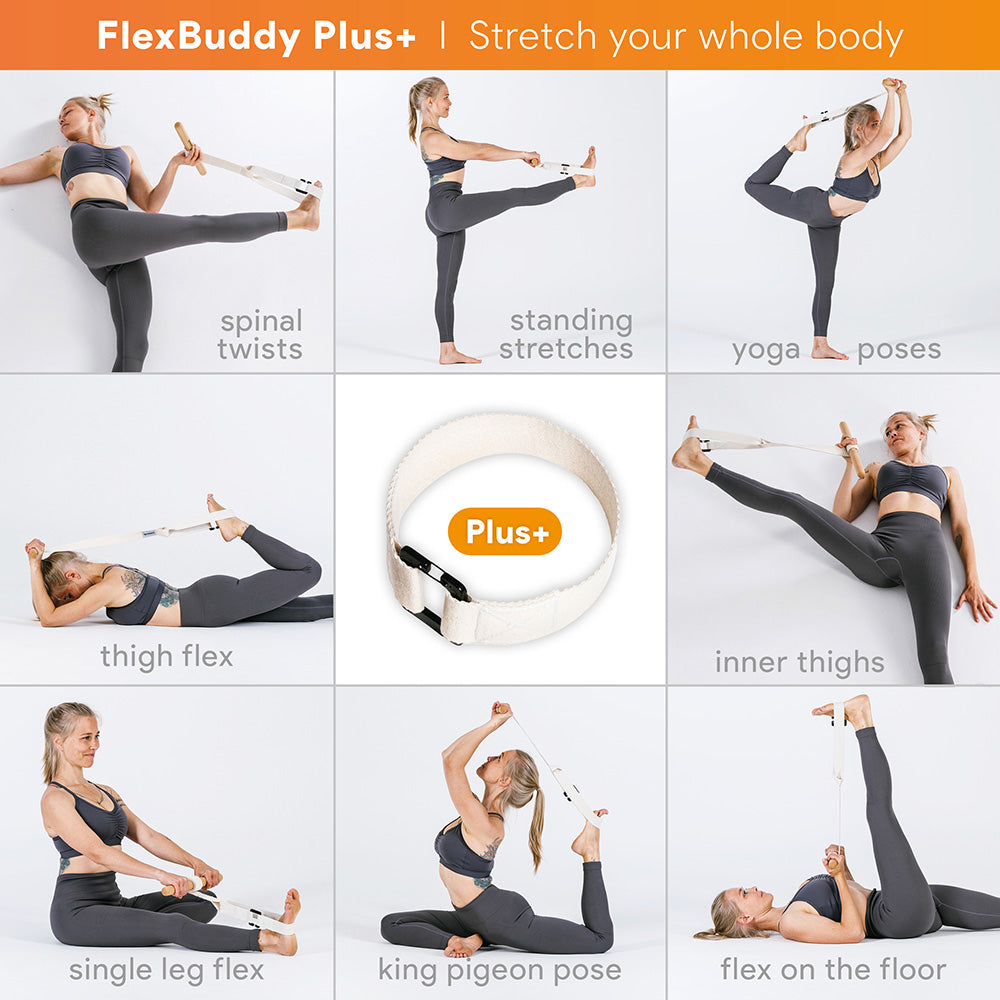
Lie on your side or front and hook FlexBuddy around the top foot; hold the handles over your shoulder and draw the heel gently towards the glutes, knees close together, pelvis neutral, no arching. This stretches the front of the thigh and the hip flexors, the other side of the pelvic tug-of-war: the hip flexors pull the pelvis forward, the hamstrings pull it back. Stretch both sides and the pelvis moves freely again.
A four-week progression
Consistency does the work. Two minutes a day beats twenty minutes on Sunday, because the first changes are in how much stretch your nervous system will tolerate rather than in the muscle's length, and tolerance is trained by repetition [9]. Show up daily and you notice the difference within days.
- Week 1, learn the position. Seated straight-back stretch, 3 holds of 10 breaths, every day. Use FlexBuddy or a strap so you can keep the chest up without reaching. Stop where you feel the thighs, not the back.
- Week 2, add the lying stretch. Same seated holds, plus the lying single-leg stretch, 2 holds per leg, after work or before bed. Most people notice the evening back-ache easing around now.
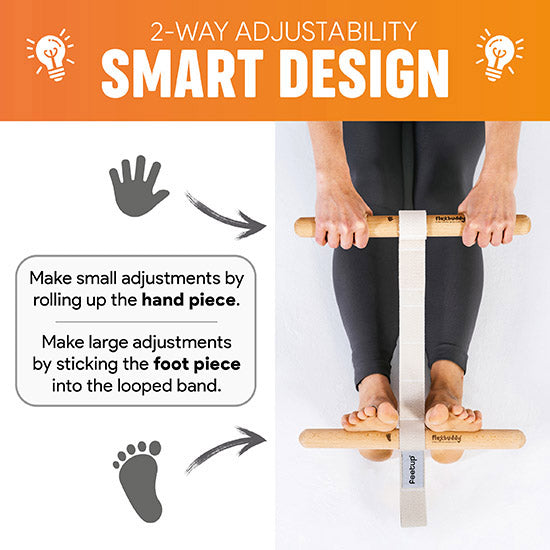
- Week 3, shorten the range by one step. Move the foot bar a loop shorter, or roll the strap once more around the hand bar. Only if the back stays long. Add the standing step stretch after any run or ride.
- Week 4, re-test. Repeat the three self-tests and compare the centimetres. Then keep going: the range stays as long as the habit does.
Be patient with the toes; our 4-week progression to touch your toes sets the pace. Some get there in a week, others need a couple of months, and everybody gains along the way. Stylianos T. wrote: "It has changed my life! I can now bend 15 cm more than before in the space of 6 months." Progress is the point; the toes are a milestone.
Hamstrings, sitting and your working day
If you sit for a living, the most useful change you can make is not a better chair. It is a daily stretch. In a 12-month trial of office workers with below-normal trunk flexibility or endurance, a programme of daily stretching and twice-weekly endurance training cut new episodes of low back pain from 19.7% to 8.8% [8]. New back pain, more than halved. The ACSM position stand adds that breaking up sitting with frequent short bouts of standing and movement has health benefits even for people who exercise [6].
So: stand up every hour, and give the hamstrings their two minutes at the end of the day, when they have been short for the longest. Keep FlexBuddy where you will see it, next to the sofa or under the desk.
When not to stretch, and when to see someone
Do not stretch through pain. If the pull runs down the leg as a burn, tingling or numbness rather than a thigh stretch, the sciatic nerve is involved; nerve-related tightness responds to gentle nerve-gliding movements, not to long holds, and a physiotherapist should set those up. A recent hamstring strain (sudden pain during a sprint or a kick, bruising, weakness) should not be stretched hard in the first days. And some back pain needs a doctor before any exercise: pain with numbness or weakness in the legs, changes in bladder or bowel control, fever, unexplained weight loss, pain after a fall or accident, or pain that keeps getting worse. Those are the small minority of cases that are not "non-specific" [2][3].
Do it properly with FlexBuddy
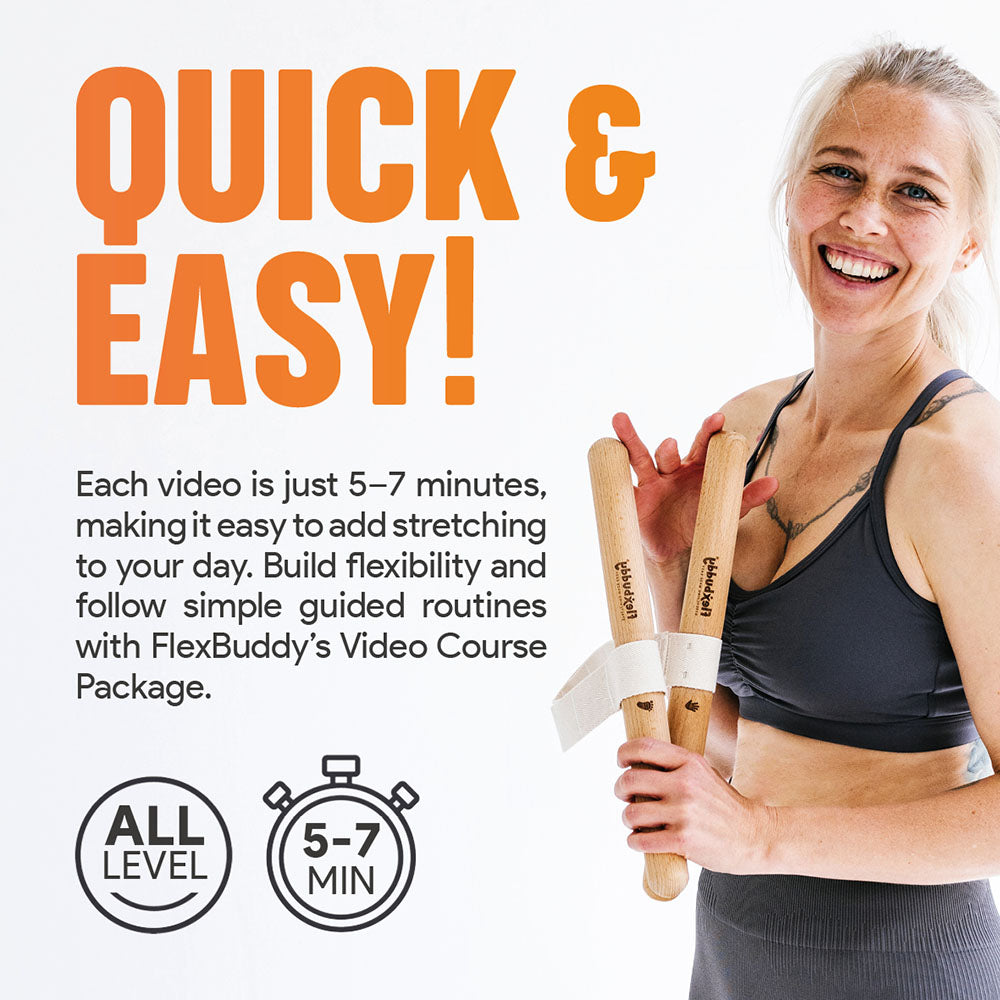
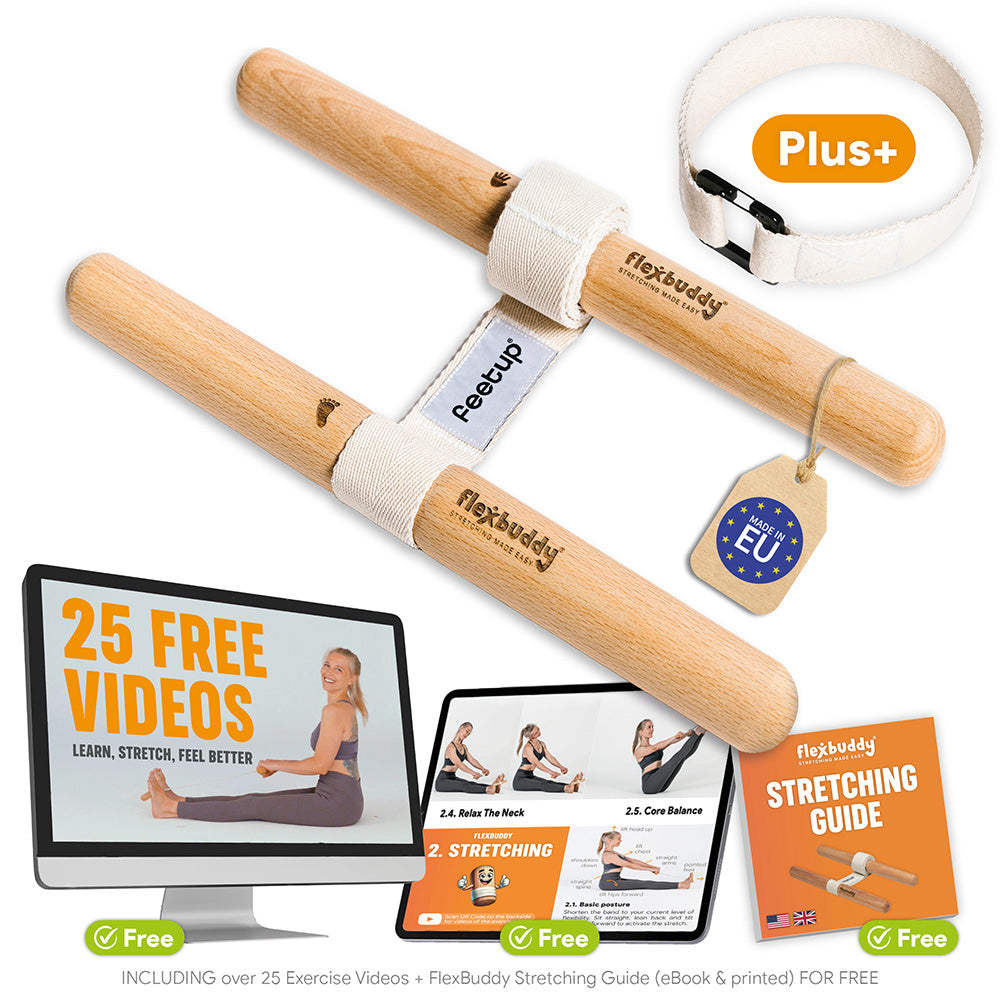
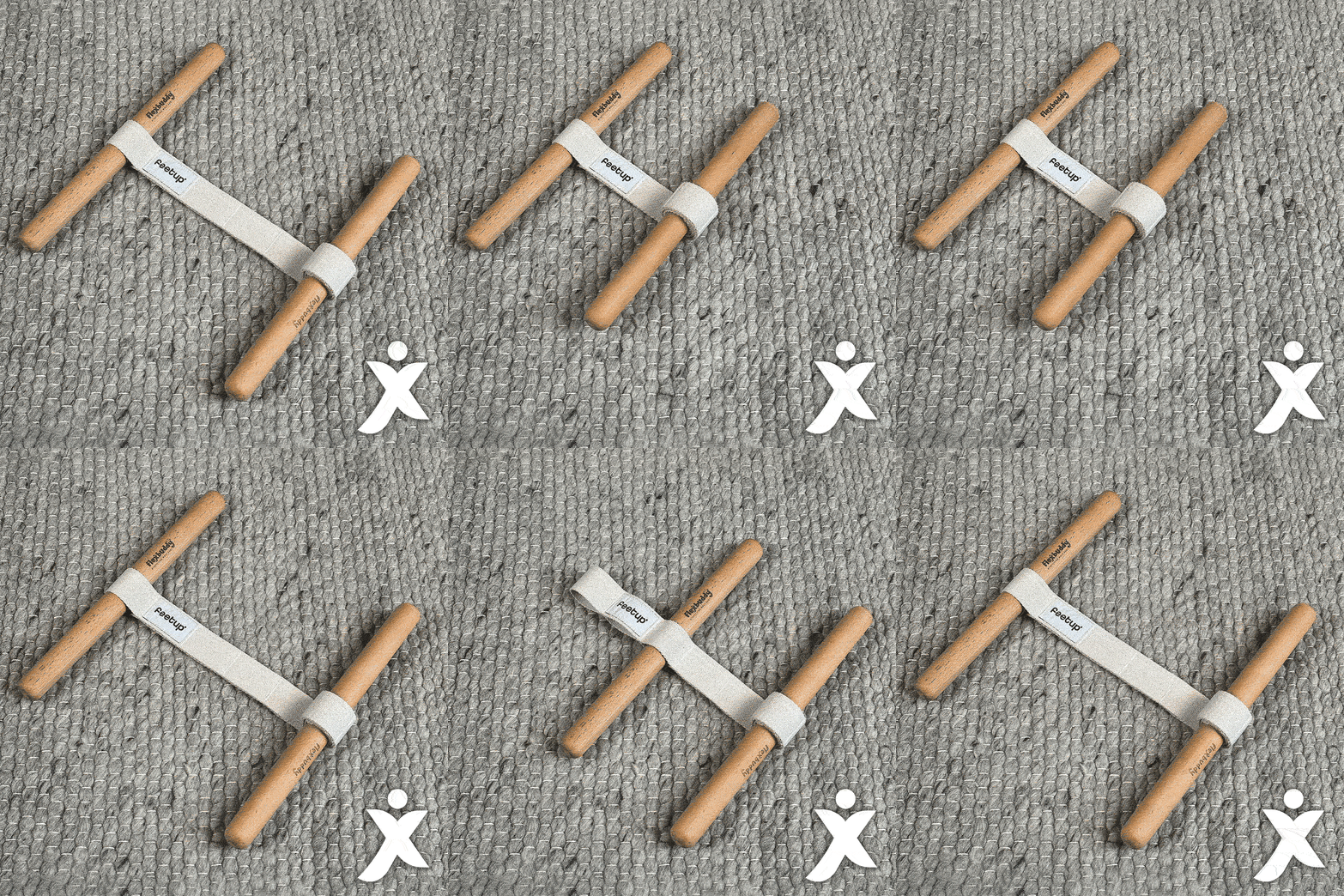
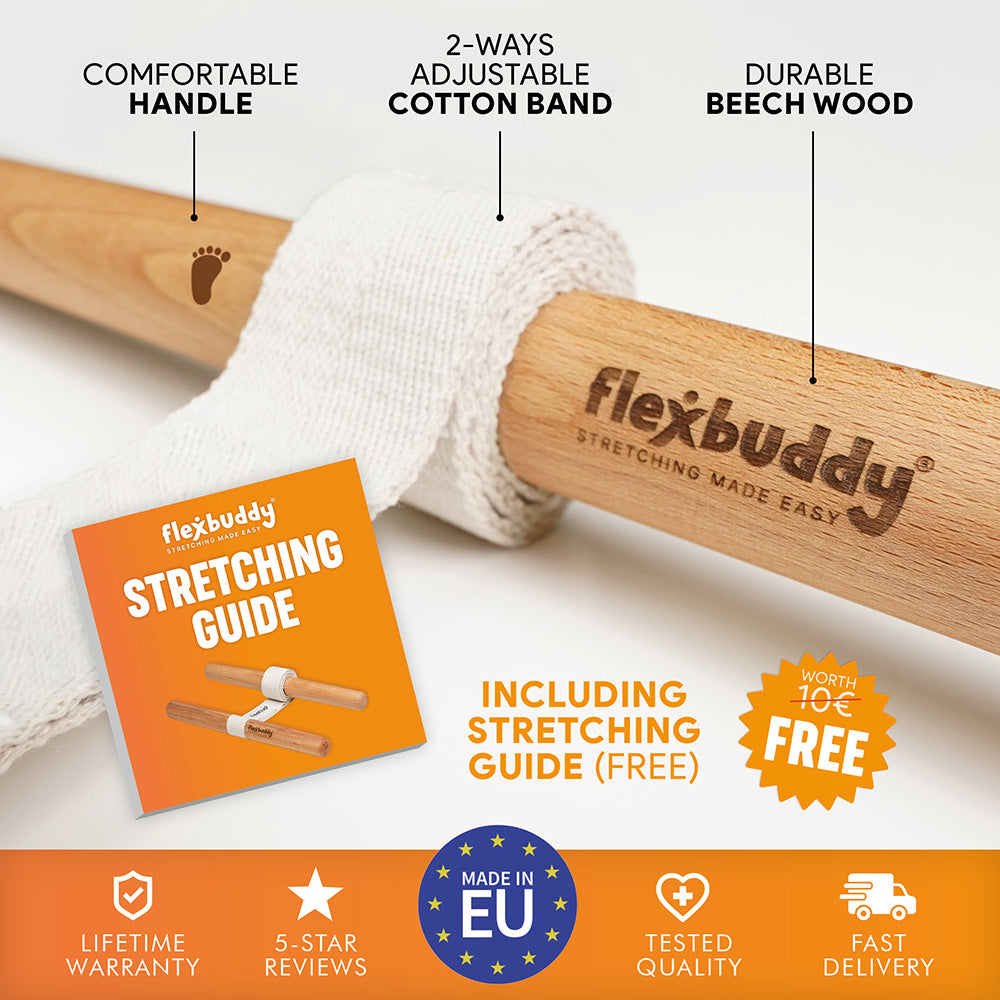
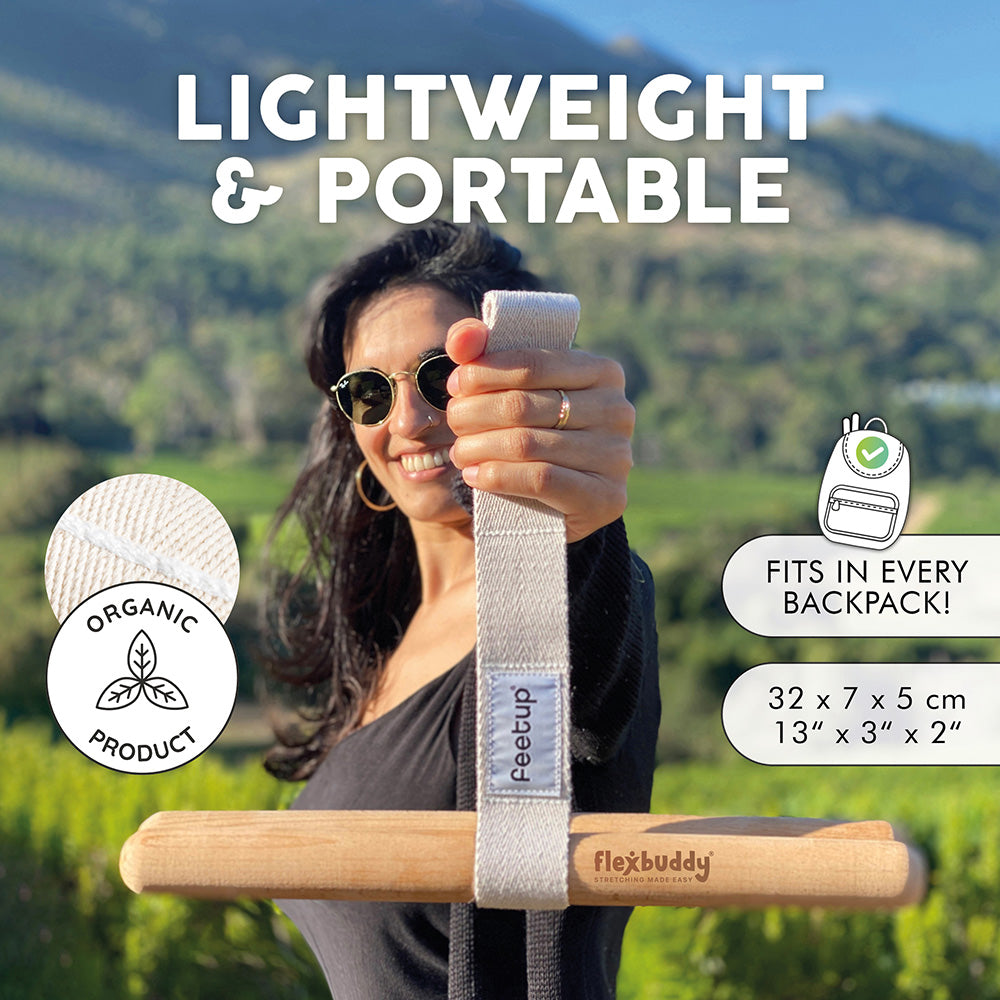
Everything in this article comes down to one position: a long spine folding at the hips while the legs stay straight. With your hands on your shins it is hard to hold, and a towel slips. FlexBuddy® solves that. It is a patented stretching device made of two beech-wood bars joined by an adjustable cotton strap. One bar goes under the soles of your feet, the other in your hands. You sit tall, tilt the hips forward, and the strap carries the pull, so your back never has to round to reach and your hamstrings and calves get the whole stretch. Move the foot bar to another loop for big steps, roll the strap around the hand bar for small ones: start long and shorten a loop a week. Comfortable wooden handles, no rope burn, one size for every body, and it fits in a bag.
Ten slow breaths, three times: about two minutes. Stephen W. wrote: "Sit at a desk 9 hours a day. My lower back used to ache every evening. Two weeks in, that's basically gone." Scott K., a trainer, wrote: "A great tool to help your clients maintain a neutral spine while stretching calves, hamstrings and lower back." FlexBuddy is rated 4.5 by verified buyers and comes with a 30-day money-back guarantee and a lifetime warranty, so you can try it without risk. Get your FlexBuddy, or take the two-minute quiz to find the routine for your kind of stiffness.
Frequently asked questions
Can tight hamstrings cause lower back pain?
The two go together, and loosening the hamstrings eases the back. A systematic review found reduced hamstring flexibility on several measures in people with low back pain [4], and a 2024 meta-analysis of 14 trials found that stretching the hamstrings reduced pain and improved function [5].
How long should I hold a hamstring stretch?
About 60 seconds of total stretch per muscle group per session, for example 15 seconds four times or 20 seconds three times, on at least two to three days a week [6][7]. Stretch to mild tightness, never pain. With FlexBuddy the routine is ten slow breaths, three times: about two minutes. The full dose by goal is in how long to hold a stretch.
Why are my hamstrings so tight even though I stretch?
Almost always it is technique, and that is easy to fix: you stretch with a rounded back so the hamstrings never reach their end range; you stretch too hard and the muscle guards; you stretch rarely; or the tightness is partly neural and needs a gentler approach. Straighten the back, ease off and do it daily. If you sit most of the day, the companion guide on lower back pain from sitting covers the hip-flexor side.
How long does it take to loosen tight hamstrings?
Days to feel it, weeks to measure it. The first gains come from your nervous system allowing more stretch rather than from longer fibres [9]. That is why a short daily habit works so fast.
Should I stretch tight hamstrings if I have sciatica?
Only gently, with a straight spine, without pain radiating down the leg, and ideally after a physiotherapist has checked you. Nerve-related tightness responds to nerve glides rather than long holds.
This article is general information, not medical advice. Tight muscles usually respond well to regular stretching. If your pain is sharp, radiates down a leg, comes with numbness, weakness, fever, bladder or bowel changes, follows an injury, or keeps getting worse, see a doctor or physiotherapist before you stretch.
References
- Jones O. Muscles of the Posterior Thigh: Hamstrings. TeachMeAnatomy. https://teachmeanatomy.info/lower-limb/muscles/thigh/hamstrings/ (accessed 4 Nov 2026).
- Hartvigsen J, Hancock MJ, Kongsted A, et al.; Lancet Low Back Pain Series Working Group. What low back pain is and why we need to pay attention. Lancet. 2018;391(10137):2356–2367. doi:10.1016/S0140-6736(18)30480-X
- Koes BW, van Tulder MW, Thomas S. Diagnosis and treatment of low back pain. BMJ. 2006;332(7555):1430–1434. doi:10.1136/bmj.332.7555.1430
- Hori M, Hasegawa H, Takasaki H. Comparisons of hamstring flexibility between individuals with and without low back pain: systematic review with meta-analysis. Physiother Theory Pract. 2021;37(5):559–582. doi:10.1080/09593985.2019.1639868
- Gou Y, Lei H, Chen X, Wang X. The effects of hamstring stretching exercises on pain intensity and function in low back pain patients: a systematic review with meta-analysis of randomized controlled trials. SAGE Open Med. 2024;12:20503121241252251. doi:10.1177/20503121241252251
- Garber CE, Blissmer B, Deschenes MR, et al.; American College of Sports Medicine. Position stand: quantity and quality of exercise for developing and maintaining cardiorespiratory, musculoskeletal, and neuromotor fitness in apparently healthy adults. Med Sci Sports Exerc. 2011;43(7):1334–1359. doi:10.1249/MSS.0b013e318213fefb
- Harvard Health Publishing. The ideal stretching routine. Harvard Medical School, 16 Mar 2026 (reviewed by H. E. LeWine, MD). https://www.health.harvard.edu/staying-healthy/the-ideal-stretching-routine (accessed 4 Nov 2026).
- Sihawong R, Janwantanakul P, Jiamjarasrangsi W. A prospective, cluster-randomized controlled trial of exercise program to prevent low back pain in office workers. Eur Spine J. 2014;23(4):786–793. doi:10.1007/s00586-014-3212-3
- Weppler CH, Magnusson SP. Increasing muscle extensibility: a matter of increasing length or modifying sensation? Phys Ther. 2010;90(3):438–449. doi:10.2522/ptj.20090012