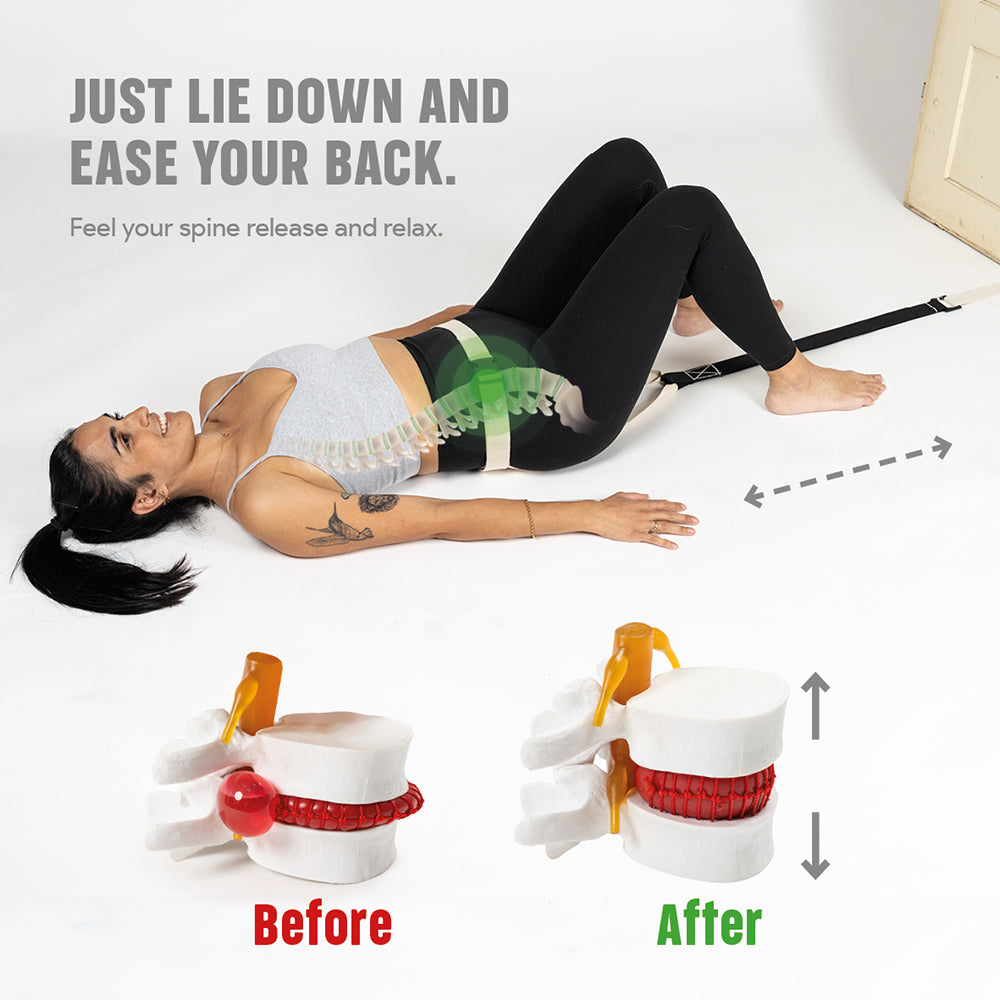
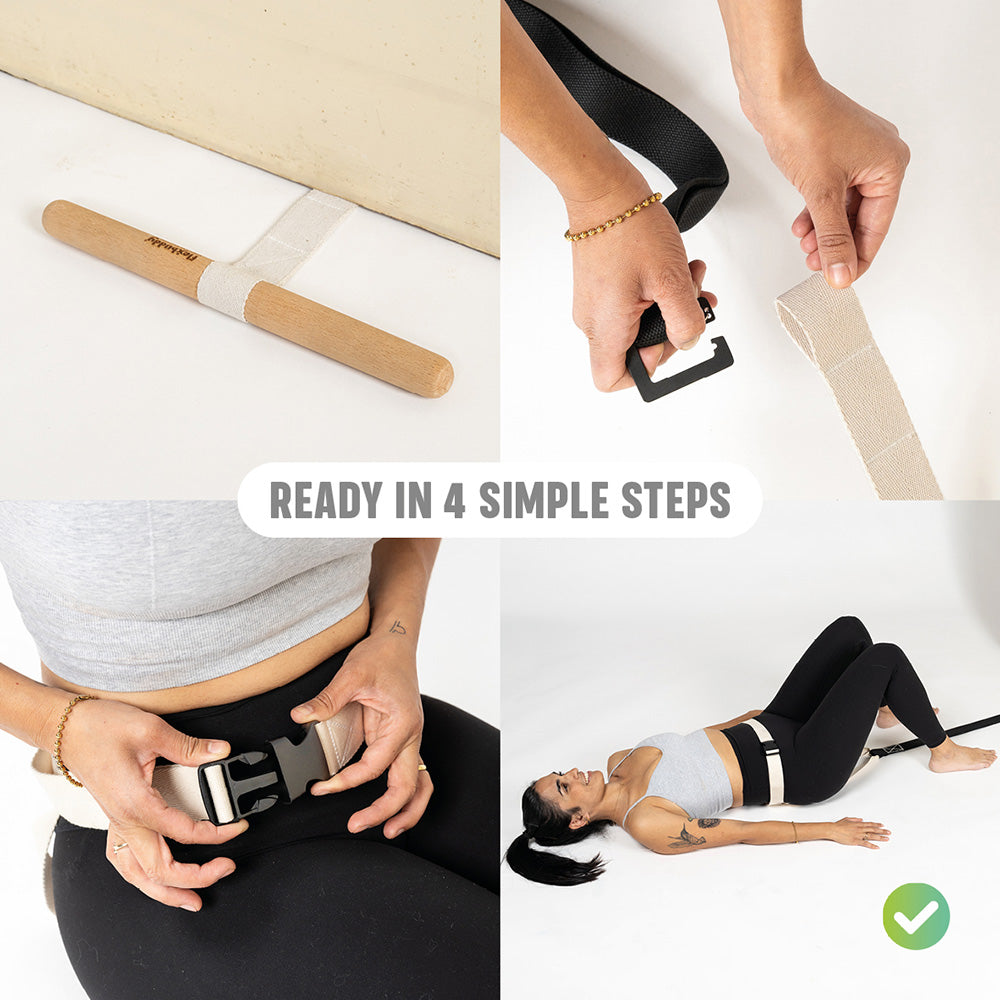
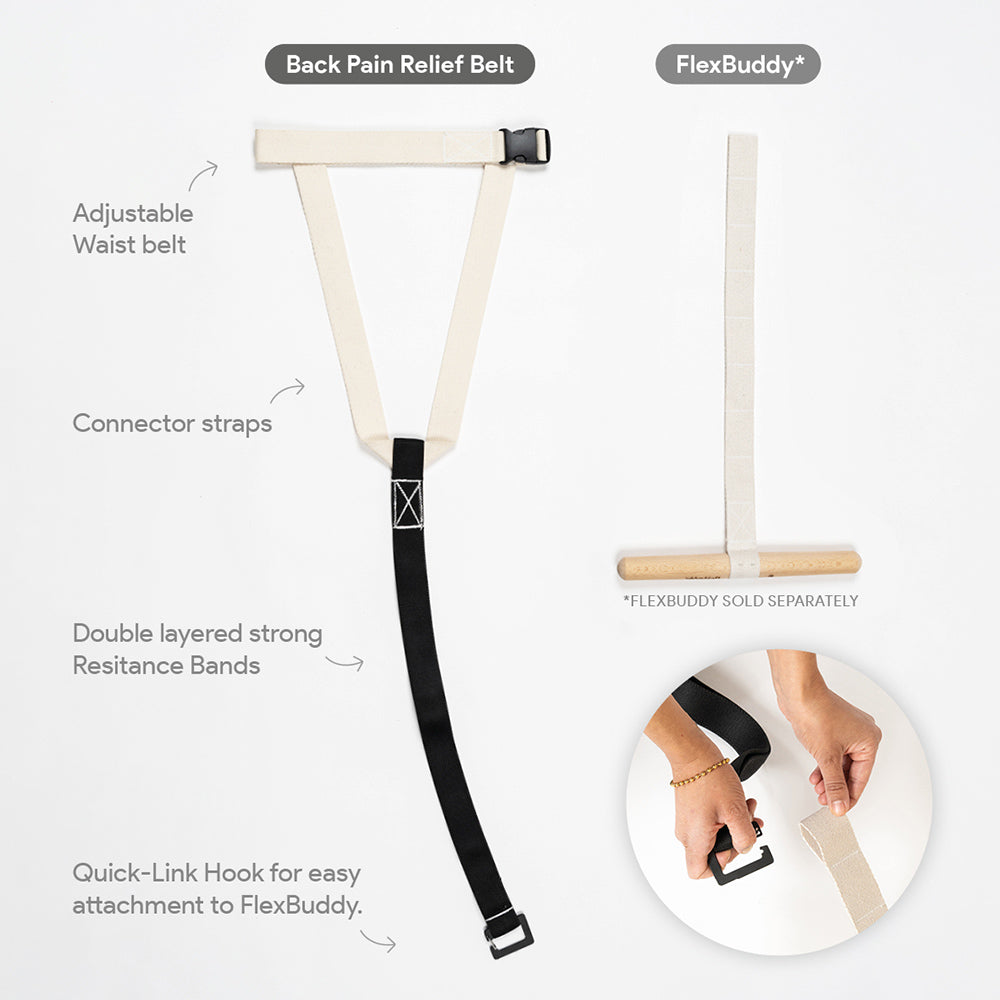
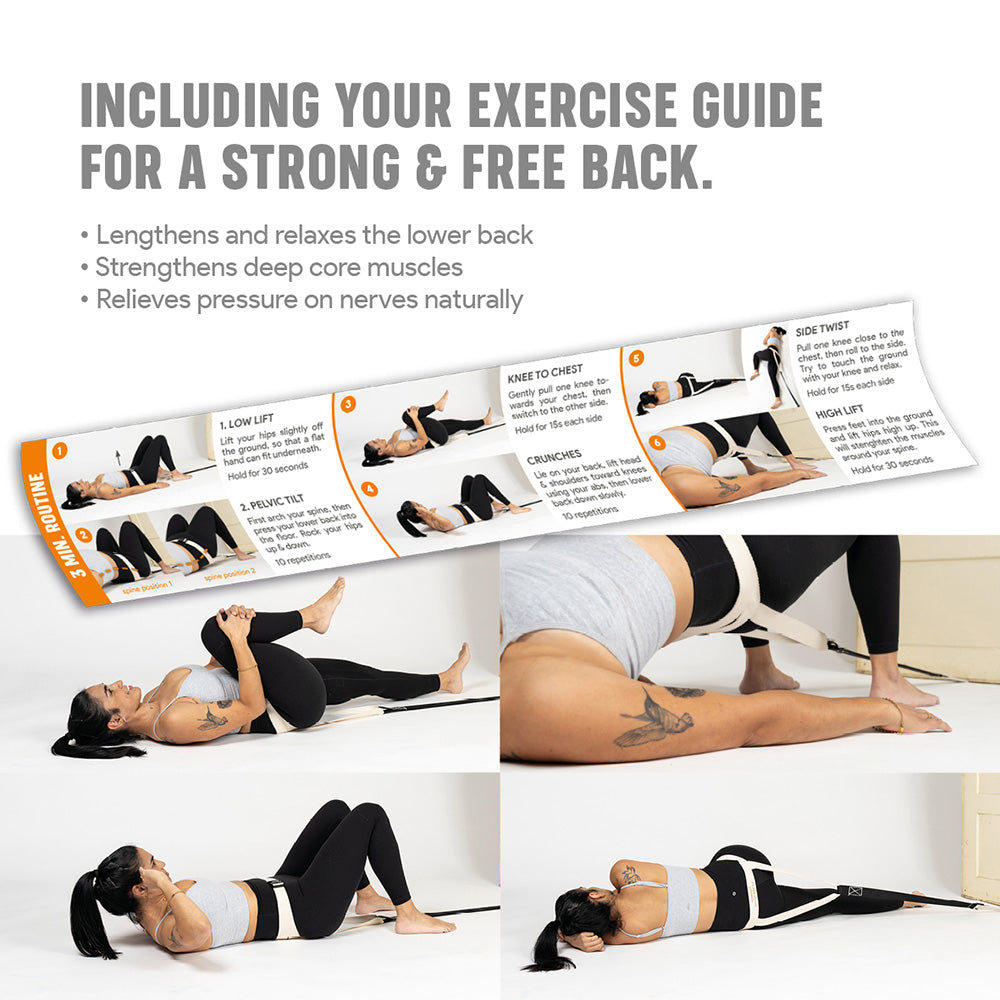
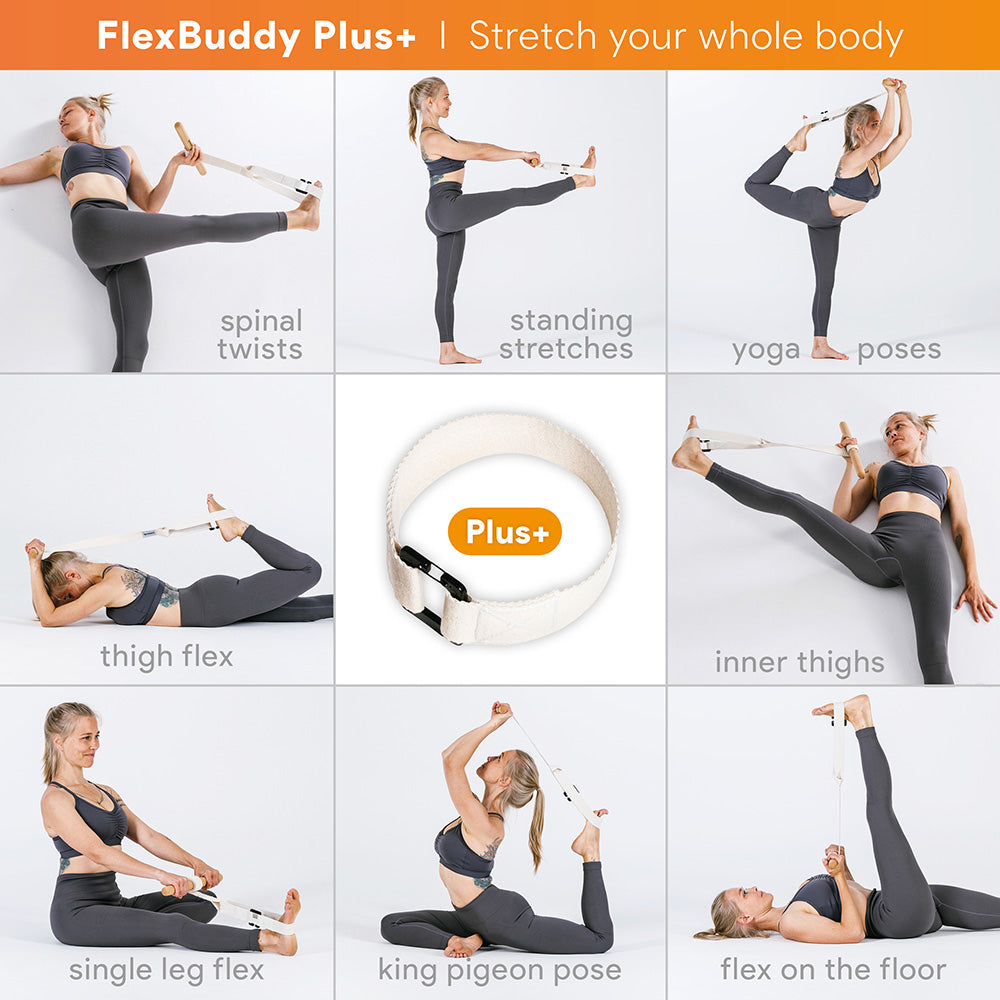
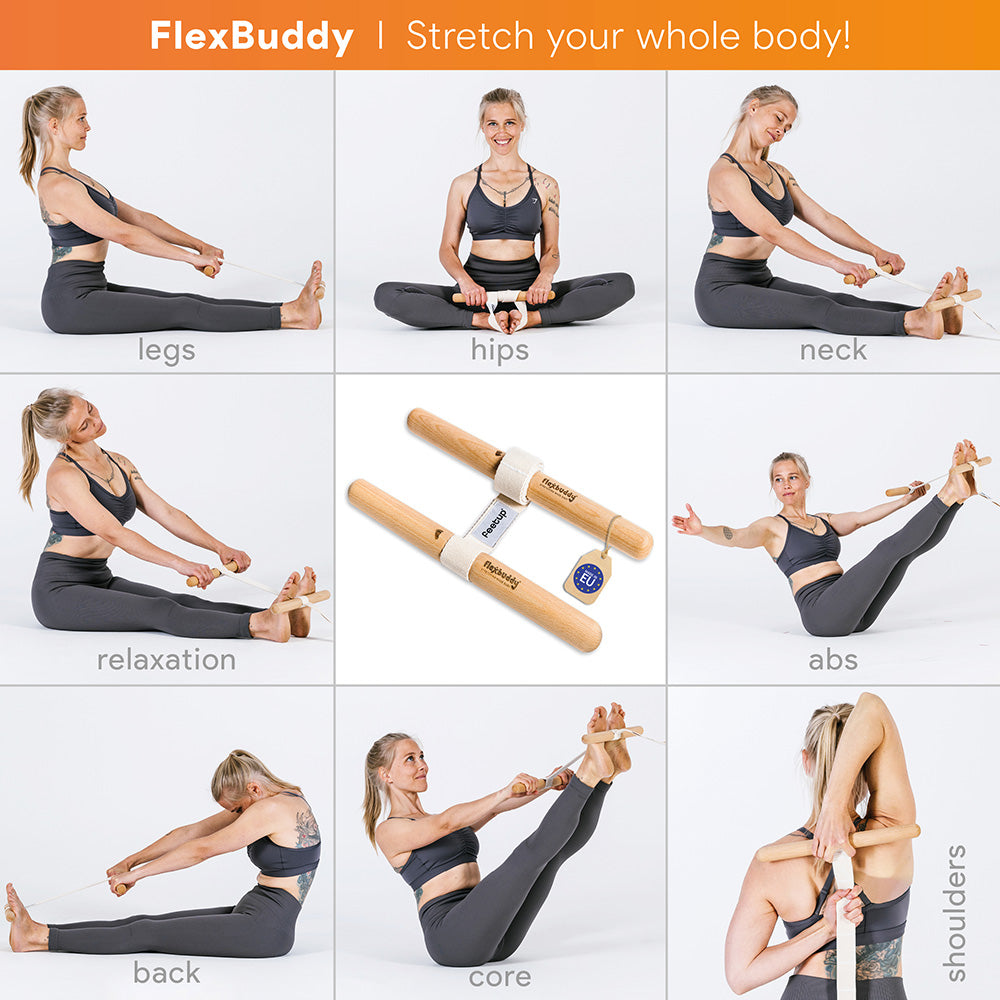
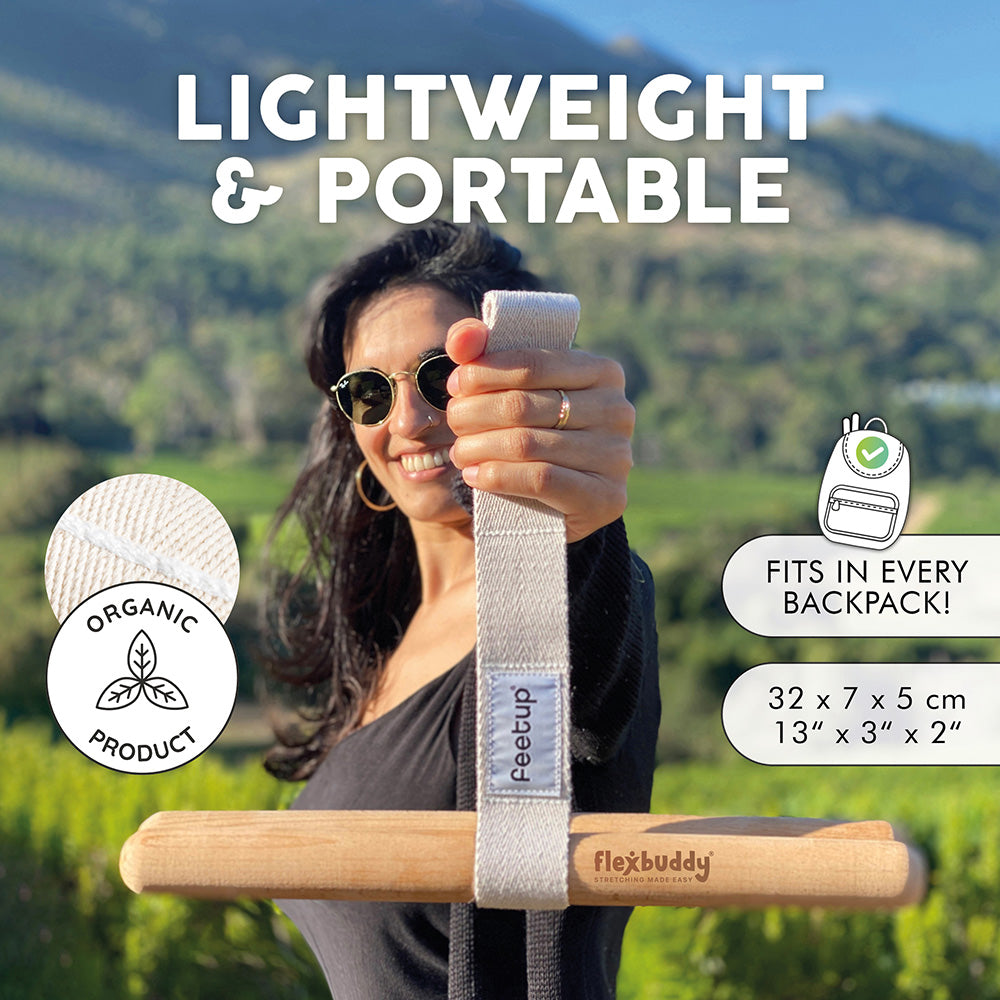
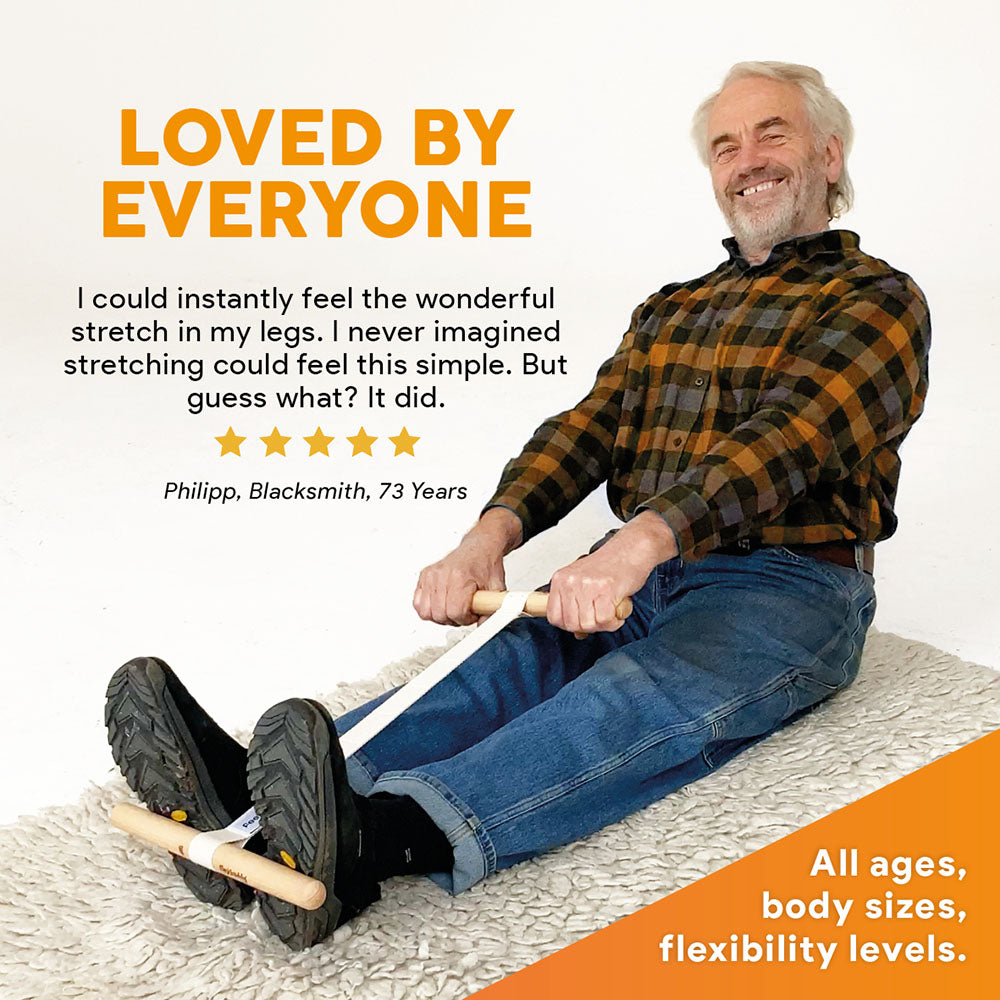
- Most back pain has nothing broken behind it. About nine in ten back pains have no structural cause a scan could find [1][2], and that is the kind that responds to gentle movement.
- Moving beats resting. The NHS advises people with back pain to keep moving and try stretches [3], and a Cochrane review found less pain and better function in people advised to stay active than in people advised to rest in bed [4].
- Hamstring stretching works. In clinical trials it reduced low back pain [5], and a systematic review found reduced hamstring flexibility in people with low back pain on several measures [6].
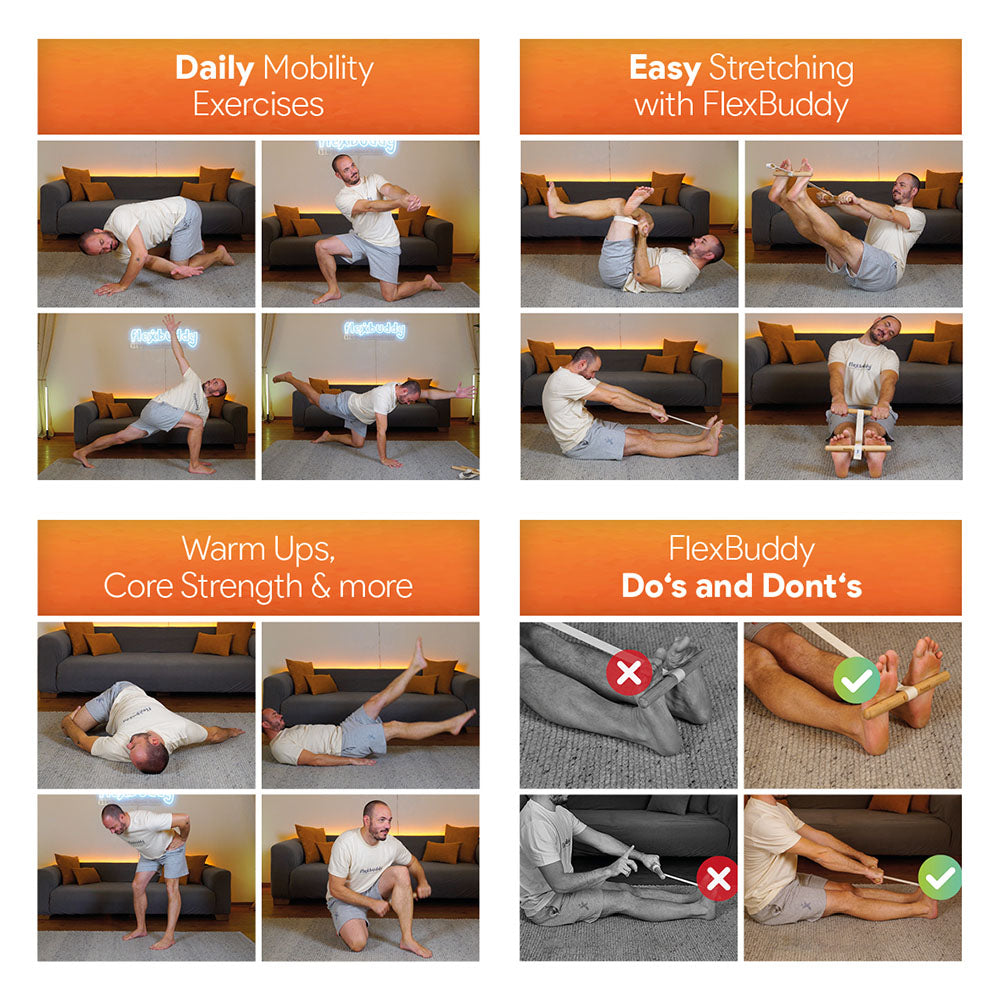
- Four FlexBuddy® exercises do the work: Basic Posture, Dynamic Rolling, Spinal Twist and Static Stretch. Hold each static position for 15 to 30 seconds, two to four times [7], which reaches the 60 seconds per exercise that the American College of Sports Medicine recommends [8].
- Six to eight minutes is all it takes. You will feel looser after the first session, and daily beats one long session a week.
- Red flags: pain that is sharp, runs down a leg, comes with numbness, weakness, fever or bladder and bowel changes, follows an accident, or keeps getting worse needs a doctor, not a stretch [3].
- FlexBuddy carries the pull for you. The strap and wooden handles keep your spine long, so your back can stop bracing and let go.
When your lower back feels stiff and tired, the instinct is either to do nothing (and stay stiff) or to attack it with aggressive stretching (and feel worse tomorrow). There is a better way: a few gentle, supported movements that ease everyday lower back stiffness in minutes, done at home, on a mat, no heroics required.
The research behind this routine is set out in full in does stretching help back pain?, and if your back mainly complains after long hours in a chair, read lower back pain from sitting as well.
Red flags first: when to see a doctor before you stretch
This routine is for the common, everyday kind of stiff and achy: the one that builds up from sitting, standing, or an ambitious weekend. A small minority of back pain is something else, and the NHS lists the signs [3].
| How urgent | Back pain together with | What to do |
|---|---|---|
| Emergency | Pain, tingling, weakness or numbness in both legs; loss of feeling around the genitals or anus; difficulty passing urine, or loss of bladder or bowel control; chest pain; pain that started after a serious accident | Call the emergency number or go to an emergency department [3] |
| Urgent, same day | Feeling hot, shivery or generally unwell; severe pain that starts suddenly or gets worse quickly | Ask for an urgent doctor's appointment [3] |
| Soon | No improvement after a few weeks of self-care; pain that stops your daily activities; weight loss without trying; a lump, swelling or change of shape in the back; pain that does not ease with rest or is worse at night; pain that is worse when you cough or sneeze | See your doctor [3] |
| Before stretching | Pain running down one leg, pins and needles, a diagnosed disc herniation, recent surgery, pregnancy | Ask a doctor or physiotherapist first |
Two of these have their own guides, because the movements and the limits are different: stretching with sciatica and stretching with a herniated disc. Stretching is not a substitute for getting checked. If no row describes you, you are in the large majority, and the rest of this page is for you.
Why your lower back feels like this
For nearly all people who have low back pain, no specific cause in the spine can be identified [1]. In general practice about 90% of patients have what doctors call non-specific low back pain: no fracture, tumour, infection or trapped nerve root behind it [2]. Non-specific does not mean imaginary. It means the pain reflects how the back is used, loaded and protected, not a lesion that needs repairing. And that is something you can change.
The lower back is the diplomatic middle child of your body: when the hips below or the mid-back above stop doing their jobs, the lumbar spine compromises on behalf of everyone. Sitting keeps your hips flexed and your hamstrings (the three muscles on the back of each thigh) in a shortened position. When you then bend, the pelvis cannot tip forward freely and the lower back rounds extra to make up the distance. Meanwhile the thoracic spine, your mid-back, goes quiet after years of facing a screen, so twisting and reaching also get billed to the lumbar area.
Add long hours in one position and you get the familiar end-of-day result: a back that feels older than you are.
A systematic review found reduced hamstring flexibility in people with low back pain on several measures [6]. A sore back can also make the hamstrings tighten protectively, so the two feed each other, which is why freeing the hamstrings is such a good place to start. The anatomy and a self-test are in our guide to tight hamstrings and the lower back.
The routine below moves the spine gently through comfortable ranges and frees the hips and mid-back, so the lower back can stop overworking.
What the research says: gentle stretching eases a sore back
Movement beats rest
Clinical guidelines agree on the first line of care: education that supports self-management, a return to normal activities, and exercise [9]. For a new episode of back pain, a Cochrane review found that people advised to stay active had less pain and better function than people advised to rest in bed [4]. For pain lasting more than 12 weeks, another Cochrane review of 249 randomised trials found that exercise reduced pain by about 15 points on a 0 to 100 scale compared with no treatment, usual care or placebo, with mostly minor side effects such as muscle soreness [10].
Stretching the hamstrings reduced back pain in trials
A 2024 meta-analysis combined 14 randomised trials of people with low back pain. Hamstring stretching lowered their pain scores and improved their function scores [5]. In a separate trial of adults with chronic low back pain, 12 weekly stretching classes did as well as 12 weekly yoga classes [11]. FlexBuddy exists to make that stretch easy to do with a straight back.
The relief is your nervous system letting go
A review of the stretching research concluded that the extra range seen after a single session, and after programmes of three to eight weeks, is best explained by a change in sensation: the nervous system tolerating more stretch before it signals "stop" [12]. Good news for a guarded back: it needs calm, repeated signals that movement is safe, not force, and a supported stretch gives it exactly that.
How long to hold, how many times, how often
A clinical review of muscle stretching recommends holding each static stretch for 15 to 30 seconds and repeating it two to four times [7]. The American College of Sports Medicine's position stand adds the weekly dose: flexibility exercises totalling about 60 seconds per exercise, on at least two days a week [8].
- Mild tension only. Stop at a clear but comfortable pull.
- Breathe slowly. Ten deep breaths take roughly 30 seconds, so count breaths and forget the clock.
- Older adults can hold longer. In adults over 65, 60-second holds improved hamstring flexibility more than shorter ones [7].
The trials behind these numbers are in how long to hold a stretch.
The at-home routine at a glance
Four FlexBuddy exercises in the order that suits a stiff back: support first, movement second, rotation third, the long hold last. You need a mat and FlexBuddy; a belt or a rolled towel around the feet will do for a first try.
| Exercise | Targets | Hold or reps | Sets | Best for |
|---|---|---|---|---|
| 1. Basic Posture | Whole back, posture | 10 deep breaths (about 30 s) | 2 | Decompression, easing in |
| 2. Dynamic Rolling | Spine, hips, hamstrings | 3 slow rolls | 2 to 3 | A back that feels "stuck" |
| 3. Spinal Twist | Mid-back rotation | 15 to 30 s per side (3 to 5 slow breaths) | 2 per side | Unloading the lumbar area |
| 4. Static Stretch | Hamstrings | 15 to 30 s (up to 10 deep breaths) | 2 to 4 | Freeing the pelvis from below |
Do the routine daily if you can, and on at least two days a week if you cannot [8].
1. Basic Posture
Start here. It is the gentlest thing on this list and it feels good immediately.
How to do it with FlexBuddy:
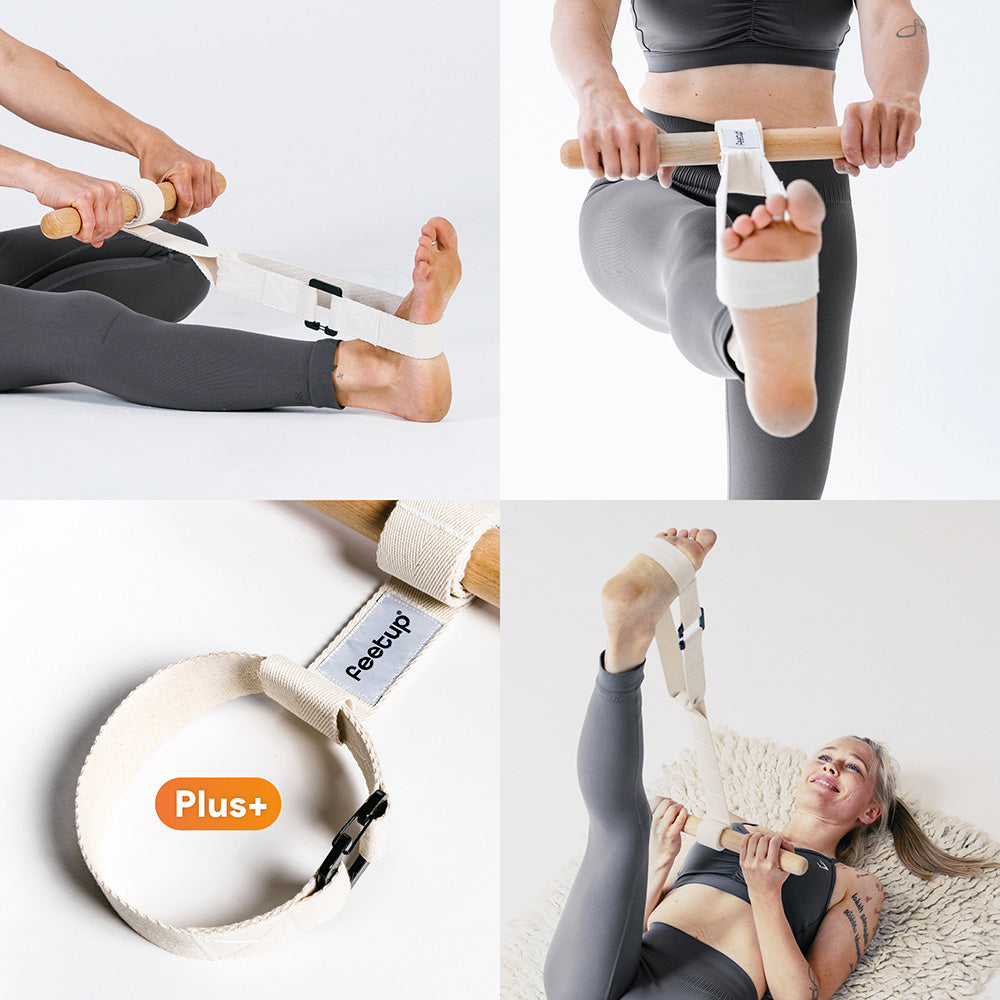
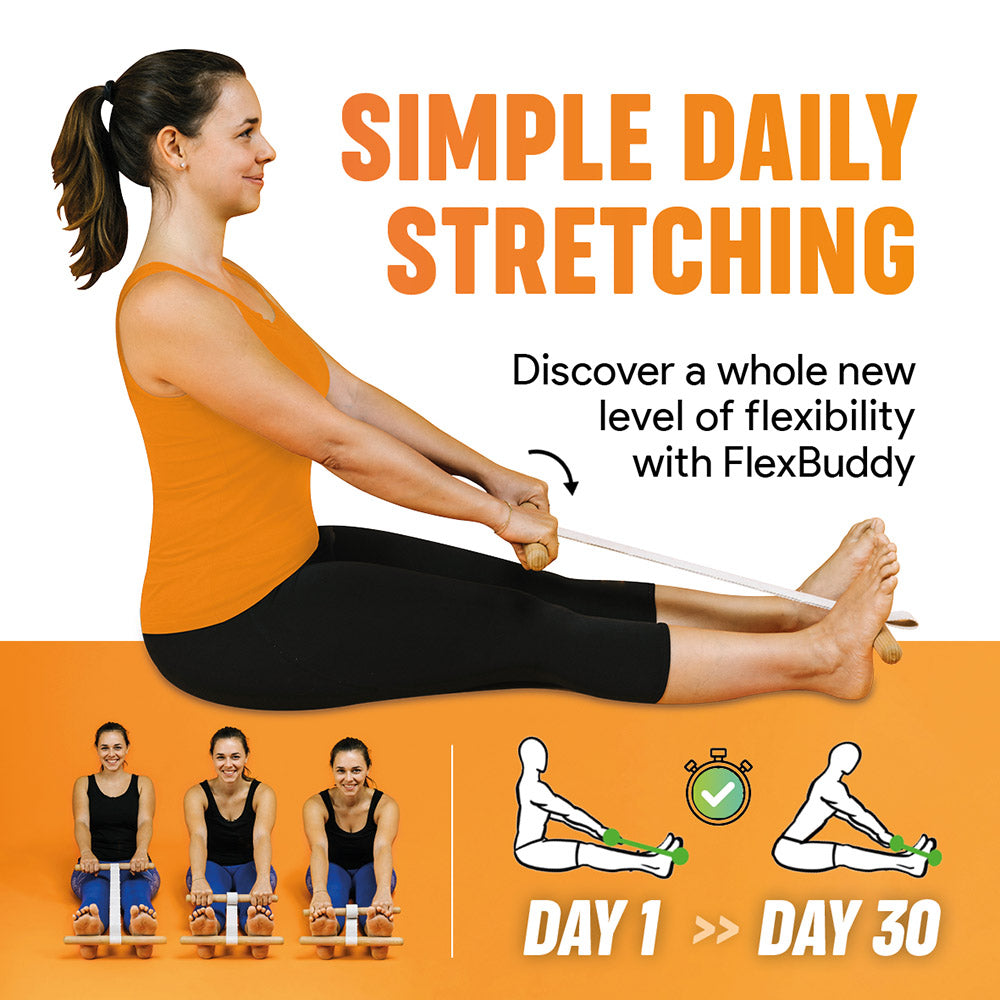
- Set the strap to the flexibility you have today, not the one you would like. Sit on the floor, knees slightly bent, with the foot bar under the soles of both feet.
- Hold the hand bar in both hands and let your arms straighten so the strap takes some of your weight.
- Lean back slightly into the support, tilt your hips forward, lift your chest, and let your spine find its natural length. Shoulders down, head up.
- Stay for ten deep breaths, about 30 seconds, shoulders soft. Rest, then repeat once.
What you will feel: decompression more than stretch, a tall, supported, unclenching feeling through the whole back.
Why it helps: after hours folded into one shape, the back's first need is a safe, supported position where the muscles can stop bracing. The counter-tension through the handles lets you lengthen without effort.
Beginner tip: if your back is having a cranky day, you are allowed to do only this exercise and call it a session.
2. Dynamic Rolling
The "oil the hinges" exercise: slow, controlled movement, with the strap holding you the whole way.
How to do it with FlexBuddy:
- From the Basic Posture position, keep light tension on the handles.
- Exhale and roll forward from the hips, only as far as your spine stays long.
- Inhale and roll back to tall, letting the strap control the return. Smooth, unhurried, no momentum.
- Do three slow rolls, rest for a few breaths, and repeat once or twice.
What you will feel: movement, warmth, a sense of "unsticking" through the hips and along the spine, and a pull in the back of the thighs that grows a little with each roll. Nothing sharp at any single point.
Why it helps: stiff backs love slow, controlled motion through comfortable ranges. Movement, not force, is what eases that locked-up feeling. The handles are what make this controlled: you are never falling forward or backward, just moving by choice.
Common mistake: speeding up. If one direction takes less than a full breath, it is too fast.
3. Spinal Twist
How to do it with FlexBuddy:
- Seated with the foot bar under your feet, hold the hand bar in one hand.
- Inhale to sit tall, exhale and rotate your torso to the free side, with the other hand on the floor behind you.
- Turn from the ribcage and keep both sitting bones grounded.
- Hold for 15 to 30 seconds, three to five slow breaths, then change sides. Twice per side.
What you will feel: rotation through the mid-back, a light opening across the chest and no cranking sensation in the lower back.
Why it helps: when the thoracic spine rotates properly, the lumbar spine gets to retire from a job it is bad at. There is more in thoracic spine mobility.
Beginner tip: think "tall, then turn". Height first, rotation second. Never trade one for the other.
4. Static Stretch
This is the hamstring stretch, the one that reduced back pain in the trials [5], done the way that keeps the lower back out of it.
How to do it with FlexBuddy:
- Extend both legs, foot bar under your feet, hand bar in both hands. Shorten the strap by one loop, or roll one turn onto the hand bar.
- Inhale and lengthen your spine. Exhale, tilt the hips forward and hinge from the hips with long arms.
- Stop at mild tension in the hamstrings, not the back, and stay for 15 to 30 seconds, breathing slowly. Ten deep breaths is about right.
- Rest for about 30 seconds and repeat, two to four holds in all.
What you will feel: the stretch along the back of the thighs. If your lower back is what is talking, you have rounded: rise a little, re-lengthen, try a smaller hinge or a longer strap.
Why it helps: short hamstrings restrict the pelvis, and a restricted pelvis sends its workload upstairs.
Common mistake: treating this as a toe-touching contest. The handles exist so you do not have to reach. Use them.
On a bad day, or in bed: the two-minute version
Some days the floor feels a long way down. Two stretches can be done lying on your bed, which is also a kind way to start a stiff morning.
| Stretch | Position | Hold | Reps |
|---|---|---|---|
| Single knee to chest | On your back, knees bent; draw one knee towards your chest, hands behind the thigh | 15 to 30 s | 2 per side |
| Lying hamstring stretch | On your back, one knee bent; raise the other leg with FlexBuddy, a strap or a belt under the foot, lower back resting on the bed | 15 to 30 s | 2 per side |
A full lying-down sequence is in stretches you can do in bed.
What to expect, week by week
After one session: you will feel looser straight away. That is the change in sensation described above [12], and it is the first sign the routine is working.
In the first weeks: most back pain improves within a few weeks [3], and about 90% of patients have stopped consulting their doctor within three months [2]. The routine keeps you moving right through that period.
After three to eight weeks of regular practice: this is the length of the programmes in which stretching research measures lasting gains in range [12]. Bending, reaching and getting out of a chair all feel easier.
Over the year: this is where the habit pays off. Back pain tends to come back: one estimate puts the risk of a recurrence within 12 months at 73% [2]. In a 12-month trial of office workers with lower-than-normal trunk flexibility or endurance, daily stretching combined with twice-weekly trunk endurance exercises cut new episodes of low back pain from 19.7% to 8.8% [13]. Add bridges, bird dogs or side planks twice a week and you have copied that trial's design.
Mistakes that make a sore back feel worse
- Rounding to reach. Folding forward with a curled lower back loads the part that hurts in order to stretch the part that does not. Keep the spine long and hinge at the hips. If bending is your trigger, see back pain when bending forward.
- Pushing into pain. A pull is fine. Sharp, pinching or electric sensations mean stop.
- Stretching a nerve like a muscle. A burning line down the leg, tingling or numbness means back off and get it assessed.
- Carrying on when it is getting worse. Next-day soreness in the hamstrings or hips is normal. A back that is worse after each session for more than a week needs a physiotherapist.
Building the habit (the part that actually matters)
This routine works through repetition, not intensity. Anchor it: after you close the laptop, before your shower, while the kettle boils. Keep FlexBuddy visible. And on bad days, shrink the session instead of skipping it: one minute of Basic Posture maintains the habit, and the habit is the asset. Give it a week and it becomes the part of the day your back looks forward to.
Desk job? The companion piece to this routine is our stretching guide for people who sit all day, which adds the neck, shoulders and hips. If you would sooner follow along than read, the free exercise videos show each movement, and the FlexBuddy Video Course has full guided routines.

Do it properly with FlexBuddy
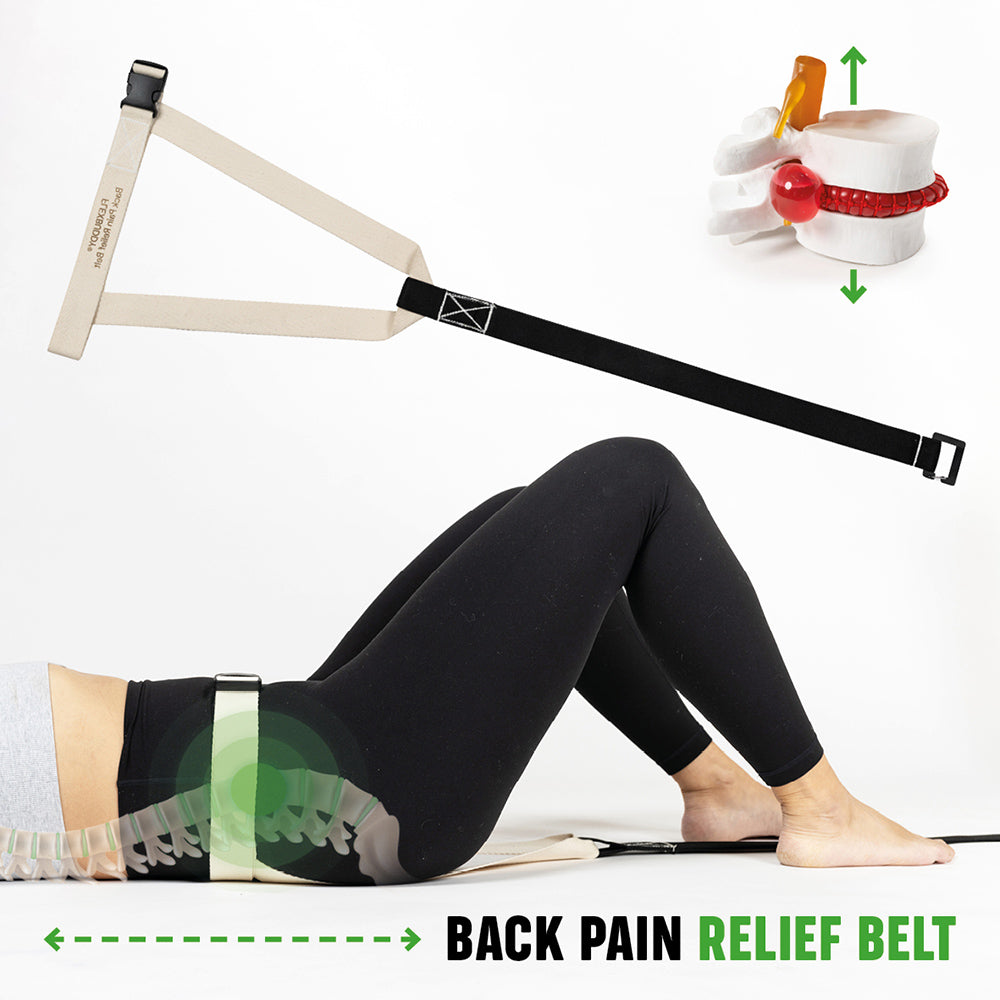
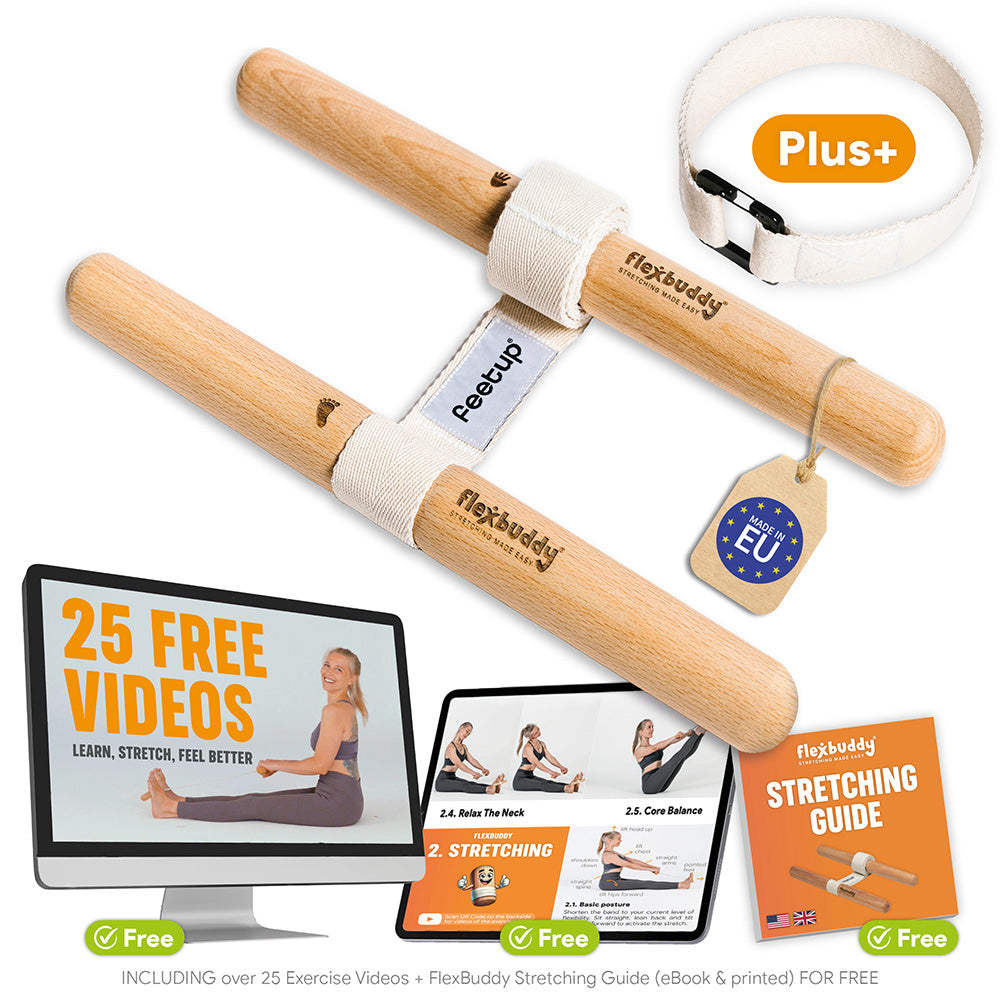
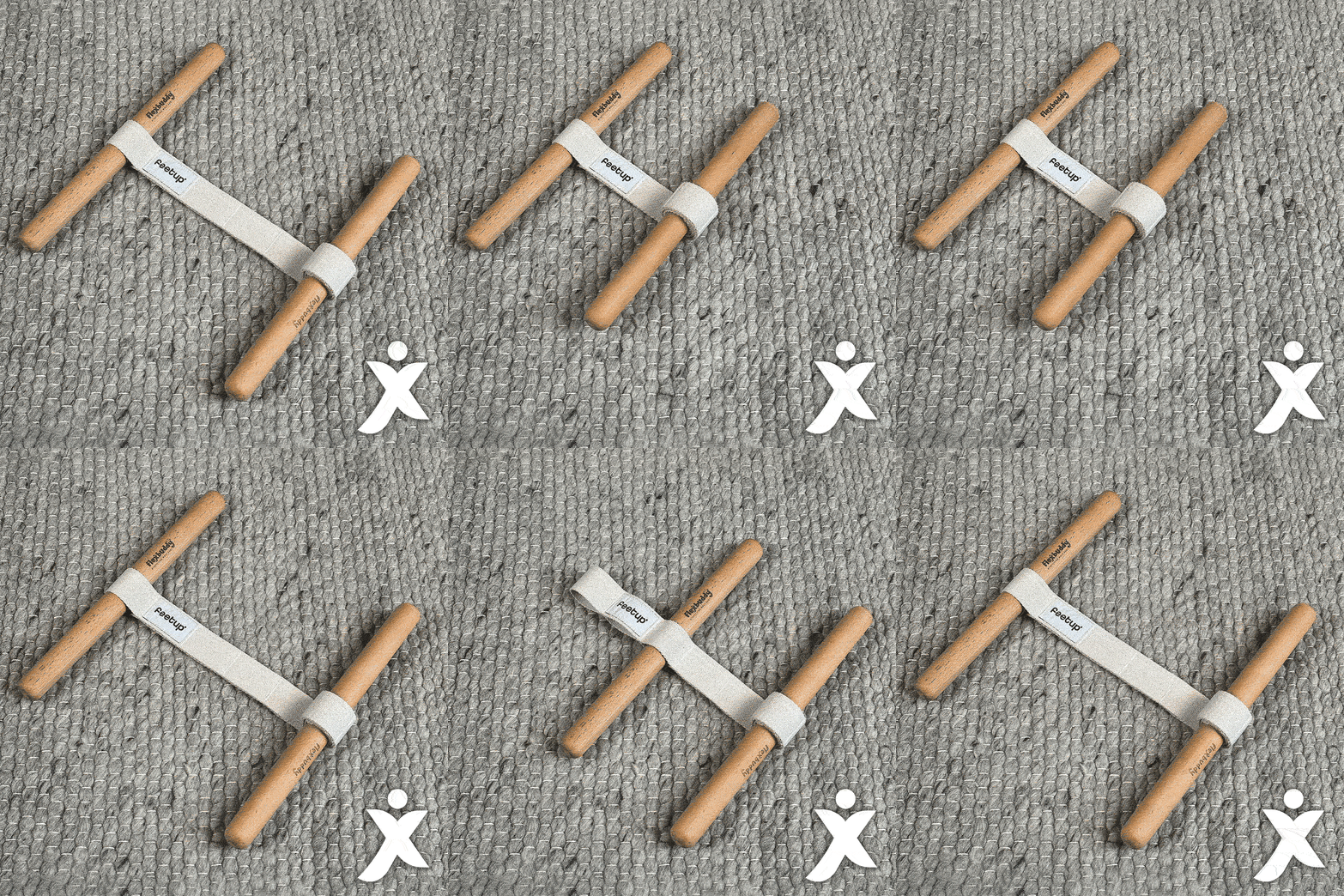
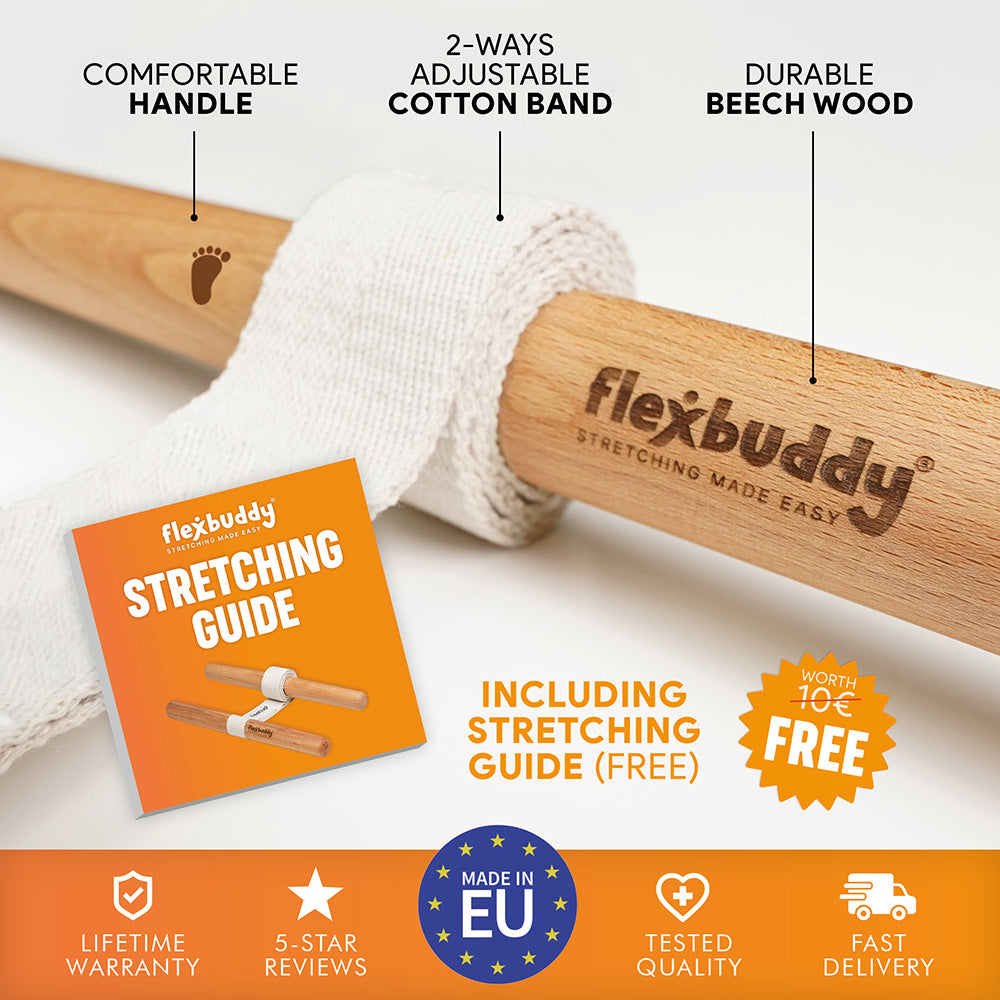
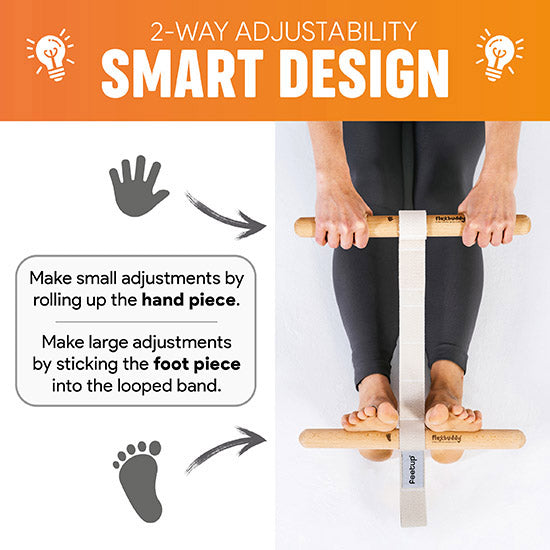
When your back already feels fragile, stretching without support can feel risky, so most people simply do not do it. FlexBuddy® changes that. It is a patented stretching device made of two beech-wood bars joined by an adjustable cotton strap. One bar goes under your feet, the other in your hands. You sit tall, lean back and tilt the hips, and the strap carries the pull, so your spine stays long and the stretch lands in your legs. You choose every depth: move the foot bar to another loop for big changes, roll the strap round the hand bar for small ones, and ease off by simply relaxing. Comfortable wooden handles, no rope burn, one size for every body.
Stephen W. wrote: "Sit at a desk 9 hours a day. My lower back used to ache every evening. Two weeks in, that's basically gone." Two minutes a day can improve your flexibility and posture. FlexBuddy is rated 4.5 by verified buyers and comes with a 30-day money-back guarantee and a lifetime warranty, so you can try it without risk. Get your FlexBuddy, or take the two-minute quiz to find the routine for your kind of stiffness.
Frequently asked questions
What are the best lower back pain stretches to do at home?
Four gentle movements: a supported seated posture, slow rolling through the hips and spine, a gentle mid-back twist and a straight-backed hamstring stretch. The hamstring stretch is the star: across 14 randomised trials it reduced low back pain and improved function [5]. FlexBuddy supports your spine through all four.
Are there stretches for lower back pain that feel better immediately?
Yes. Basic Posture and a single knee to chest usually ease stiffness within a minute or two. Your nervous system lets go and tolerates more stretch from the first session [12]. Keep going daily and it lasts longer each week.
How often should I do this routine?
Daily or near-daily, in short sessions. The guideline minimum is about 60 seconds per exercise on at least two days a week [8].
Should I stretch if my back hurts right now?
For everyday stiffness, yes: gentle movement in comfortable ranges is encouraged, and long periods in bed are not [3]. But sharp pain, numbness, tingling, pain radiating down a leg, or pain that is not improving means see a health professional before stretching.
Can I do lower back pain stretches in bed?
Yes. A single knee to chest and a lying hamstring stretch with FlexBuddy or a strap work well on a mattress, with 15 to 30 second holds, twice per side [7]. The seated exercises need a firmer surface.
Can these stretches cure my back pain?
They can make an everyday stiff back feel much better. A consistent gentle routine eases stiffness, supports better mobility and makes your back feel less locked-up, and in trials hamstring stretching reduced low back pain [5]. No stretch or tool is a medical cure, so if pain persists, see a doctor.
This article is general information, not medical advice. Tight muscles usually respond well to regular stretching. If your pain is sharp, radiates down a leg, comes with numbness, weakness, fever, bladder or bowel changes, follows an injury, or keeps getting worse, see a doctor or physiotherapist before you stretch.
References
- Hartvigsen J, Hancock MJ, Kongsted A, et al.; Lancet Low Back Pain Series Working Group. What low back pain is and why we need to pay attention. Lancet. 2018;391(10137):2356–2367. doi:10.1016/S0140-6736(18)30480-X. PMID 29573870 (abstract verified on PubMed, 14 Nov 2026).
- Koes BW, van Tulder MW, Thomas S. Diagnosis and treatment of low back pain. BMJ. 2006;332(7555):1430–1434. doi:10.1136/bmj.332.7555.1430. PMID 16777886; PMC1479671. https://pmc.ncbi.nlm.nih.gov/articles/PMC1479671/ (full text accessed 14 Nov 2026).
- NHS. Back pain. Page last reviewed 5 March 2026. https://www.nhs.uk/conditions/back-pain/ (accessed 14 Nov 2026).
- Dahm KT, Brurberg KG, Jamtvedt G, Hagen KB. Advice to rest in bed versus advice to stay active for acute low-back pain and sciatica. Cochrane Database Syst Rev. 2010;(6):CD007612. doi:10.1002/14651858.CD007612.pub2. PMID 20556780 (abstract verified on PubMed, 14 Nov 2026).
- Gou Y, Lei H, Chen X, Wang X. The effects of hamstring stretching exercises on pain intensity and function in low back pain patients: a systematic review with meta-analysis of randomized controlled trials. SAGE Open Med. 2024;12:20503121241252251. doi:10.1177/20503121241252251. PMID 39086556; PMC11289822 (abstract verified on PubMed, 14 Nov 2026).
- Hori M, Hasegawa H, Takasaki H. Comparisons of hamstring flexibility between individuals with and without low back pain: systematic review with meta-analysis. Physiother Theory Pract. 2021;37(5):559–582. doi:10.1080/09593985.2019.1639868. PMID 31317831 (abstract verified on PubMed, 14 Nov 2026).
- Page P. Current concepts in muscle stretching for exercise and rehabilitation. Int J Sports Phys Ther. 2012;7(1):109–119. PMID 22319684; PMC3273886. https://pmc.ncbi.nlm.nih.gov/articles/PMC3273886/ (full text accessed 14 Nov 2026).
- Garber CE, Blissmer B, Deschenes MR, et al.; American College of Sports Medicine. Position stand: quantity and quality of exercise for developing and maintaining cardiorespiratory, musculoskeletal, and neuromotor fitness in apparently healthy adults: guidance for prescribing exercise. Med Sci Sports Exerc. 2011;43(7):1334–1359. doi:10.1249/MSS.0b013e318213fefb. PMID 21694556 (abstract verified on PubMed, 14 Nov 2026).
- Foster NE, Anema JR, Cherkin D, et al.; Lancet Low Back Pain Series Working Group. Prevention and treatment of low back pain: evidence, challenges, and promising directions. Lancet. 2018;391(10137):2368–2383. doi:10.1016/S0140-6736(18)30489-6. PMID 29573872 (abstract verified on PubMed, 14 Nov 2026).
- Hayden JA, Ellis J, Ogilvie R, Malmivaara A, van Tulder MW. Exercise therapy for chronic low back pain. Cochrane Database Syst Rev. 2021;9(9):CD009790. doi:10.1002/14651858.CD009790.pub2. PMID 34580864; PMC8477273 (abstract verified on PubMed, 14 Nov 2026).
- Sherman KJ, Cherkin DC, Wellman RD, et al. A randomized trial comparing yoga, stretching, and a self-care book for chronic low back pain. Arch Intern Med. 2011;171(22):2019–2026. doi:10.1001/archinternmed.2011.524. PMID 22025101; PMC3279296 (abstract verified on PubMed, 14 Nov 2026).
- Weppler CH, Magnusson SP. Increasing muscle extensibility: a matter of increasing length or modifying sensation? Phys Ther. 2010;90(3):438–449. doi:10.2522/ptj.20090012. PMID 20075147 (abstract verified on PubMed, 14 Nov 2026).
- Sihawong R, Janwantanakul P, Jiamjarasrangsi W. A prospective, cluster-randomized controlled trial of exercise program to prevent low back pain in office workers. Eur Spine J. 2014;23(4):786–793. doi:10.1007/s00586-014-3212-3. PMID 24492949; PMC3960439 (abstract verified on PubMed, 14 Nov 2026).