- Most sciatica gets better, and movement helps. It usually settles within a few weeks to a few months [1], and staying active is part of the recovery [1][2].
- Know which kind you have. Sciatica is pain, tingling or numbness along the sciatic nerve, usually down the back of one leg [1]. About nine times in ten a disc is pressing on a nerve root [2]. Sometimes it is a tight piriformis muscle in the buttock [3], the kind stretching was made for.
- Check the emergency signs first. Sciatica in both legs, numbness around the genitals or anus, or new trouble controlling your bladder or bowels means A&E now, not a stretch [1].
- Tight muscle: stretch it. Irritated nerve: glide it. Long holds can make an irritated nerve worse; gentle nerve glides cut pain and disability in two reviews of the trials [4][5].
- One rule for every stretch: a long, straight spine, mild tension in the muscle, nothing travelling down the leg. If a stretch sends symptoms further down, stop.
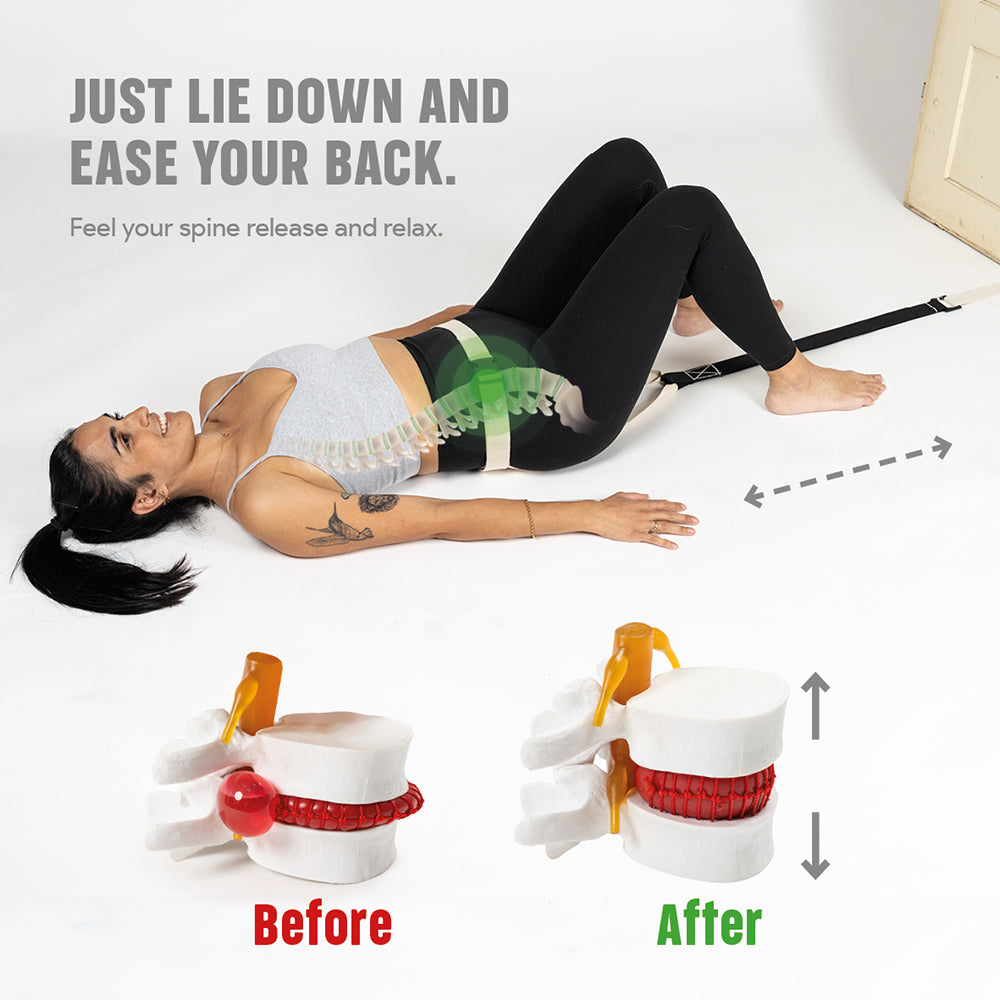
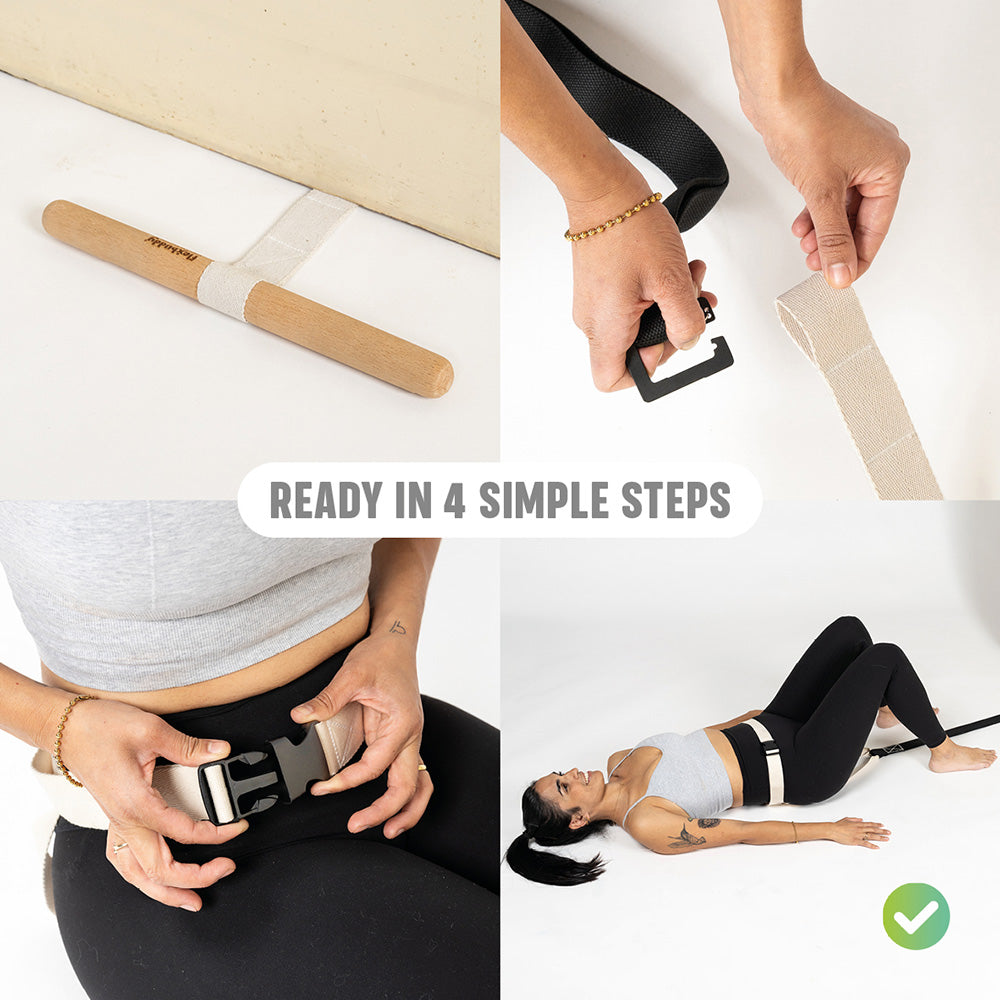
- FlexBuddy® holds the straight spine for you in the hamstring stretch, once a physiotherapist or GP confirms your leg pain is muscular tightness. It is for tight muscles, not a treatment for the nerve.
What sciatica is
The good news first: most sciatica eases on its own, and there is a lot you can do to feel better while it does.
The sciatic nerve is the largest nerve in the body [6]. It forms from nerve roots in the lower back, runs through the buttock beneath the piriformis muscle [3], then down the back of the thigh, where it supplies the hamstrings, and on into the calf and foot. Anything that squeezes or inflames it along that route produces the same symptoms: pain, tingling, numbness or weakness in the bottom, the back of one leg, and sometimes the foot and toes [1].
The word says where it hurts, not why, and the why picks your move: a stretch for a tight muscle, a glide for an irritated nerve. So rule out the emergencies first, then find out what is irritating the nerve.
Stop and get help now if you have any of these
A small number of people with sciatica have pressure on the bundle of nerves at the bottom of the spinal canal, the cauda equina, which controls the bladder, bowel and the skin between the legs. It is rare, it is a surgical emergency, and the window for preventing permanent damage is short. The NHS lists these as reasons to go to A&E or call 999 immediately [1]:
- sciatica on both sides;
- severe or worsening weakness or numbness in both legs;
- numbness around or under the genitals, or around the anus (the "saddle" area; some people first notice a change in feeling when wiping);
- difficulty starting to pee, being unable to pee, or losing control of peeing, if this is new for you;
- not noticing when you need to poo, or losing control of your bowels, if this is new for you.
Do not drive yourself: get someone to take you or call an ambulance, and bring your medicines [1]. A change in how your genitals feel during sex, or new difficulty with erections, belongs on the same list [7].
Two further groups need a doctor before a stretching routine. Ask for an urgent GP appointment or call 111 if you feel hot, cold, shivery or generally unwell with your back pain, or if the pain is severe and started suddenly or is getting worse quickly [7]. See a GP, less urgently, for weight loss you did not intend, a lump or swelling in the back, pain that is worse at night or does not ease with rest, or pain that began after a serious accident [7]. None of that is you? Good. Everything below is yours to use.
Sciatica is a symptom, not a diagnosis
The nerve can be irritated in three broad places, and each has its own answer.
At the spine: a disc or a narrowed canal
In about 90% of cases the cause is a herniated disc: the cushion between two vertebrae pushes out and presses on a nerve root as it leaves the spine [2]. A narrowed spinal canal, a slipped vertebra, disc degeneration and, rarely, growths can do the same [2][6]. The clues that point to the spine: leg pain greater than back pain, pain radiating to the foot or toes, numbness or pins and needles in the same strip of skin, and more leg pain when the straight leg is lifted [2]. If this is your picture, start with our guide to stretching with a herniated disc and talk to a physiotherapist before anything below.
In the buttock: piriformis syndrome
The piriformis is a flat, narrow muscle running from the sacrum, through the buttock, to the top of the thigh bone, and the sciatic nerve most commonly passes directly beneath it [3]. When the muscle is tight, in spasm or inflamed, it can press on the nerve. This is the sciatica that stretching is designed for. Doctors have been describing it for over 70 years [8]. The latest systematic review pins it down to four features: buttock pain, pain made worse by sitting, tenderness near the greater sciatic notch (the deep point in the middle of the buttock), and pain on any manoeuvre that tightens the piriformis [9]. Recognise yourself? Our piriformis stretch guide takes you through the figure-4, seated and lying versions. Straight-leg raising can be limited here too [9], so run the checks in the next section.
Elsewhere: pregnancy, the hamstring, the hip
Pregnancy can bring on sciatica through posture change and ligaments that soften in preparation for labour [6][10]. A hamstring injury can irritate the nerve where it runs alongside the muscle, the hip joint can refer pain into the same area, and sometimes no cause is found [6]. Age, extra body weight, weak core muscles, jobs with heavy lifting or long periods of sitting, type 2 diabetes and smoking all raise the risk [6].
Nerve or muscle? How to tell before you stretch
A short muscle and an irritated nerve can both make the back of the leg feel "tight", but they behave differently when tested. The tests take two minutes, and they tell you which half of this article is yours.
| Check | Points to muscle | Points to nerve |
|---|---|---|
| Where you feel it | A broad pull in the belly of the muscle: back of the thigh, or deep in the buttock | A line that travels: buttock to calf, heel or toes, or a patch of skin that feels different |
| What it feels like | A dull stretching ache that eases the moment you release | Burning, electric, tingling, numbness; may linger after you stop |
| Cough, sneeze, strain | No change | Often sharpens the leg pain [1] |
| Pull the toes up during a hamstring stretch | Little or no change (the hamstring does not cross the ankle) | Symptoms increase down the leg |
| Drop the chin to the chest in the same stretch | No change | Symptoms increase (the nerve runs from the spine; tension at the top is felt at the bottom) |
| Sitting for a long time | Stiff on standing, loosens with a few steps | Pain builds while sitting, especially in the buttock [9] |
| One leg or both? | Usually both, roughly equal | Usually one (both at once is a red flag [1]) |
The hamstrings do not attach below the knee, so pulling the foot up should not change a muscular pull; it does lengthen the path of the sciatic nerve. If that small move sends the feeling further down the leg, the nerve is involved and long holds are the wrong tool. Your tool is gentle, rhythmic movement, the nerve glides below. If the tests point to muscle, the stretches are for you, and you will feel them working from the first session.
Does stretching help sciatica?
Yes, when you match the tool to the cause.
Tight hamstrings with back and leg pain: stretching helps. A 2024 systematic review of randomised trials found that hamstring stretching reduced pain in people with low back pain and improved function on the Oswestry Disability Index (mean difference −6.97 points) [11]. In the people whose back pain radiated into the leg, straight-leg-raise range improved markedly, with the trials in close agreement [11]. Stretching does not repair a disc; it gives you a looser, more comfortable leg while your back recovers. Our article on tight hamstrings and lower back pain goes through that review in detail.
Nerve-related pain: nerve glides help. A 2017 systematic review of 40 studies found that neural mobilisation reduced pain by about 1.8 points on a 10-point scale and disability by about 9 points on a 50-point scale in chronic low back pain [4]. A 2023 meta-analysis of 20 trials in lumbar radiculopathy, the medical name for sciatica from a nerve root, found large reductions in pain and disability [5].
Long-standing sciatica: exercise plus nerve glides is among the front-runners. A 2025 network meta-analysis of 50 trials in people with sciatica of three months or more found exercise combined with neural mobilisation among the treatments with the largest short-term reductions in leg pain [12].
And time is on your side. In trials, about half of the people given only a placebo were better within 10 days and three-quarters after four weeks [2]. Stretches and glides are the low-risk, feel-better-now part of that recovery: you stay comfortable and keep moving while your body does the rest.
The stretches that help (when the problem is a muscle)
Three rules make these work. One: a long, straight spine. Rounding the lower back to reach further loads the disc and tensions the nerve, so start lying down, where the floor holds the spine straight for you, and progress to sitting tall only when the lying version is easy and the leg is quiet. Two: mild tension in the muscle, never pain, never anything that travels down the leg. If symptoms spread, lower the leg, and if that does not fix it, go to the nerve-glide section instead. Three: a little, often. The guideline dose is about 60 seconds of total stretch per exercise on at least two days a week [13], which can be two to four holds of 15 to 30 seconds [14]. Older adults do well with longer holds: 60-second holds produced larger hamstring gains in one study of older adults [14].
| Stretch | Position | Hold | Reps | Notes |
|---|---|---|---|---|
| Knee to chest | On your back, one knee bent, hug it gently towards the chest | 20–30 s | 2–3 per side | The safest start; a flare-day stretch |
| Figure-4 (piriformis), lying | On your back, knees bent; cross one ankle over the opposite knee; hold the back of the other thigh and draw it towards you | 20–30 s | 2–3 per side | Feel it deep in the buttock; if it spreads down the leg or tingles, ease off or skip it today |
| Figure-4, seated | Sit tall, ankle on the opposite knee, hinge forward from the hips with a flat back | 20–30 s | 2–3 per side | Office version; stop if the buttock pain spreads |
| Gentle hamstring, lying | On your back, other knee bent, FlexBuddy, a strap or a towel round one foot; raise the straight leg to a mild thigh pull; back flat; toes relaxed | 20–30 s | 2–3 per side | Pulling the toes up turns it into a nerve test |
| Seated hamstring, straight spine | Sit tall, legs straight, FlexBuddy or a strap around the feet; tip the pelvis forward, chest lifted | 20–30 s | 2–3 | Only once the lying version is easy; the spine does not round |
| Hip-flexor lunge | Half-kneeling, back knee on a cushion; tuck the tailbone and shift forward until the front of the back hip pulls | 20–30 s | 2 per side | Opens the front of the hip after long sitting |
| Cat–Cow | On all fours, slowly round and then gently hollow the back with the breath | no hold | 8–10 slow | Movement, not a hold; calms a stiff back |
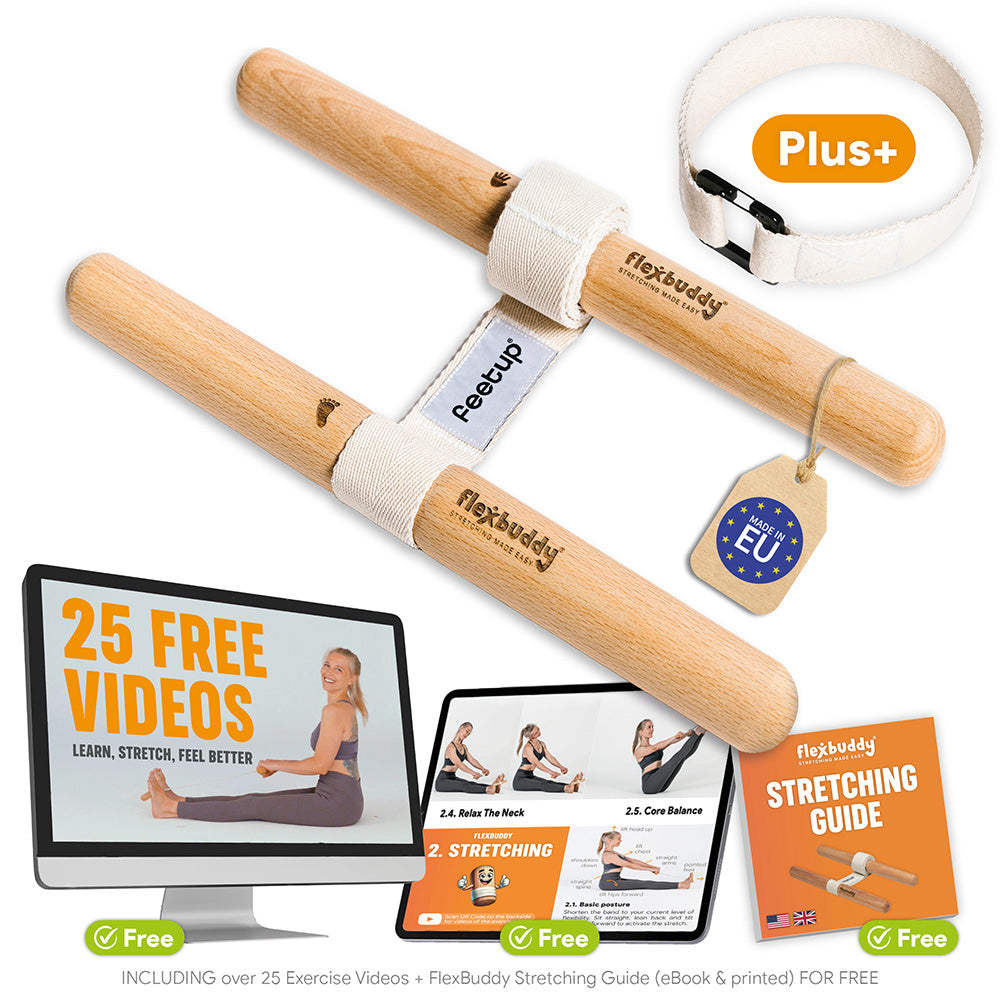
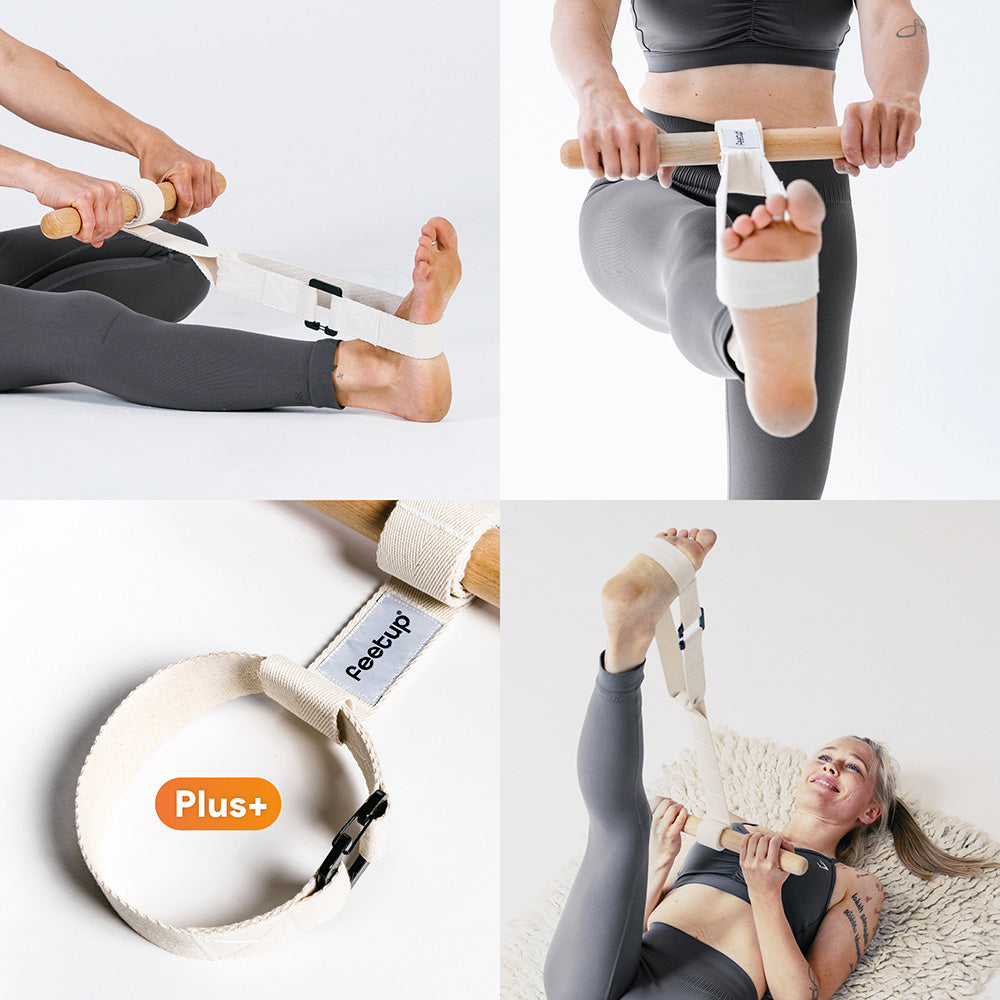
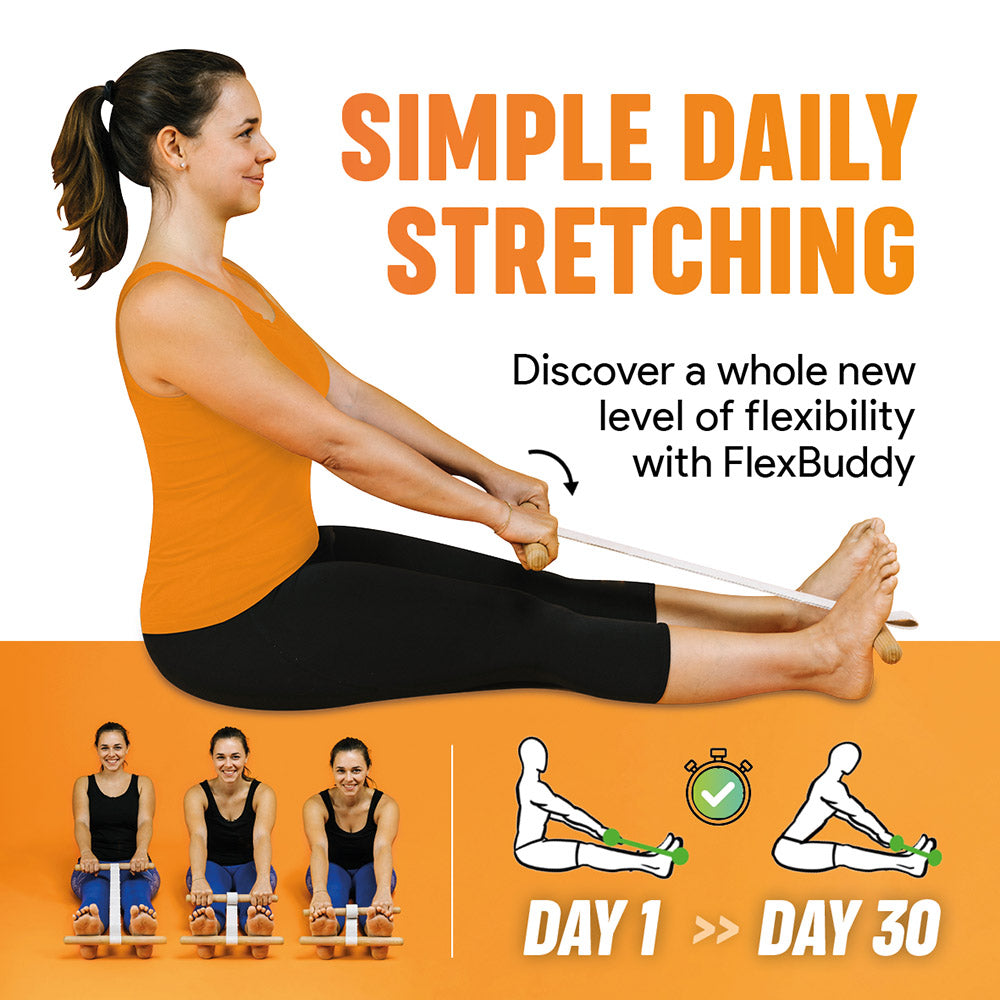
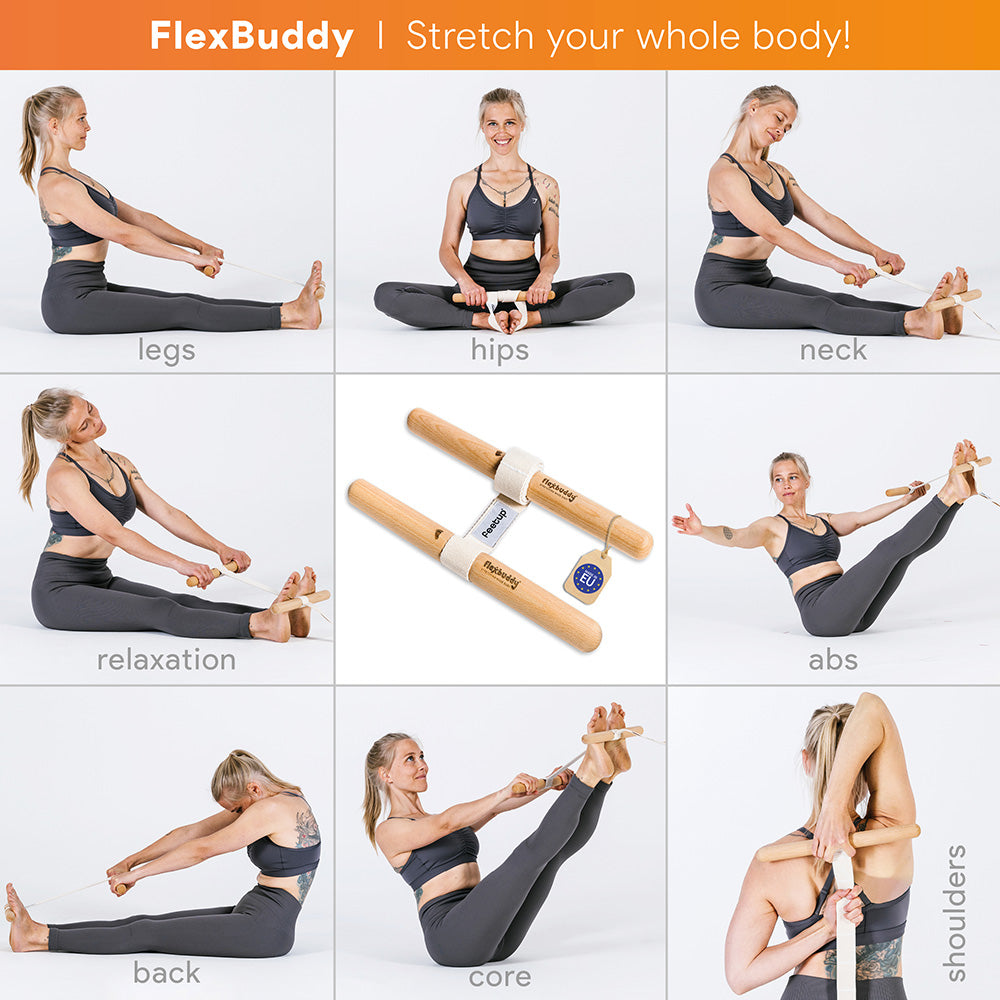
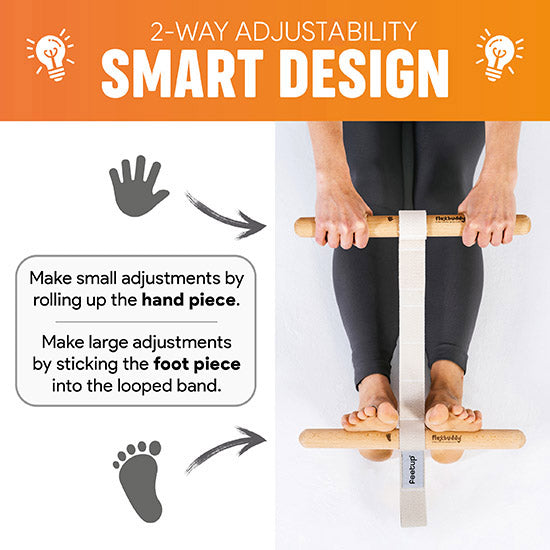
FlexBuddy makes the seated version easy. Foot bar under your soles, hand bar in both hands, sit tall and tip the hips forward. The strap carries the pull, so your spine stays long and the stretch lands in the backs of the thighs. Use it once a physiotherapist or GP has confirmed your tightness is muscular.
In bed
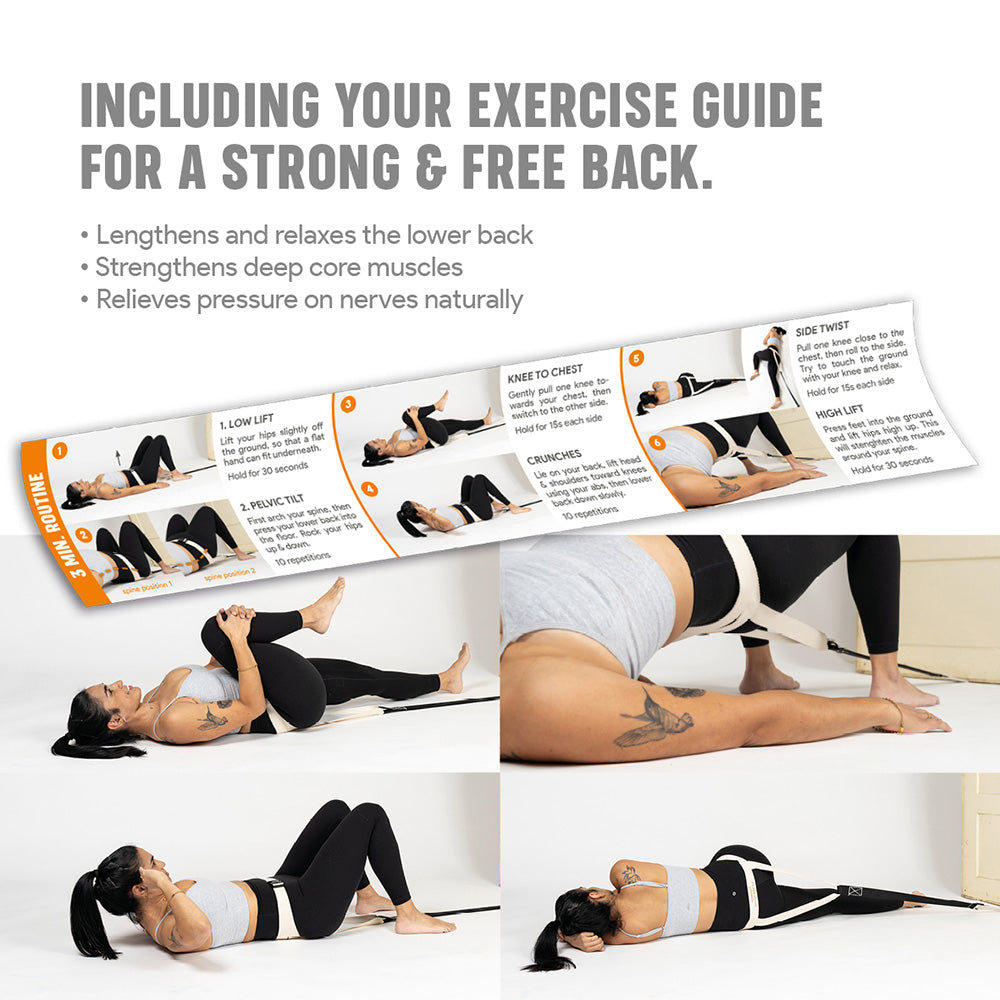
Everything in the table except the seated figure-4 and the lunge works on a firm mattress. On mornings and flare days, bed is the best place to start: knee-to-chest, the lying figure-4, the lying hamstring stretch with a strap or dressing-gown belt, then ten slow pelvic tilts. To get up, roll onto your side, push up with your arms and swing the legs down together. Our article on stretches you can do in bed has the full routine.
Nerve glides, explained
If your checks pointed to the nerve, this section is yours. Neural mobilisation, also called nerve gliding or nerve flossing, is a movement-based technique that aims to restore normal movement in and around the nervous system [4]. A healthy nerve slides a few millimetres through the tissues around it as you move; an irritated one tends to stop sliding and start guarding. A glide moves the nerve gently back and forth along its path without stretching it.
The common version for sciatica is the seated slider. Sit tall on the edge of a chair. Straighten one knee and, at the same time, lift your head to look at the ceiling; then bend the knee as you drop your chin to your chest. Straightening the knee pulls the nerve from the bottom while tipping the head back gives it slack from the top, so the nerve slides without being stretched. Go slowly, 10 to 15 times, well short of pain. Lying down, the idea is the same: hold one thigh at 90 degrees with both hands and gently straighten and bend the knee, pulling the toes up only as the knee bends.
Glides are movements, not holds: hold the straight-knee position and it becomes a nerve stretch again. A familiar symptom that settles straight afterwards is fine; one that is worse ten minutes later means you did too much. The trials that showed the benefit used programmes set up by physiotherapists [4][5], so have one show you your version, then do it daily at home.
What makes sciatica worse
- Stretching a sensitive nerve like a muscle. Long hamstring holds, toe-touches with a rounded back, yoga forward folds held "through the burn". If the feeling travels down the leg, it is a nerve under load, not a stretch. Glide it instead.
- Bed rest. Movement is not harmful and can speed up your recovery even if it hurts, so the NHS advice is not to sit or lie down for long periods [1]. A few hours lying down may ease the pain, but prolonged rest is no longer recommended [2].
- Sitting as a default. Long sitting is a risk factor for sciatica [6] and aggravates piriformis pain in particular [9]. Stand, walk, change position every half hour. If your sciatica is worst after a day at a desk, the lower back pain from sitting and tight hips from sitting guides are your next reads.
- Bouncing, forcing, and heavy lifting or repeated bending with a rounded back in the first weeks, which make irritated tissue guard harder and load the disc that may be the source [6].
- Ignoring the red flags. Weakness that is getting worse, numbness that is spreading, any bladder or bowel change: not a sign to stretch harder.
What helps in the meantime: keep up your normal activities as far as you can [1], walk, and use ice in the first few days and heat after that, each for around 20 minutes [6]. Ask a pharmacist about painkillers instead of guessing: paracetamol is unlikely to help [1].
When to see someone
Immediately, for anything on the red-flag list. Within days if the pain is severe, a leg is becoming weak, or numbness is spreading. Otherwise, the NHS suggests seeing a GP if the pain has not improved after a few weeks of self-care, is getting worse, or is stopping your normal activities; in many areas you can refer yourself directly to an NHS musculoskeletal service [1]. A physiotherapist is your shortcut: they can do the nerve-versus-muscle tests properly, tell you which stretches fit, and set up your nerve glides. Scans are reserved for people with red flags or those being considered for injections or surgery, because most sciatica improves without either [2]. Most episodes settle within a few weeks to a few months [1], many within four to six weeks [6], and it can come back [1]. Sciatica still present at three months is the point at which a specialist opinion earns its place [12].

Stretch with a straight spine: FlexBuddy, once you have been cleared
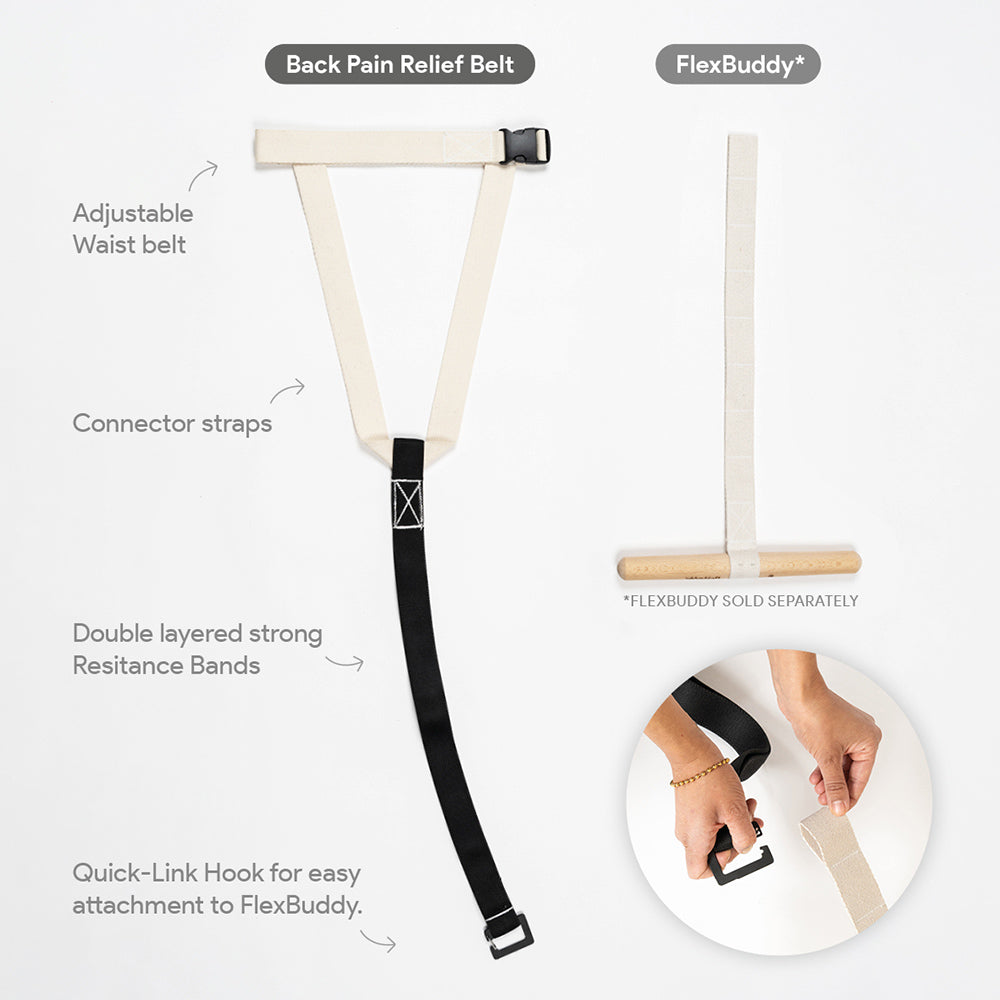
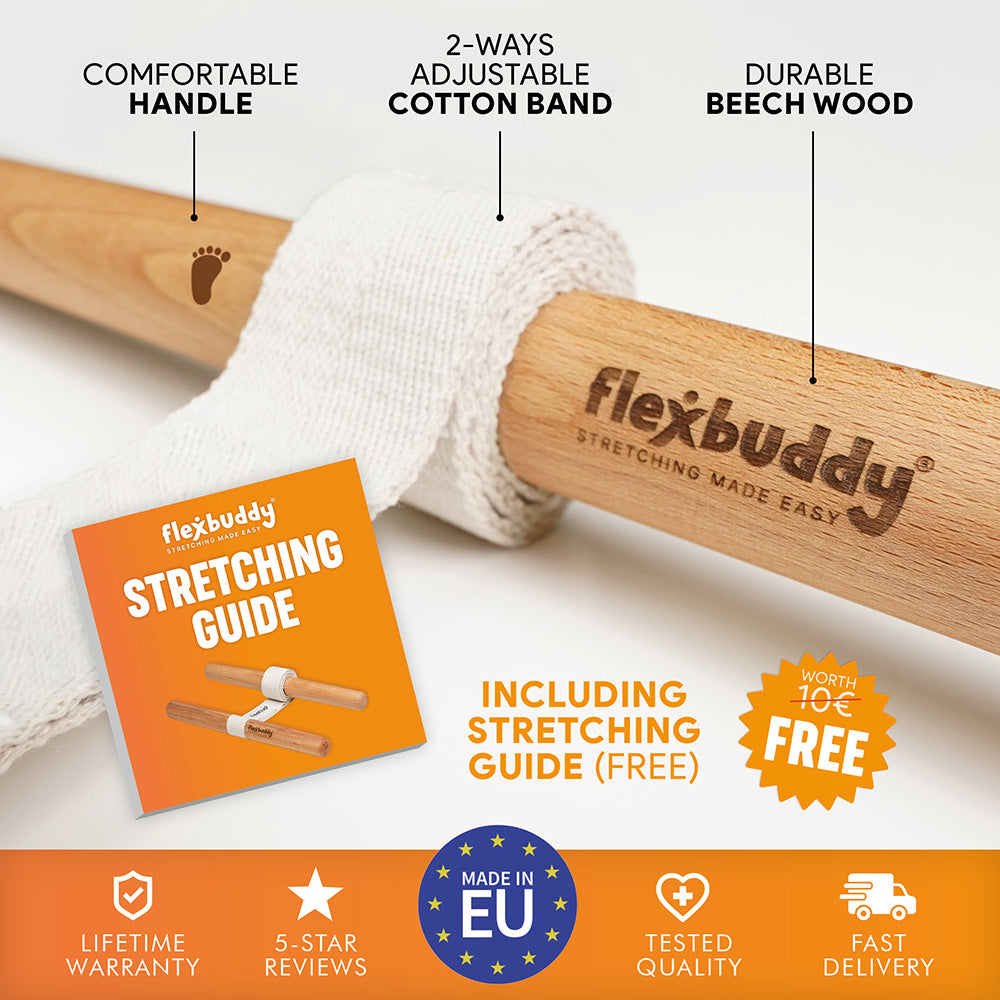
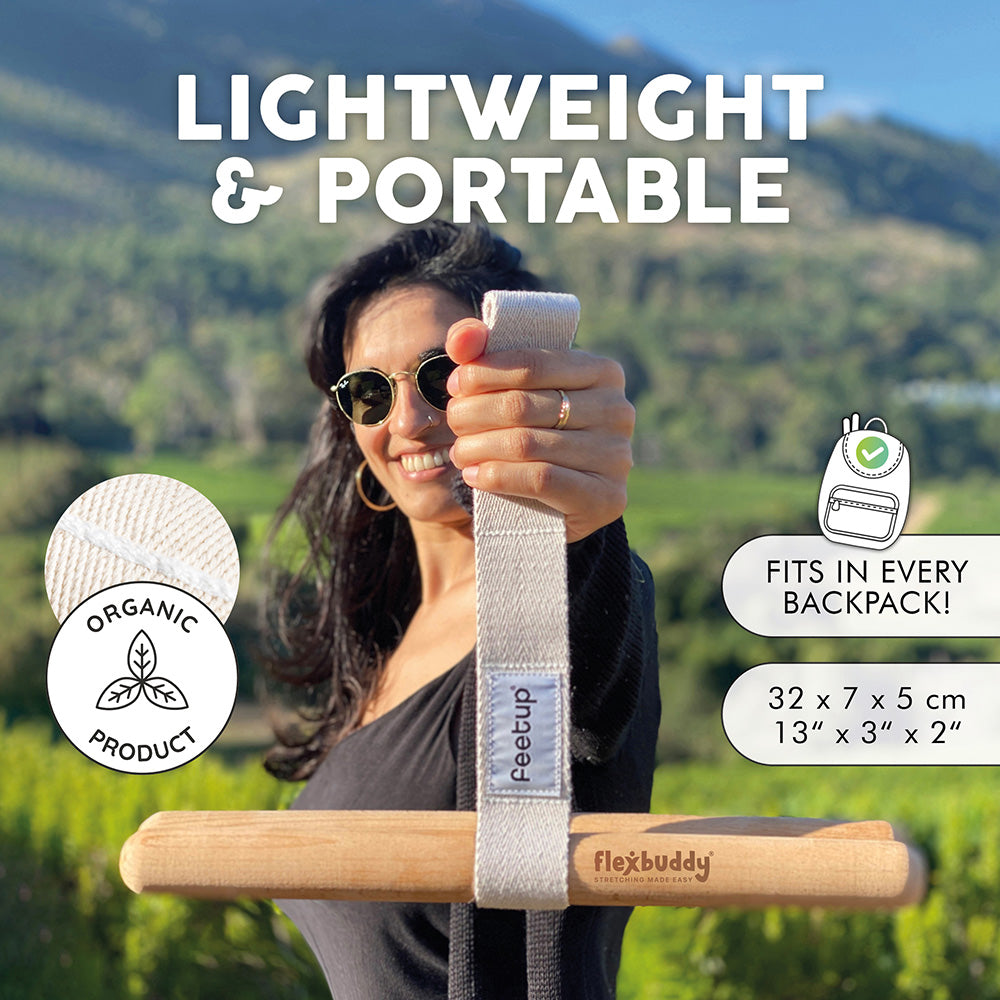
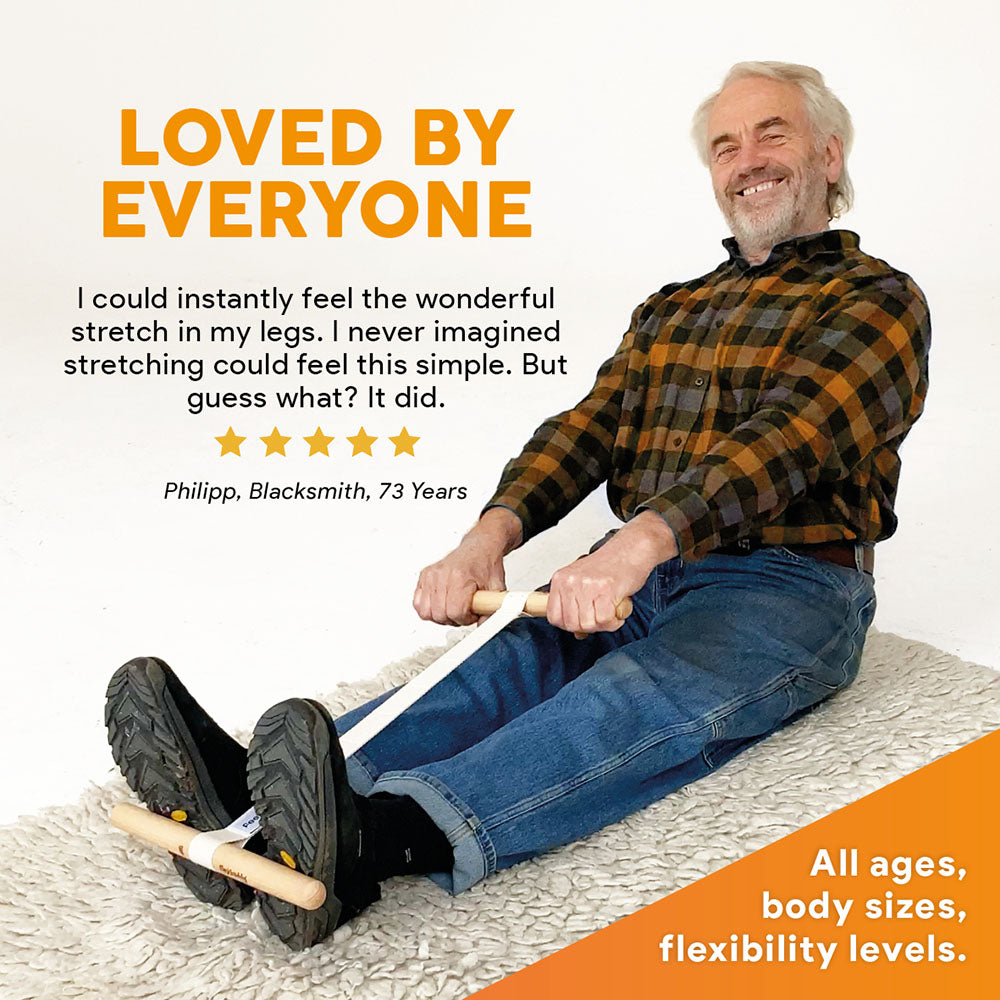
Every stretch here comes back to one rule: keep the spine long. It is also the hardest part to get right alone: reach for your feet and the lower back rounds. FlexBuddy® solves exactly that. It is a patented stretching device: two beech-wood bars joined by an adjustable cotton strap. Foot bar under your soles, hand bar in your hands. You sit tall, lean back, tip the hips forward, and the pull lands in the backs of the thighs while your lower back stays out of it. Comfortable wooden handles, no rope burn, one size for every body.
The order matters: red flags ruled out, a physiotherapist or GP confirming that your leg pain is muscular tightness and not an irritated nerve root, and the lying stretches above comfortable first. FlexBuddy is a stretching device, not a treatment for sciatica. Start with the strap at its longest, keep the feet soft, hold for ten slow breaths and stop at mild tension. If anything travels down the leg, loosen a loop or put it away for the day. Trainer Scott K. calls it "a great tool to help your clients maintain a neutral spine while stretching calves, hamstrings and lower back". Rated 4.5 by verified buyers, with a 30-day money-back guarantee and a lifetime warranty. Get your FlexBuddy, or take the two-minute quiz.
Frequently asked questions
Does stretching help sciatica or make it worse?
It helps when you match it to the cause. If a tight piriformis or hamstring is the problem, gentle stretching with a straight spine eases it [11]. If the nerve root itself is inflamed, long stretches keep it under tension and can make it worse, so use gentle nerve glides there: they brought large reductions in pain and disability [5]. A stretch that stays in the muscle is good; one that sends burning or tingling down the leg means stop.
What sciatica stretches can I do in bed?
Knee-to-chest, the lying figure-4 piriformis stretch, the lying hamstring stretch with a strap or belt around the foot, and slow pelvic tilts, each for 20 to 30 seconds or ten slow repetitions. Bed keeps your spine supported, which makes these the safest versions on a flare day. Avoid anything that needs you to sit up and fold forward.
Are sciatica stretches safe in pregnancy?
Gentle ones usually are: the NHS recommends the all-fours Cat–Cow, prenatal yoga and aquanatal classes for pregnancy back pain [10]. From 28 weeks, NHS advice is to sleep on your side rather than flat on your back [15], so use seated and side-lying versions of the figure-4 and skip the lying hamstring stretch late in pregnancy. Contact your midwife or GP urgently if back pain comes with fever, bleeding or pain on passing urine, or if you are in the second or third trimester, and go to A&E if you lose feeling in your legs, bottom or genitals [10].
Which sciatica stretches are best for elderly people?
The lying and seated versions, done slowly, with longer and gentler holds. Older adults do well with longer stretch times than the usual 15 to 30 seconds: 60-second holds produced greater hamstring gains in one study of older adults [14]. Start with knee-to-chest, the seated figure-4 on a firm chair and the lying hamstring stretch with a strap. Balance problems and osteoporosis change the picture, so a physiotherapist should set the routine if you have either.
Does stretching hamstrings help sciatica?
Yes, when the hamstring is part of the problem. In a 2024 meta-analysis, people whose back pain radiated into the leg improved their straight-leg-raise range markedly after hamstring stretching programmes [11]. The conditions are a straight spine, a relaxed foot and no symptoms running down the leg; pull the toes up during the stretch and it becomes a nerve stretch, with different rules. Once a physiotherapist has confirmed the tightness is muscular, FlexBuddy keeps your spine long for you.
How do I do a piriformis stretch for sciatica?
Lie on your back, cross one ankle over the opposite knee, and draw that thigh gently towards your chest until you feel a deep pull in the buttock of the crossed leg. Hold 20 to 30 seconds, two or three times per side. Seated, it is the same shape on a chair, hinging forward with a flat back. It suits the piriformis picture best: buttock pain, worse sitting, tender in the middle of the buttock [9]. If that is not your picture, run the nerve-or-muscle checks first.
This article is general information, not medical advice. Tight muscles usually respond well to regular stretching. If your pain is sharp, radiates down a leg, comes with numbness, weakness, fever, bladder or bowel changes, follows an injury, or keeps getting worse, see a doctor or physiotherapist before you stretch.
References
- NHS. Sciatica. nhs.uk, page last reviewed 3 Dec 2024. https://www.nhs.uk/conditions/sciatica/ (accessed 4 Nov 2026).
- Koes BW, van Tulder MW, Peul WC. Diagnosis and treatment of sciatica. BMJ. 2007;334(7607):1313–1317. doi:10.1136/bmj.39223.428495.BE. https://pmc.ncbi.nlm.nih.gov/articles/PMC1895638/ (accessed 4 Nov 2026).
- Cleveland Clinic. Piriformis Syndrome. Last reviewed 13 Jul 2022. https://my.clevelandclinic.org/health/diseases/23495-piriformis-syndrome (accessed 4 Nov 2026).
- Basson A, Olivier B, Ellis R, Coppieters M, Stewart A, Mudzi W. The effectiveness of neural mobilization for neuromusculoskeletal conditions: a systematic review and meta-analysis. J Orthop Sports Phys Ther. 2017;47(9):593–615. doi:10.2519/jospt.2017.7117
- Lin LH, Lin TY, Chang KV, Wu WT, Özçakar L. Neural mobilization for reducing pain and disability in patients with lumbar radiculopathy: a systematic review and meta-analysis. Life (Basel). 2023;13(12):2255. doi:10.3390/life13122255
- Cleveland Clinic. Sciatica. Last updated 10 Feb 2026. https://my.clevelandclinic.org/health/diseases/12792-sciatica (accessed 4 Nov 2026).
- NHS. Back pain. nhs.uk, page last reviewed 5 Mar 2026. https://www.nhs.uk/conditions/back-pain/ (accessed 4 Nov 2026).
- Hopayian K, Song F, Riera R, Sambandan S. The clinical features of the piriformis syndrome: a systematic review. Eur Spine J. 2010;19(12):2095–2109. doi:10.1007/s00586-010-1504-9
- Hopayian K, Danielyan A. Four symptoms define the piriformis syndrome: an updated systematic review of its clinical features. Eur J Orthop Surg Traumatol. 2018;28(2):155–164. doi:10.1007/s00590-017-2031-8
- NHS. Back pain in pregnancy. nhs.uk, page last reviewed 10 Jan 2024. https://www.nhs.uk/pregnancy/related-conditions/common-symptoms/back-pain/ (accessed 4 Nov 2026).
- Gou Y, Lei H, Chen X, Wang X. The effects of hamstring stretching exercises on pain intensity and function in low back pain patients: a systematic review with meta-analysis of randomized controlled trials. SAGE Open Med. 2024;12:20503121241252251. doi:10.1177/20503121241252251
- Zhu Z, Schouten T, Strijkers R, Koes B, Gerger H, Chiarotto A. Effectiveness of non-surgical interventions for patients with chronic sciatica: a systematic review with network meta-analysis. J Pain. 2025;33:105431. doi:10.1016/j.jpain.2025.105431
- Garber CE, Blissmer B, Deschenes MR, et al.; American College of Sports Medicine. Position stand: quantity and quality of exercise for developing and maintaining cardiorespiratory, musculoskeletal, and neuromotor fitness in apparently healthy adults. Med Sci Sports Exerc. 2011;43(7):1334–1359. doi:10.1249/MSS.0b013e318213fefb
- Page P. Current concepts in muscle stretching for exercise and rehabilitation. Int J Sports Phys Ther. 2012;7(1):109–119. https://pmc.ncbi.nlm.nih.gov/articles/PMC3273886/ (accessed 4 Nov 2026).
- Countess of Chester Hospital NHS Foundation Trust. Safe sleep during pregnancy. https://coch.nhs.uk/all-services/maternity-services/your-pregnancy/safe-sleep-during-pregnancy.aspx (accessed 4 Nov 2026).