- Sitting on its own has not been shown to cause back pain; the risk rises when long sitting is combined with slumped postures and vibration, such as driving [1]. What sitting reliably does is flatten the lumbar curve [2] and hold your hip flexors and hamstrings at their shortest length for hours.
- It is common: in a survey of 1,185 office workers, 34% reported low back symptoms in the previous year [3].
- About nine in ten back pains have no identifiable structural cause [4][5]. That is the kind that responds to movement, posture change and stretching, not to scans.
- Stretching helps. In 14 trials, hamstring stretching reduced low back pain [6], and a 12-month trial in 563 office workers cut new back pain from 19.7% to 8.8% with daily stretching and twice-weekly trunk endurance work [7].
- "Feels better immediately" is real but short-lived: a single stretch changes how much stretch you tolerate, not the length of the muscle [8]. The daily habit is what lasts.
- Breaks matter: active breaks with a change of posture are the only type with moderate-quality evidence for reducing pain in office workers [9], and in one trial they cut recurrence of neck and back pain from 44% to around 20% [10].
Red flags first: when sitting is not the problem
Pain that builds over a working day and eases when you move is the mechanical, non-specific kind this article is about. A small minority is not, and the NHS is clear about the signs that need a doctor rather than a stretch [11]. Go to A&E if back pain comes with pain, tingling, weakness or numbness in both legs, loss of feeling around the genitals or anus, difficulty passing urine or loss of bladder or bowel control, chest pain, or if it started after a serious accident [11]. Ask for an urgent appointment if the pain is severe and sudden, getting worse quickly, or you feel hot, shivery or unwell [11]. See a GP if it has not improved after a few weeks of self-care, you have lost weight without trying, it is worse at night or does not ease with rest, or it is worse when you cough, sneeze or strain [11].
Pain that runs down one leg below the knee, especially with pins and needles, points to the sciatic nerve rather than a muscle; see our guide to stretching with sciatica before you start a routine. If none of this applies to you, read on. Nine times out of ten, that is where you are.
What sitting does to your hips, hamstrings and lumbar spine
A chair asks three groups of tissue to hold still in a folded position for hours. Each pays a different price.
Hip flexors: the muscles that connect your thigh bone to your spine
The main hip flexor is the iliopsoas, two muscles that merge into one tendon. Psoas major starts on the lumbar vertebrae; iliacus starts on the inside of the pelvis; together they attach to the top of the thigh bone and their job is to flex the thigh at the hip [12]. That origin on the lumbar spine is the detail that matters. In a chair the hip is bent to roughly 90 degrees and the iliopsoas is at its shortest; held there for hours, day after day, it adapts. When you stand, a shortened muscle running from lower back to thigh pulls on both ends, tugging the front of the pelvis down and the lumbar spine into a deeper arch, which is the textbook reason the first steps after a long sit feel stiff. The mechanism is plausible and widely taught; nobody has shown it causes back pain by itself, so treat it as a contributor rather than the culprit.
Hamstrings: shortest in a chair, longest when you bend
The hamstrings run from the sitting bone to just below the knee, so a bent hip plus a bent knee is their shortest position, which is exactly what a chair gives them. When they are short, the pelvis cannot tip forward freely, so every bend, from tying shoes to lifting a bag, is done by rounding the lumbar spine instead. A systematic review found reduced hamstring flexibility in people with low back pain on several measures but rated the evidence as very low quality and could not say which comes first [13]. Stretching them, on the other hand, has good trial evidence for easing back pain [6]. The full story, including a self-test, is in our hamstrings and lower back pillar.
The lumbar spine: a curve that disappears when you sit
Standing, your lower back has an inward curve (lordosis). An X-ray study measured it at an average of 63 degrees standing and found it decreased by 43 degrees when the same men sat in a car seat; the L4/L5 segment alone flexed by 13 degrees [2]. Sitting removes most of the curve and parks the lower joints in flexion. Disc pressure follows posture. In the classic measurement of one volunteer's L4/L5 disc, relaxed standing produced 0.5 megapascals, upright unsupported sitting 0.46, slouched sitting 0.3, sitting bent fully forward 0.83 and standing bent forward 1.1 [14]. The authors' practical conclusion was that constantly changing position matters because movement pumps fluid and nutrients into the disc [14]. A static afternoon starves it.
So does sitting cause back pain?
Not on its own. A systematic review of 25 studies in occupations with sitting for more than half the working day concluded that sitting by itself was not associated with the risk of developing low back pain. The risk rose about fourfold when sitting was combined with whole-body vibration and awkward postures, and length of exposure mattered more than intensity [1]. That is why drivers and helicopter pilots fared worst in that review (pilots had an odds ratio of 9.0) [1]. For desk workers the problem is not the chair; it is the hours without a change of position, the slump, and the short muscles you take with you when you stand up. It is still very common: in a survey of 1,185 office workers, 63% reported a work-related musculoskeletal symptom in the past year, led by the neck (42%) and lower back (34%) [3].
Non-specific back pain: nine in ten have no structural cause
This fact should change how you think about the 4 p.m. ache. Low back pain is the leading cause of disability in the world, yet for nearly all people who have it no specific cause in the spine can be identified; only a small proportion have a well-understood pathology such as a fracture, a tumour or an infection [5]. In primary care, about 90% of patients have "non-specific" low back pain; compression fractures account for about 4%, tumours for 0.7% and infection for 0.01% [4].
Non-specific does not mean imaginary. It means the pain comes from how the back is used, muscles, joints and discs responding to load, posture and lack of movement, rather than from a lesion a scan could show. For a desk worker that is good news twice over: the problem is modifiable, and the evidence on what helps is consistent. Advice to stay active speeds recovery and reduces long-term disability; bed rest does not help [4]. The NHS says the same: keep moving, try exercises and stretches, do not stay in bed for long; most episodes improve within a few weeks [11]. The longer answer on what stretching can and cannot do for a sore back is in Does stretching help back pain?
Stretches for lower back pain that feel better immediately (and what "immediately" means)
Here is the straight answer to the most searched phrase in this subject. Yes, several stretches make a sitting-sore back feel better within a minute or two. No, that feeling is not the muscle getting longer. A review of the stretching research concluded that muscle length increases only while a stretch is applied, and that the gains seen after a single session and after three-to-eight-week programmes are best explained by a change in sensation, the nervous system tolerating more stretch [8]. Add that changing position moves fluid through the disc [14], and you have the honest mechanism: you feel better because you changed the load and your nervous system eased off, and the effect fades if you sit straight back down. Lasting change comes from doing it daily for weeks.
Each stretch below reverses something the chair did. Hold to mild tightness, never pain, and breathe slowly: ten slow breaths is roughly 30 seconds and stops you bracing.
1. Half-kneeling hip-flexor stretch (undoes the bent hip)
Kneel on one knee, other foot in front, both knees at right angles. Tuck the tailbone under (squeeze the buttock on the kneeling side), then shift forward a few centimetres until the front of that hip pulls. Keep the trunk tall; if the lower back arches you are loading the spine, not the hip flexor. Hold 20 to 30 seconds, twice each side.
2. Knee-to-chest (unloads the lumbar joints)
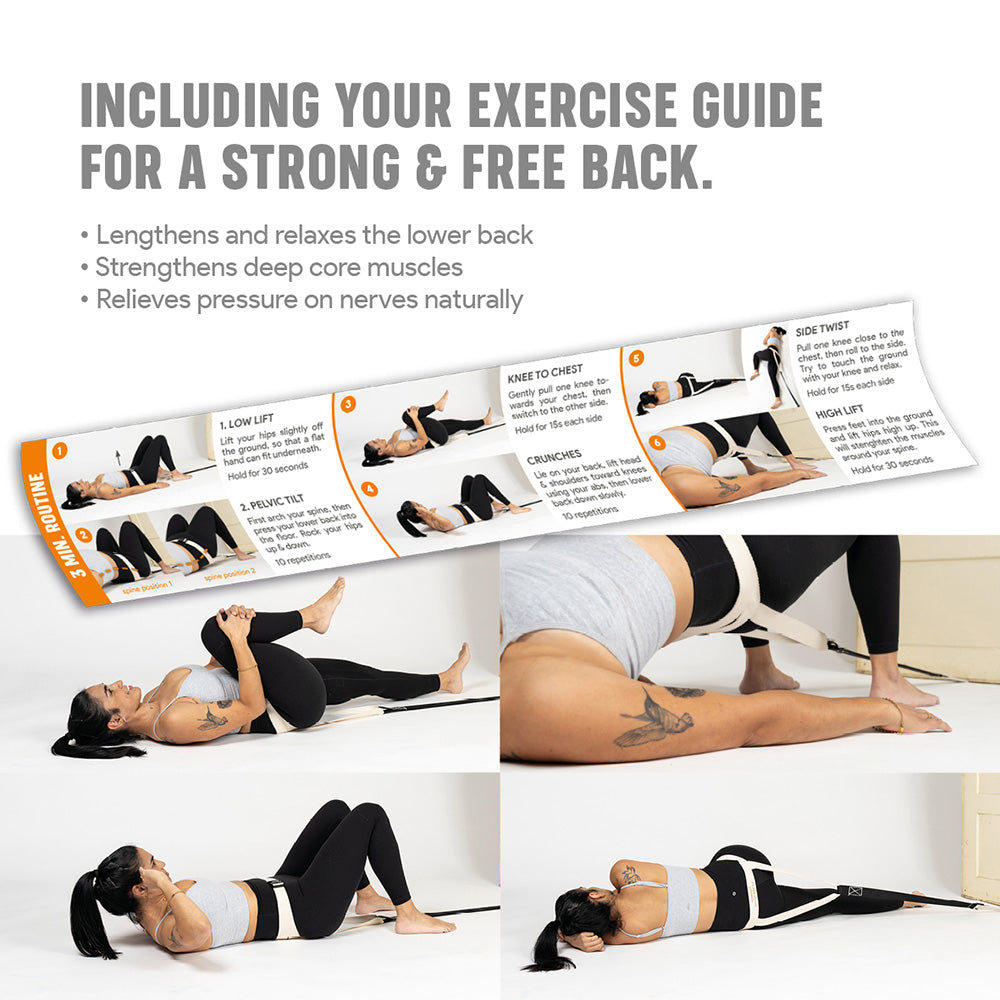
Lie on your back, draw one knee towards your chest with your hands behind the thigh, other foot flat on the floor, and let the lower back soften. Hold 20 to 30 seconds per side, then both knees together for 30 seconds. This is the one most people describe as instant relief.
3. Lying hamstring stretch with a strap (undoes the bent knee)
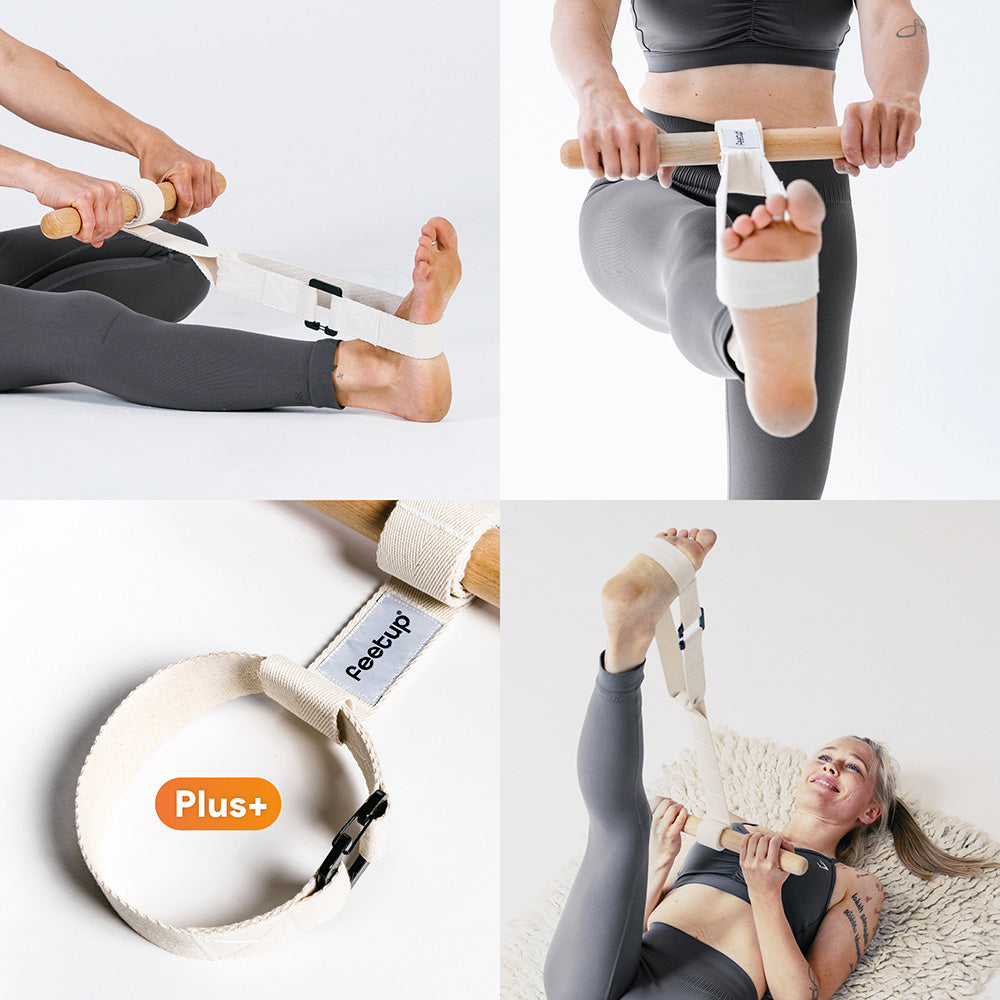
On your back, loop a strap, belt or the foot bar of a stretching device under one foot and raise the straight leg until the back of the thigh pulls. Lower back on the floor, other knee bent. Hold ten slow breaths, two to three times per leg. The spine stays out of it entirely, which makes this the safest hamstring stretch for a back that is already sore.
4. Seated straight-back hamstring stretch (the one that fixes the bend)
Sit on the floor, legs straight, a strap or device under the feet, and sit up tall. Lean back slightly, then tip the pelvis forward over the thighs with the chest lifted until the hamstrings pull. The back stays long; you may be nowhere near your toes at first, and that is correct. Hold ten breaths, three times. This teaches the body to bend from the hips instead of the lumbar spine, the habit that matters most once you stand up from the desk.
5. Cat–cow (restores the lost curve)
On hands and knees, breathe in and let the belly drop as the chest and tailbone lift (cow); breathe out and round the whole spine (cat). Ten slow cycles. Not a hold: it is the changing position the disc research recommends [14], done deliberately.
6. Child's pose (a resting stretch for the back extensors)
From kneeling, sit back towards your heels and reach the arms forward, forehead down. Hold 30 to 45 seconds, breathing into the back of the ribs. Widen the knees if it bothers a knee or if you are pregnant.
Stretches in bed
Numbers 2 and 3 work on a mattress: do them before you get up and again before sleep. Everything else in a lying-down format is in Stretches you can do in bed.
Stretches at the desk
You cannot do a floor routine in an open-plan office, but you can reverse the chair every hour: foot on the chair seat and hinge from the hips with a straight back for the hamstrings; one leg back in a standing lunge, tailbone tucked, for the hip flexor; hands on the desk and hips dropping back into a half-fold; then sit and tilt the pelvis forward and back ten times. Each takes 20 to 30 seconds. The eight-exercise desk routine is in Stretches for sitting all day; a general home routine for an achy back is in Lower back pain stretches to do at home.
The 10-minute daily plan
The numbers first. The American College of Sports Medicine recommends flexibility exercises for each major muscle-tendon group totalling about 60 seconds per exercise on at least two days a week [15]; Harvard Health summarises it as two to three times a week, 60 seconds per stretch, for example 15 seconds repeated four times [16]. Daily is better, and for people who sit all day the evening is when the hips and hamstrings have been short for longest. The plan below fits those numbers, takes ten minutes, and reverses every change the chair made.
| Stretch | Position | Hold | Reps | Frequency |
|---|---|---|---|---|
| Half-kneeling hip-flexor stretch | One knee down, tailbone tucked, shift forward until the front of the hip pulls | 20–30 s | 2 per side | Daily, after work |
| Knee-to-chest | On your back, one knee hugged in, other foot flat; then both knees | 20–30 s | 2 per side + 1 both | Daily; also in bed, morning and night |
| Lying hamstring stretch with strap | On your back, strap under one foot, leg straight, lower back on the floor | 10 breaths (~30 s) | 2 per leg | Daily; the safest version during a flare |
| Seated straight-back hamstring stretch | Sit tall, strap or device under the feet, tip the pelvis forward, chest up | 10 breaths (~30 s) | 3 | Daily; the one to keep if you only have two minutes |
| Cat–cow | Hands and knees, slow arch and round with the breath | no hold | 10 cycles | Daily; also mid-afternoon |
| Child's pose | Kneeling, hips back towards heels, arms forward | 30–45 s | 2 | Daily, to finish |
If you have only two minutes, do the seated straight-back hamstring stretch three times; it is the one that changes how you bend for the rest of the day. A stretch that produces pain rather than a pull, especially pain that travels, is a signal to stop.
Give it a fair trial: the trials that reduced back pain ran for weeks, not days [6], and the sensation-based gains of the first sessions only last if the habit survives the first fortnight [8].
Sitting breaks: what the evidence says
The most useful thing you can do at the desk costs nothing: change position before the pain arrives.
Pain builds within the hour, and short standing breaks blunt it. In a laboratory study, 20 people typed for an hour without a break and 8 (40%) developed low back pain in that hour. Standing breaks of 5 minutes every 30 minutes, 2.5 minutes every 15, or 50 seconds every 5 all gave some relief, but none restored pain scores to pre-sitting levels [17]. Breaks help; they do not undo a static day on their own.
Active breaks with a change of posture are the type that works. A systematic review of 11 controlled trials in office workers found break programmes varied enormously (work periods of 5 minutes to 2 hours, breaks of 20 seconds to 30 minutes) and that the evidence for breaks in general was low quality and conflicting for pain. When the reviewers separated the types, active breaks with a postural change had moderate-quality evidence for reducing pain and discomfort, and moderate-quality evidence that they did not hurt productivity [9]. Standing up and stretching beats standing still.
They also shorten episodes and prevent recurrence. A 12-month cluster-randomised trial gave 193 high-risk office workers a device prompting active breaks, a device prompting postural shifts, or a placebo seat pad. When neck or low back pain occurred, median recovery took one month in both intervention groups versus two in the control group, and recurrence was 21% and 18% versus 44% [10]. An earlier trial of 563 office workers with below-normal trunk flexibility or endurance, using daily stretching and twice-weekly endurance training, cut new episodes of low back pain over a year from 19.7% to 8.8%, a hazard ratio of 0.37 [7].
Reducing total sitting helps people who already have chronic pain. The Stand Back trial randomised 27 desk workers with chronic low back pain to a sit-stand desk attachment, an activity-prompting wristband, counselling and pain self-management. Over six months they sat 1.5 hours a day less at work and scored 8 points lower on disability, a 50% relative reduction from baseline against 14% in controls; pain ratings moved the right way without reaching statistical significance [18]. Moving more makes life easier before it makes the ache vanish.
The ACSM position stand says that interspersing frequent, short bouts of standing and activity between periods of sitting has health benefits even for people who exercise regularly [15]. The Cochrane review of workplace sitting found that short breaks of one to two minutes every half hour reduced daily sitting by about 40 minutes more than two 15-minute breaks a day [19]. A practical rule that matches both: every 30 minutes, stand for one to two minutes and do one of the desk stretches above; every hour, walk somewhere. Tie the hourly stand-up to something you already do, like fetching water, so it survives busy days.
Chairs, cars and standing desks
The chair
A chair decides how far your lumbar curve collapses. The X-ray study lost 43 degrees of lordosis in a car seat [2], and slumped sitting lowered disc pressure while fully flexed sitting almost doubled it [14]; a chair that supports the lower back lets you sit in the middle without effort. Set the seat so your hips are level with or slightly above your knees, feet flat, with a rolled towel in the small of the back if there is no lumbar support. Then forget perfect posture: the best position is the next one, and a posture held rigidly for an hour is just another static load.
The car
The occupational review explains why cars are worse than chairs: sitting combined with whole-body vibration and awkward posture raised risk about fourfold, and drivers and pilots were the groups most affected [1]. A car seat is also where the lumbar curve was measured flattening by 43 degrees [2]. Bring the seat forward so your knees stay slightly bent on the pedals, recline only a little, use the lumbar adjustment or a rolled towel, and on any drive over an hour stop for the standing lunge and hamstring hinge. Vibration dose builds with time, so breaks matter even more in the car [1].
Standing desks
Sit-stand desks reduce sitting: the Cochrane review found they cut sitting at work by around 100 minutes a day in the short term and 57 minutes at three to twelve months, on low-quality evidence, with no difference between fixed standing and sit-stand desks [19]. Whether that means less back pain is less certain. A meta-analysis of eight studies found a small reduction in low back discomfort among pain-free workers using sit-stand workstations (standardised mean difference −0.23), noted that studies in people who already have back pain were lacking, and that the right dose of standing is unknown [20]. Standing all day is its own static load. Alternate, 30 to 60 minutes each way, and treat the desk as a way of taking the breaks above without leaving work.
Sitting on the floor, and standing up after sitting
Floor sitting rounds the lumbar spine further than a chair because tight hamstrings and hips pull the pelvis backwards; sit on a folded blanket so the hips are higher than the knees. The stiff first steps after a long sit are the short hip flexors and flexed lumbar joints letting go: tilt the pelvis forward and back before you stand, tuck the tailbone and take a few tall steps after. Sharp pain on standing, or pain travelling down the leg, belongs with a doctor.
Lower back stiffness in the morning that goes away
A stiff lower back on waking that loosens within half an hour of moving is usually mechanical and benign. Part of the explanation is the disc: overnight, disc pressure rose from 0.1 to 0.24 megapascals as the disc rehydrated [14], so the spine is at its fullest and stiffest first thing. Sleeping curled up, which is sitting lying down, adds the shortened hip flexors. Knee-to-chest and the lying hamstring stretch before you get up are the fix. The pattern to take seriously is different: pain and stiffness worse in the morning and at night, better with exercise but not with rest, starting between about 18 and 40, is inflammatory back pain such as ankylosing spondylitis [21]. If your morning stiffness lasts well beyond half an hour, wakes you at night and has gone on for months, ask a GP rather than stretching harder.
Doing this with FlexBuddy
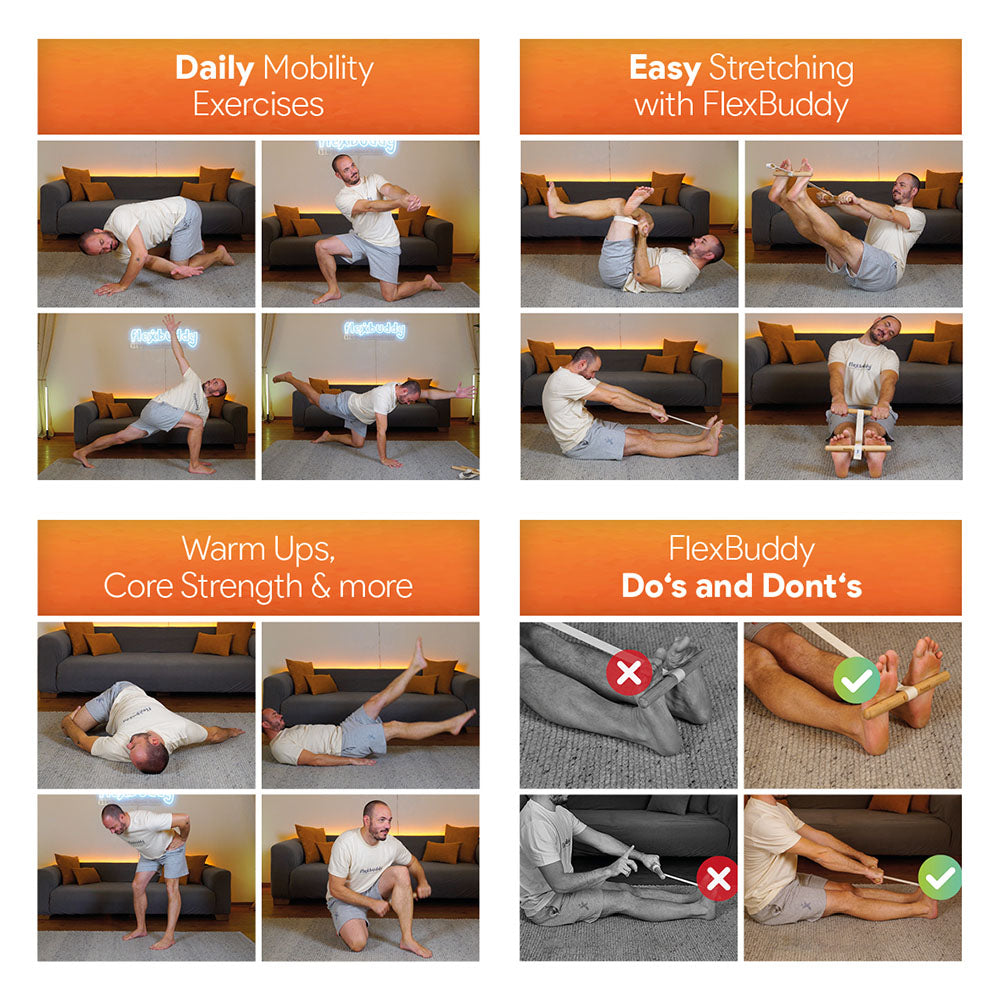
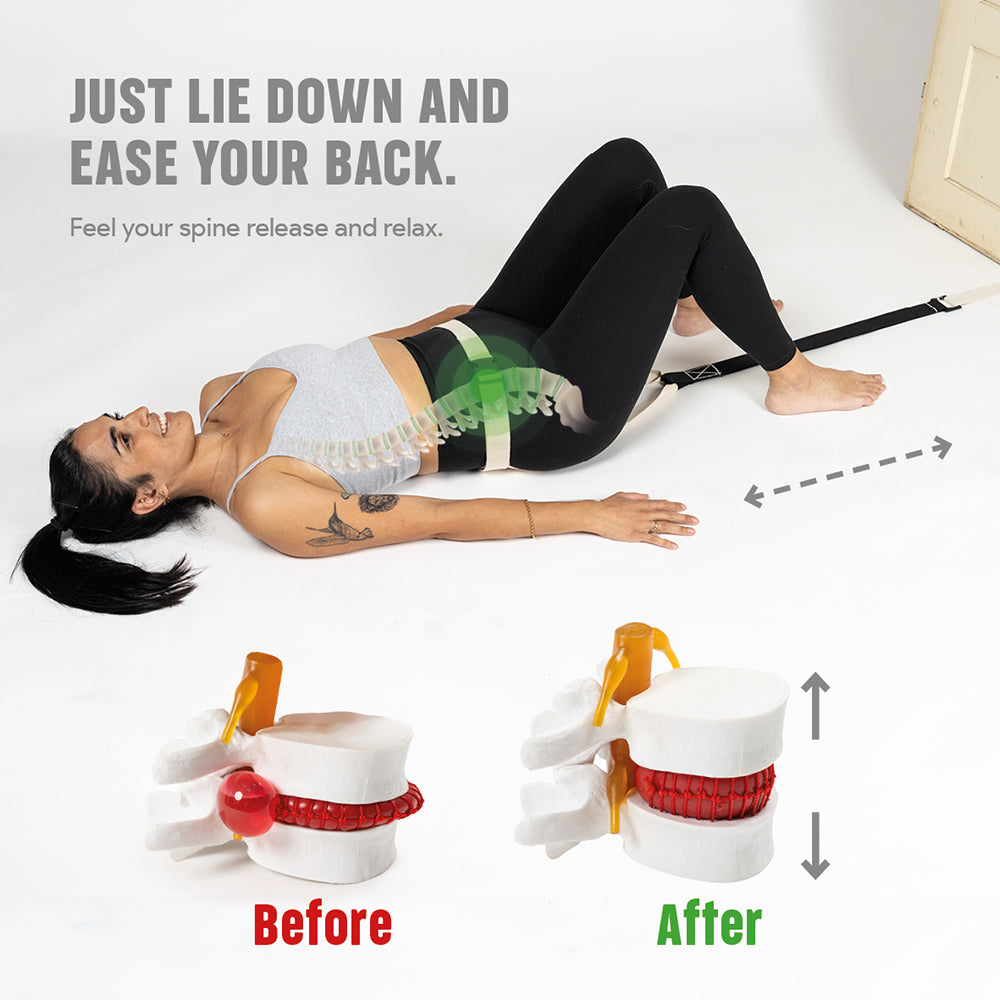
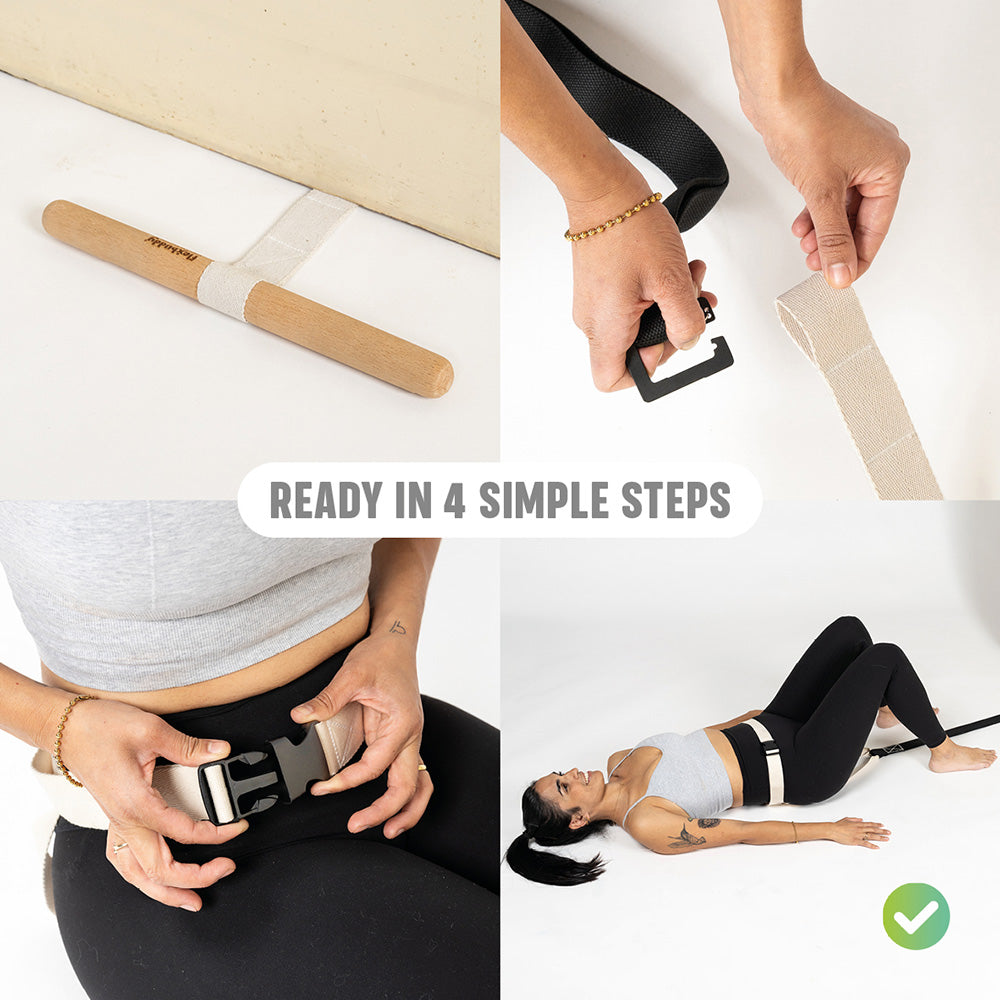
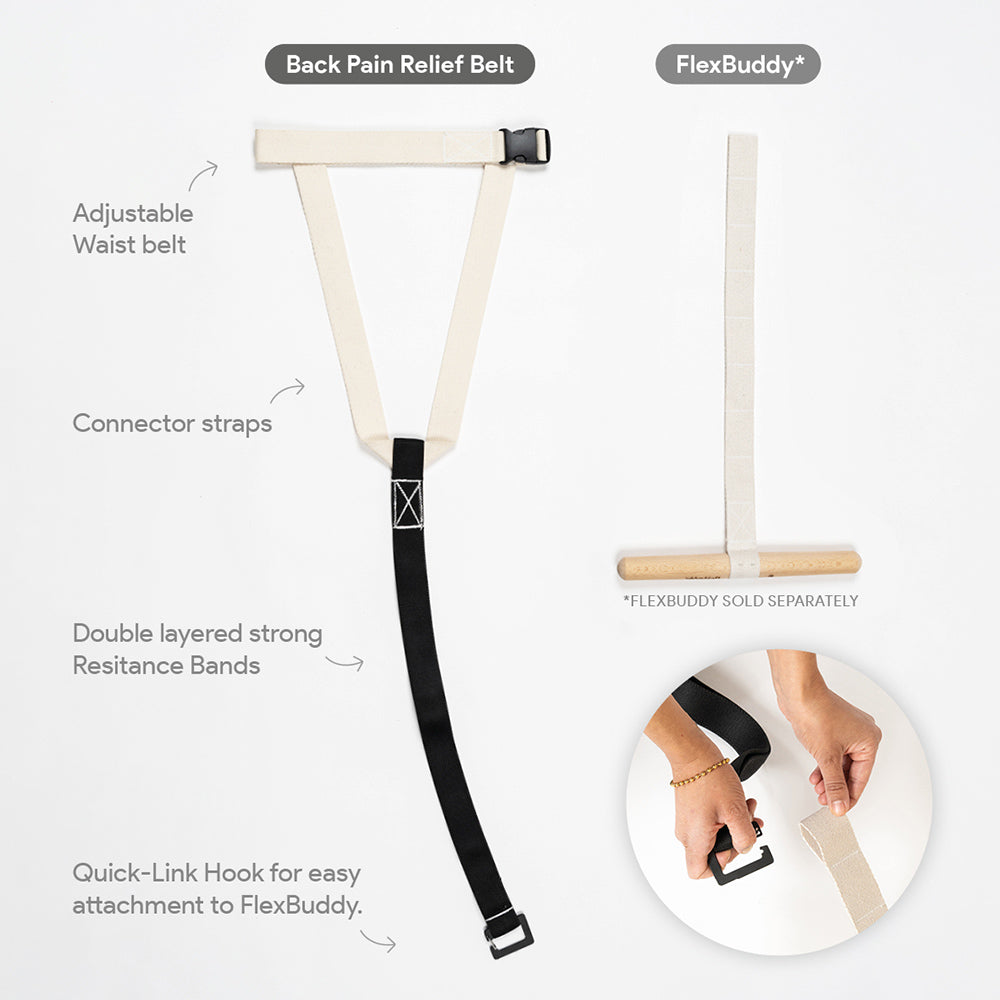
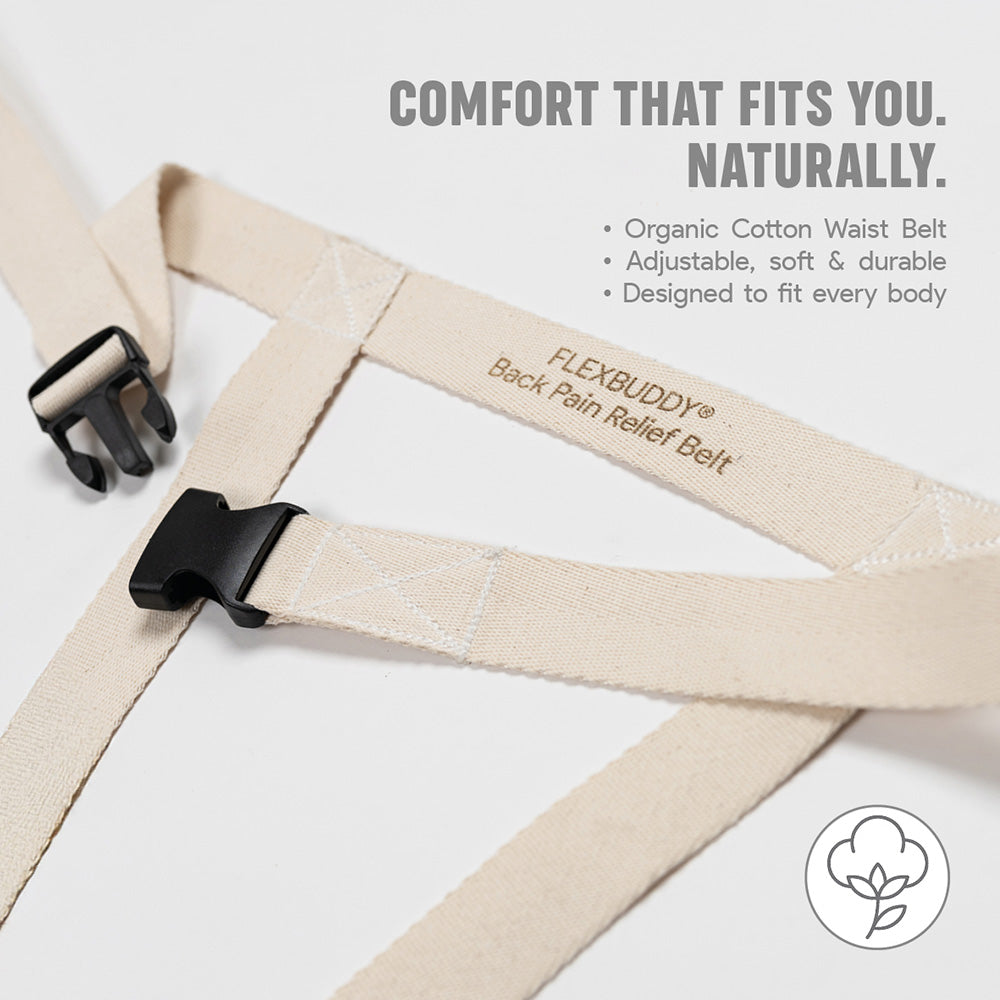
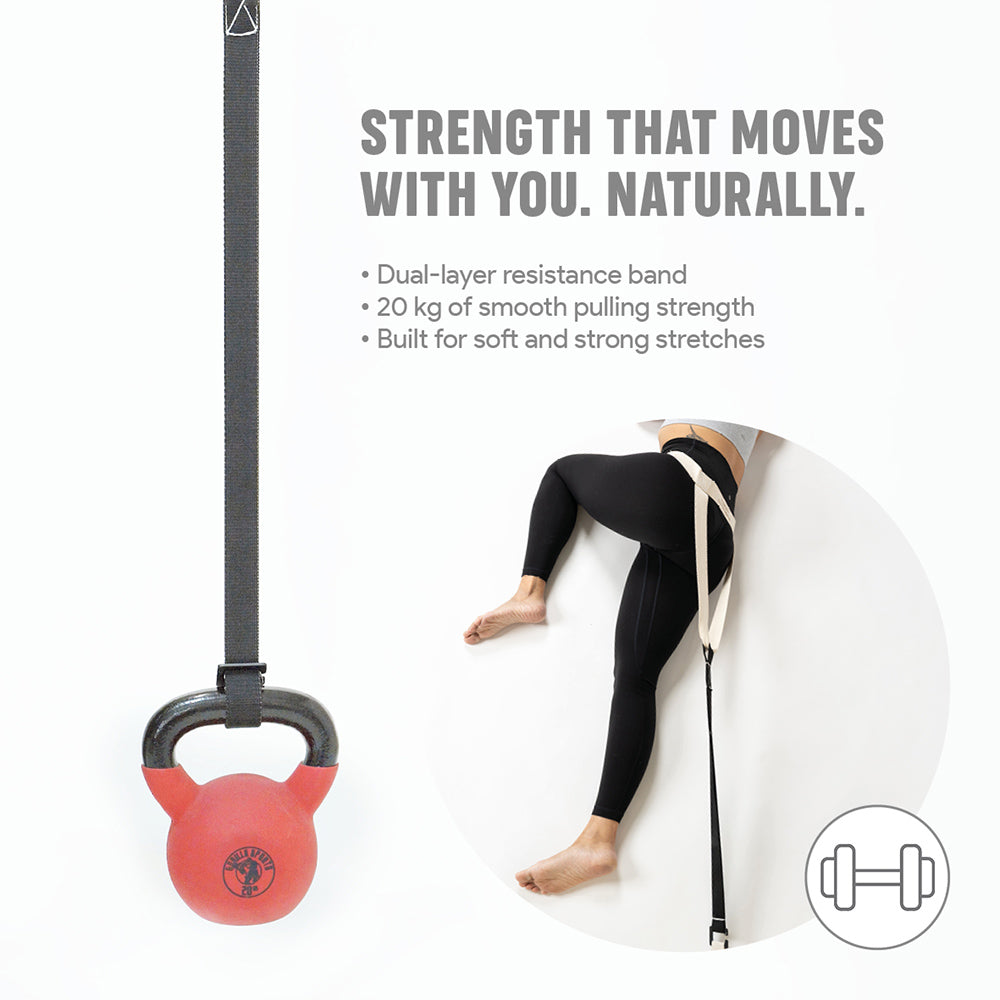
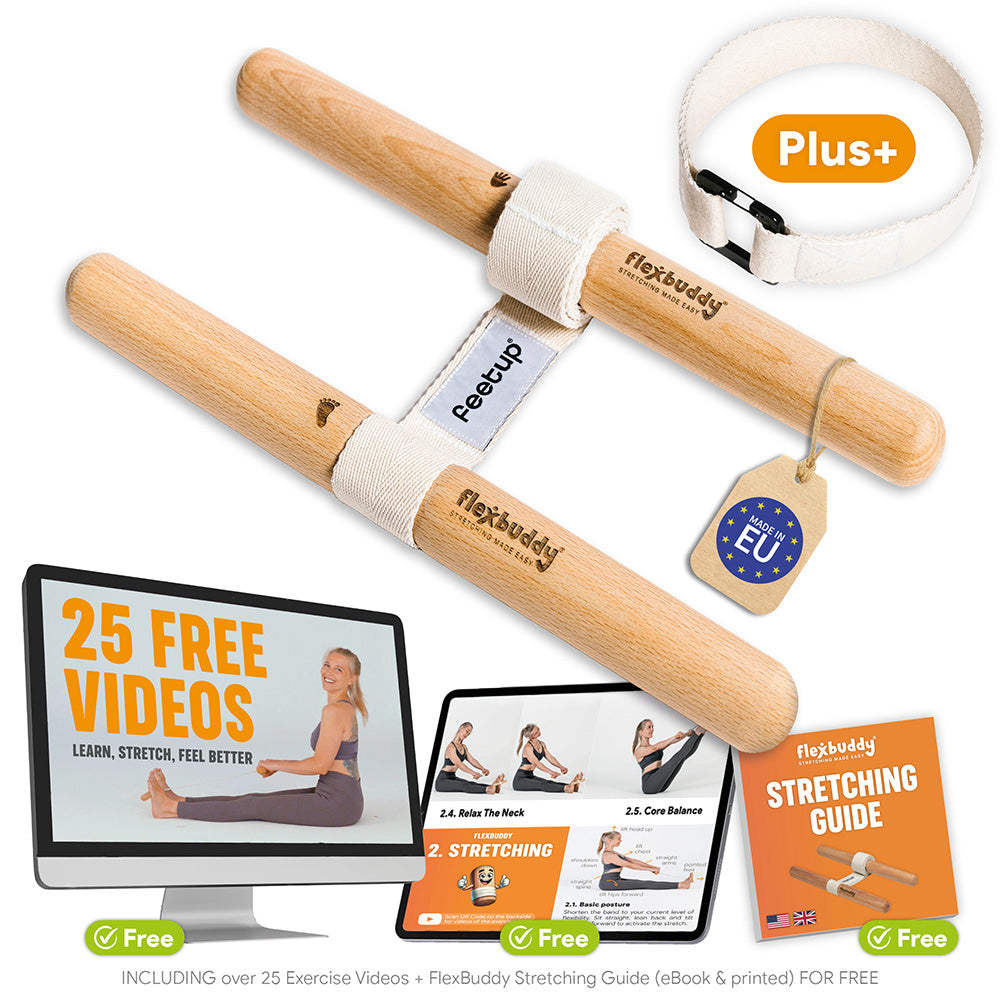
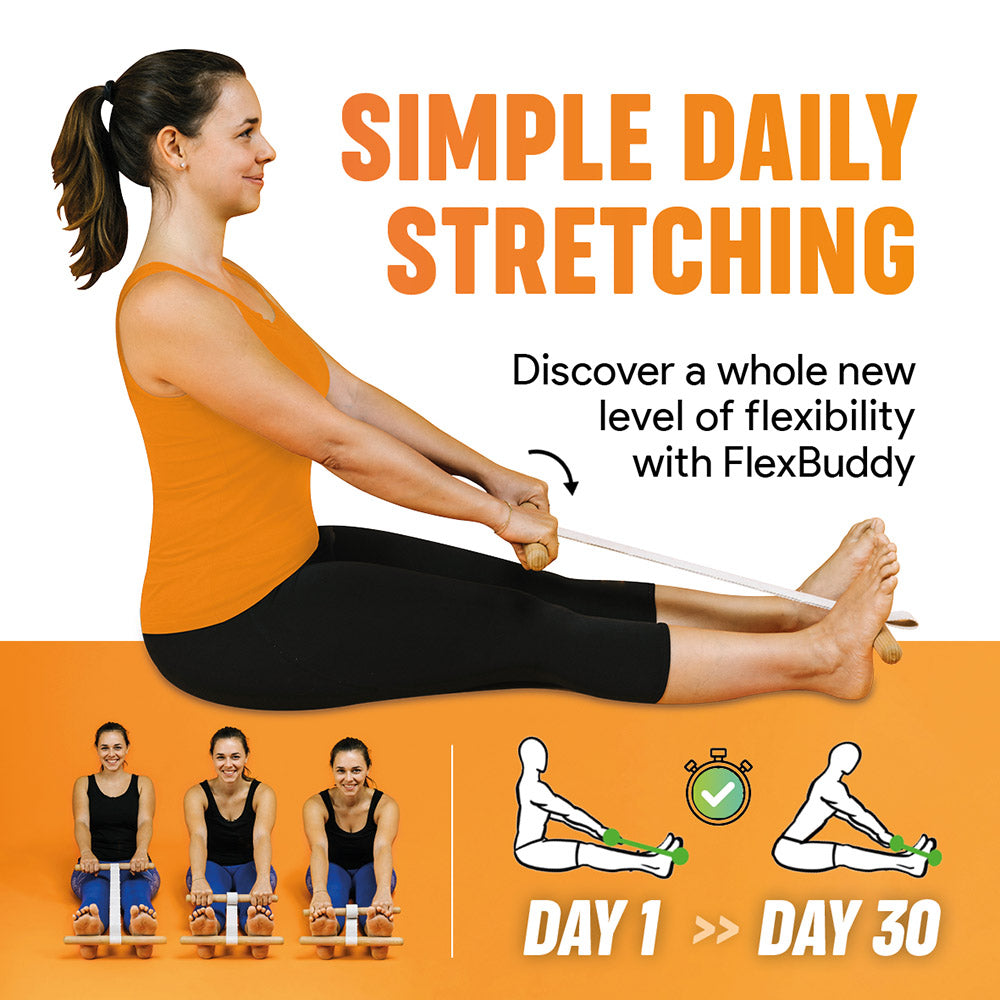
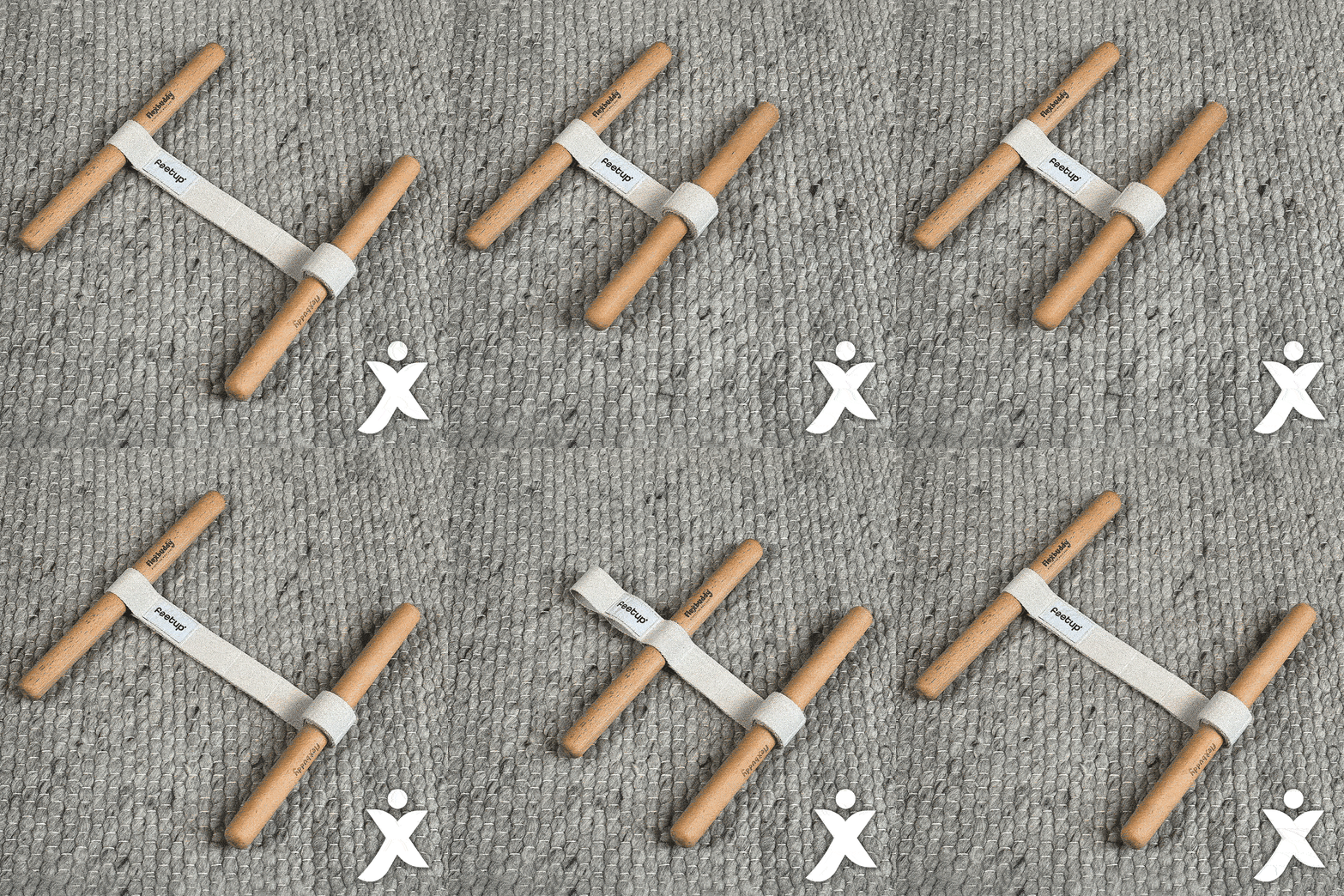
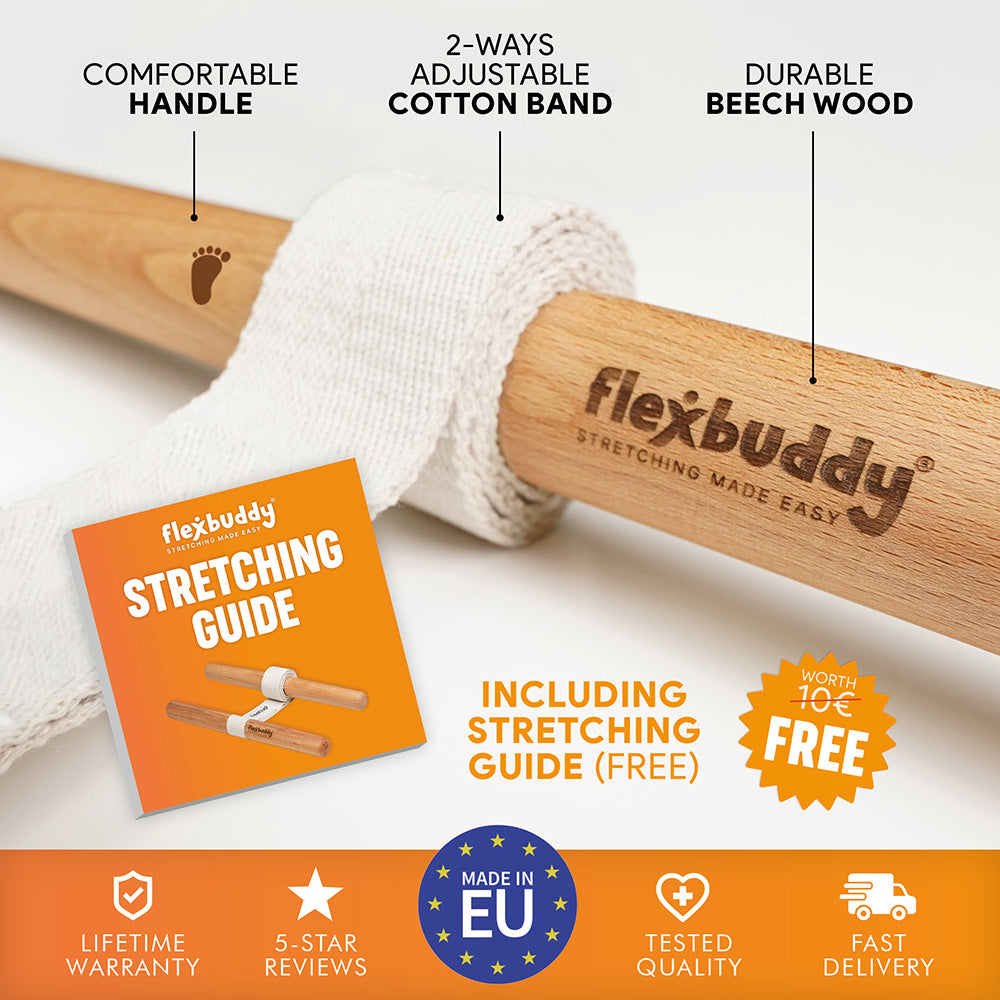
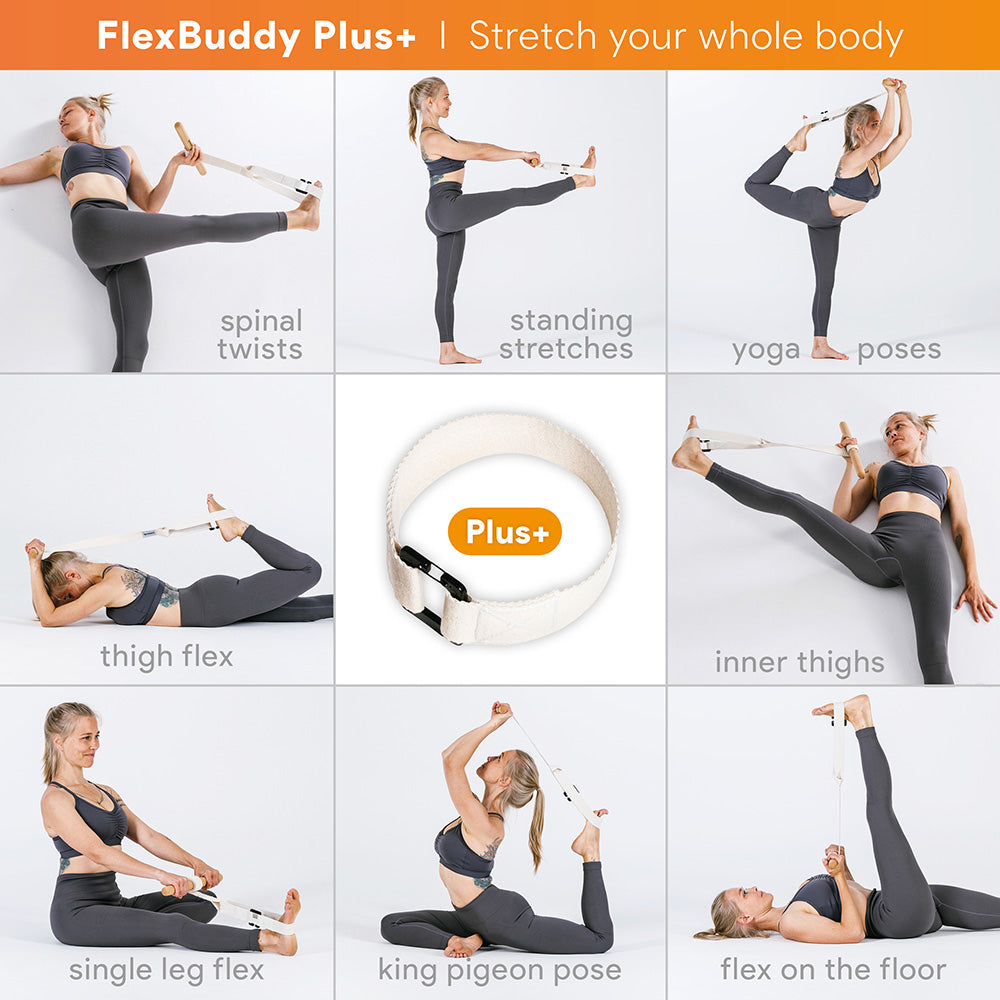
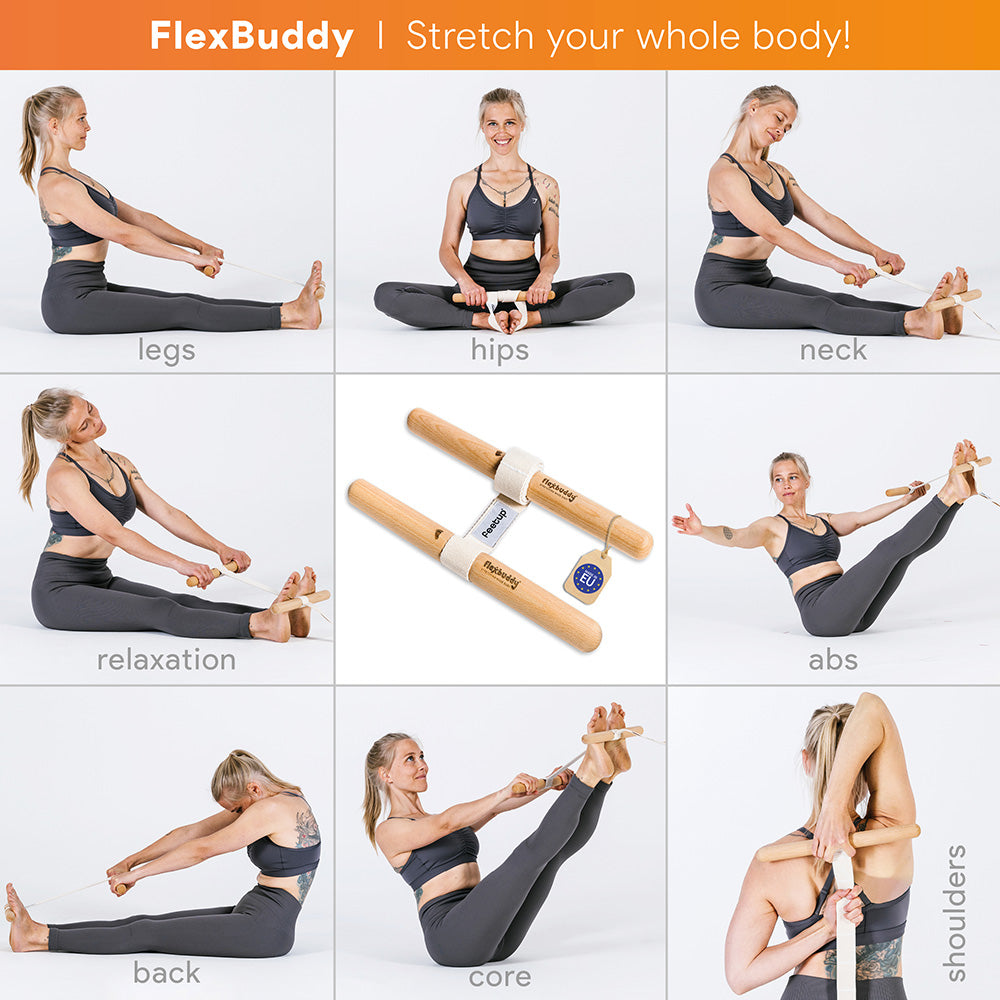
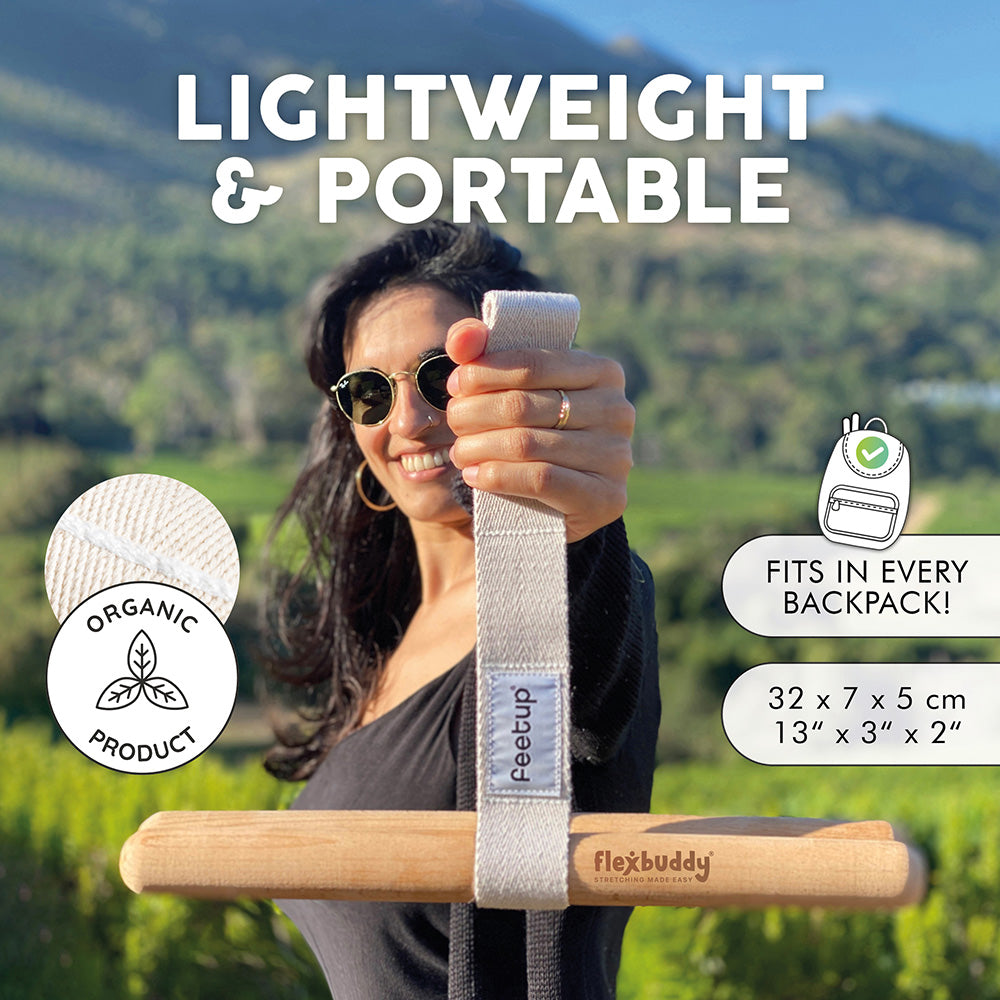
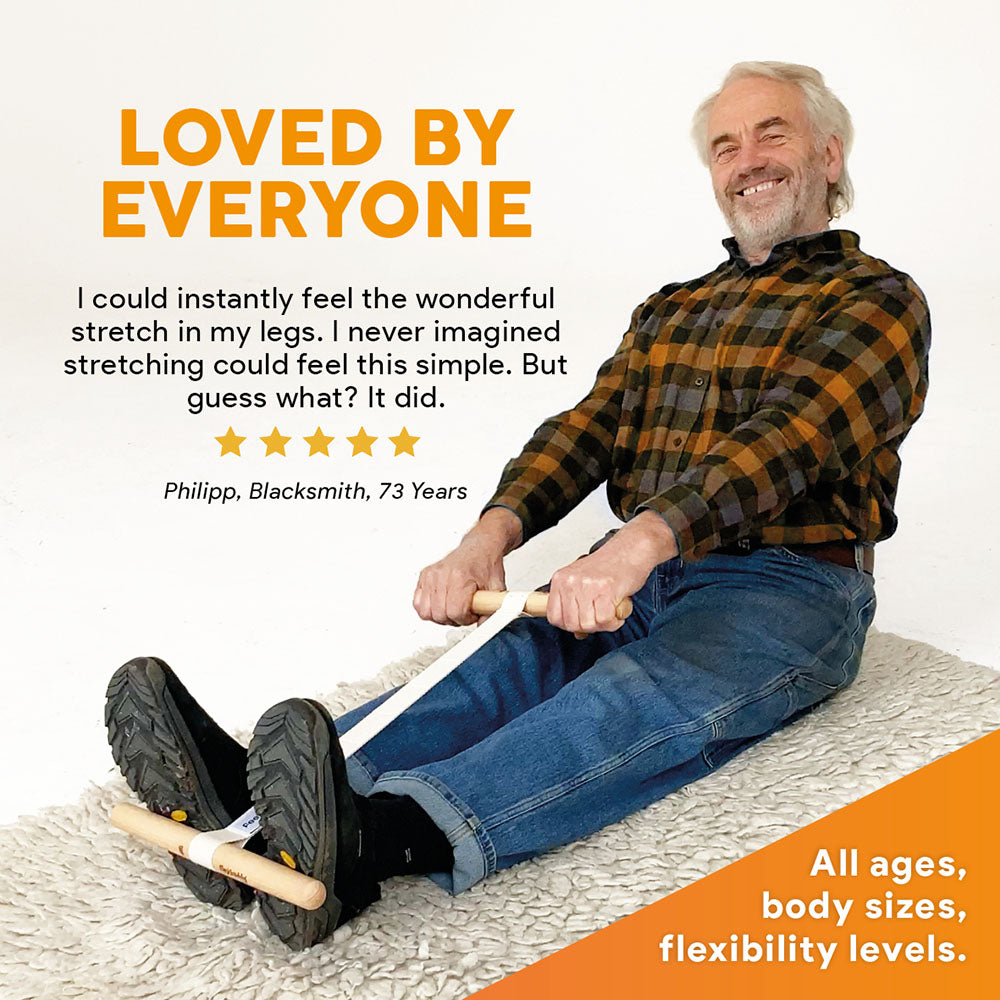
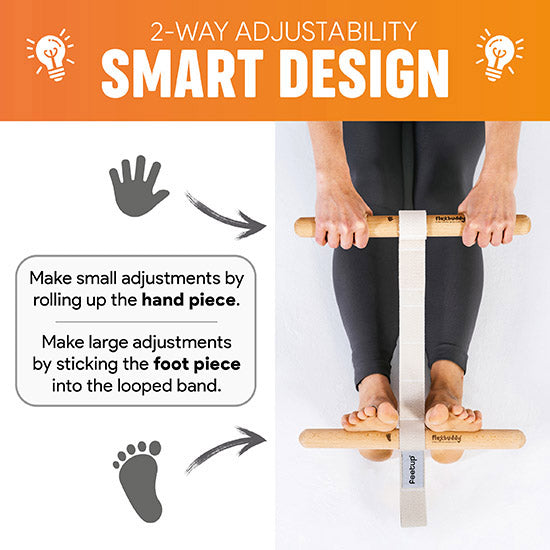
The stretch that does the most for a sitting-sore back, the seated straight-back hamstring stretch, is also the hardest to do correctly: the moment you reach for your feet the lower back rounds and the stretch leaves the legs for the spine. FlexBuddy® is a stretching device made of two beech-wood bars joined by an adjustable cotton strap. One bar sits under the soles of your feet, the other in your hands; you sit tall, lean back and tilt the hips forward, and the strap takes the pull so your back never has to bend to reach. The foot bar moves between loops for big length changes and the hand bar rolls the strap for small ones, so you start long and shorten a notch as the weeks go by. Wooden handles mean nothing cuts into your hands. Ten slow breaths, three times, takes about two minutes. "Sit at a desk 9 hours a day. My lower back used to ache every evening — two weeks in, that's basically gone," wrote one owner, Stephen W. Lifetime warranty, 30-day money-back guarantee. See FlexBuddy, or take the two-minute quiz and choose "lower back after sitting".
Frequently asked questions
Why does my lower back hurt from sitting too long?
Sitting flattens the lumbar curve by around 43 degrees [2] and holds the hip flexors and hamstrings at their shortest length. Sitting alone has not been shown to cause back pain, but long hours combined with a slumped posture or vibration raise the risk about fourfold [1], and in one laboratory study 40% of people developed back pain within a single hour of unbroken typing [17]. Change position every 30 minutes and stretch the hips and hamstrings daily.
Why does my lower back hurt when I go from sitting to standing?
Shortened hip flexors, which attach to the lumbar vertebrae [12], and lumbar joints parked in flexion take a moment to let go when you stand, which you feel as stiff, bent-over first steps. Tilt the pelvis forward and back before you stand, tuck the tailbone as you rise, and stretch the hip flexors daily. Sharp pain or pain travelling down a leg on standing needs a doctor.
Does lower back pain from sitting go away?
Usually, yes. About nine in ten cases have no structural cause [4][5], most episodes improve within a few weeks [11], and staying active speeds recovery while bed rest does not [4]. In office workers, active breaks with a change of posture halved recovery time and cut recurrence from 44% to about 20% [10]; daily stretching plus trunk endurance training cut new episodes from 19.7% to 8.8% [7].
What stretches for lower back pain feel better immediately?
Knee-to-chest, the half-kneeling hip-flexor stretch, the lying hamstring stretch with a strap, cat–cow and child's pose all give relief within a minute or two for most people. It comes from changing the load on the spine and the nervous system tolerating more stretch [8], not from a longer muscle, so it fades if you sit straight back down. Daily practice for weeks is what lasts.
Why is my lower back stiff in the morning, and why does it go away?
Discs take on fluid overnight (pressure rose from 0.1 to 0.24 megapascals during sleep in the classic measurement) [14] and sleeping curled up keeps the hip flexors short, so the spine is stiffest on waking. Stiffness lasting well beyond half an hour that improves with exercise but not rest, and wakes you at night, can be inflammatory back pain [21] and is worth a GP visit.
This article is general information, not medical advice. Tight muscles usually respond well to regular stretching. If your pain is sharp, radiates down a leg, comes with numbness, weakness, fever, bladder or bowel changes, follows an injury, or keeps getting worse, see a doctor or physiotherapist before you stretch.
References
- Lis AM, Black KM, Korn H, Nordin M. Association between sitting and occupational LBP. Eur Spine J. 2007;16(2):283–298. doi:10.1007/s00586-006-0143-7. PMID 16736200 (abstract accessed 4 Nov 2026).
- De Carvalho DE, Soave D, Ross K, Callaghan JP. Lumbar spine and pelvic posture between standing and sitting: a radiologic investigation including reliability and repeatability of the lumbar lordosis measure. J Manipulative Physiol Ther. 2010;33(1):48–55. doi:10.1016/j.jmpt.2009.11.008. PMID 20114100 (abstract accessed 4 Nov 2026).
- Janwantanakul P, Pensri P, Jiamjarasrangsri V, Sinsongsook T. Prevalence of self-reported musculoskeletal symptoms among office workers. Occup Med (Lond). 2008;58(6):436–438. doi:10.1093/occmed/kqn072. PMID 18544589 (abstract accessed 4 Nov 2026).
- Koes BW, van Tulder MW, Thomas S. Diagnosis and treatment of low back pain. BMJ. 2006;332(7555):1430–1434. doi:10.1136/bmj.332.7555.1430. https://pmc.ncbi.nlm.nih.gov/articles/PMC1479671/ (accessed 4 Nov 2026).
- Hartvigsen J, Hancock MJ, Kongsted A, et al.; Lancet Low Back Pain Series Working Group. What low back pain is and why we need to pay attention. Lancet. 2018;391(10137):2356–2367. doi:10.1016/S0140-6736(18)30480-X. PMID 29573870 (abstract accessed 4 Nov 2026).
- Gou Y, Lei H, Chen X, Wang X. The effects of hamstring stretching exercises on pain intensity and function in low back pain patients: a systematic review with meta-analysis of randomized controlled trials. SAGE Open Med. 2024;12:20503121241252251. doi:10.1177/20503121241252251. PMID 39086556 / PMC11289822 (accessed 4 Nov 2026).
- Sihawong R, Janwantanakul P, Jiamjarasrangsi W. A prospective, cluster-randomized controlled trial of exercise program to prevent low back pain in office workers. Eur Spine J. 2014;23(4):786–793. doi:10.1007/s00586-014-3212-3. PMID 24492949 / PMC3960439 (accessed 4 Nov 2026).
- Weppler CH, Magnusson SP. Increasing muscle extensibility: a matter of increasing length or modifying sensation? Phys Ther. 2010;90(3):438–449. doi:10.2522/ptj.20090012. PMID 20075147 (abstract accessed 4 Nov 2026).
- Waongenngarm P, Areerak K, Janwantanakul P. The effects of breaks on low back pain, discomfort, and work productivity in office workers: a systematic review of randomized and non-randomized controlled trials. Appl Ergon. 2018;68:230–239. doi:10.1016/j.apergo.2017.12.003. PMID 29409639 (abstract accessed 4 Nov 2026).
- Akkarakittichoke N, Waongenngarm P, Janwantanakul P. The effects of active break and postural shift interventions on recovery from and recurrence of neck and low back pain in office workers: a 3-arm cluster-randomized controlled trial. Musculoskelet Sci Pract. 2021;56:102451. doi:10.1016/j.msksp.2021.102451. PMID 34450361 (abstract accessed 4 Nov 2026).
- NHS. Back pain. Page last reviewed 5 March 2026. https://www.nhs.uk/conditions/back-pain/ (accessed 4 Nov 2026).
- Jones O. Muscles of the Anterior Thigh (iliopsoas). TeachMeAnatomy, last updated 11 Oct 2026. https://teachmeanatomy.info/lower-limb/muscles/thigh/anterior-compartment/ (accessed 4 Nov 2026).
- Hori M, Hasegawa H, Takasaki H. Comparisons of hamstring flexibility between individuals with and without low back pain: systematic review with meta-analysis. Physiother Theory Pract. 2021;37(5):559–582. doi:10.1080/09593985.2019.1639868. PMID 31317831 (abstract accessed 4 Nov 2026).
- Wilke HJ, Neef P, Caimi M, Hoogland T, Claes LE. New in vivo measurements of pressures in the intervertebral disc in daily life. Spine. 1999;24(8):755–762. doi:10.1097/00007632-199904150-00005. PMID 10222525 (abstract accessed 4 Nov 2026).
- Garber CE, Blissmer B, Deschenes MR, et al.; American College of Sports Medicine. Position stand: quantity and quality of exercise for developing and maintaining cardiorespiratory, musculoskeletal, and neuromotor fitness in apparently healthy adults. Med Sci Sports Exerc. 2011;43(7):1334–1359. doi:10.1249/MSS.0b013e318213fefb. PMID 21694556 (abstract accessed 4 Nov 2026).
- Harvard Health Publishing. The ideal stretching routine. Harvard Medical School, 16 Mar 2026 (reviewed by H. E. LeWine, MD). https://www.health.harvard.edu/staying-healthy/the-ideal-stretching-routine (accessed 4 Nov 2026).
- Sheahan PJ, Diesbourg TL, Fischer SL. The effect of rest break schedule on acute low back pain development in pain and non-pain developers during seated work. Appl Ergon. 2016;53 Pt A:64–70. doi:10.1016/j.apergo.2015.08.013. PMID 26674405 (abstract accessed 4 Nov 2026).
- Barone Gibbs B, Hergenroeder AL, Perdomo SJ, Kowalsky RJ, Delitto A, Jakicic JM. Reducing sedentary behaviour to decrease chronic low back pain: the Stand Back randomised trial. Occup Environ Med. 2018;75(5):321–327. doi:10.1136/oemed-2017-104732. PMID 29330230 / PMC8283944 (abstract accessed 4 Nov 2026).
- Shrestha N, Kukkonen-Harjula KT, Verbeek JH, Ijaz S, Hermans V, Pedisic Z. Workplace interventions for reducing sitting at work. Cochrane Database Syst Rev. 2018;6:CD010912. doi:10.1002/14651858.CD010912.pub4. PMID 29926475 (abstract accessed 4 Nov 2026).
- Agarwal S, Steinmaus C, Harris-Adamson C. Sit-stand workstations and impact on low back discomfort: a systematic review and meta-analysis. Ergonomics. 2018;61(4):538–552. doi:10.1080/00140139.2017.1402960. PMID 29115188 (abstract accessed 4 Nov 2026).
- NHS. Ankylosing spondylitis: symptoms. Page last reviewed 5 January 2023. https://www.nhs.uk/conditions/ankylosing-spondylitis/symptoms/ (accessed 4 Nov 2026).