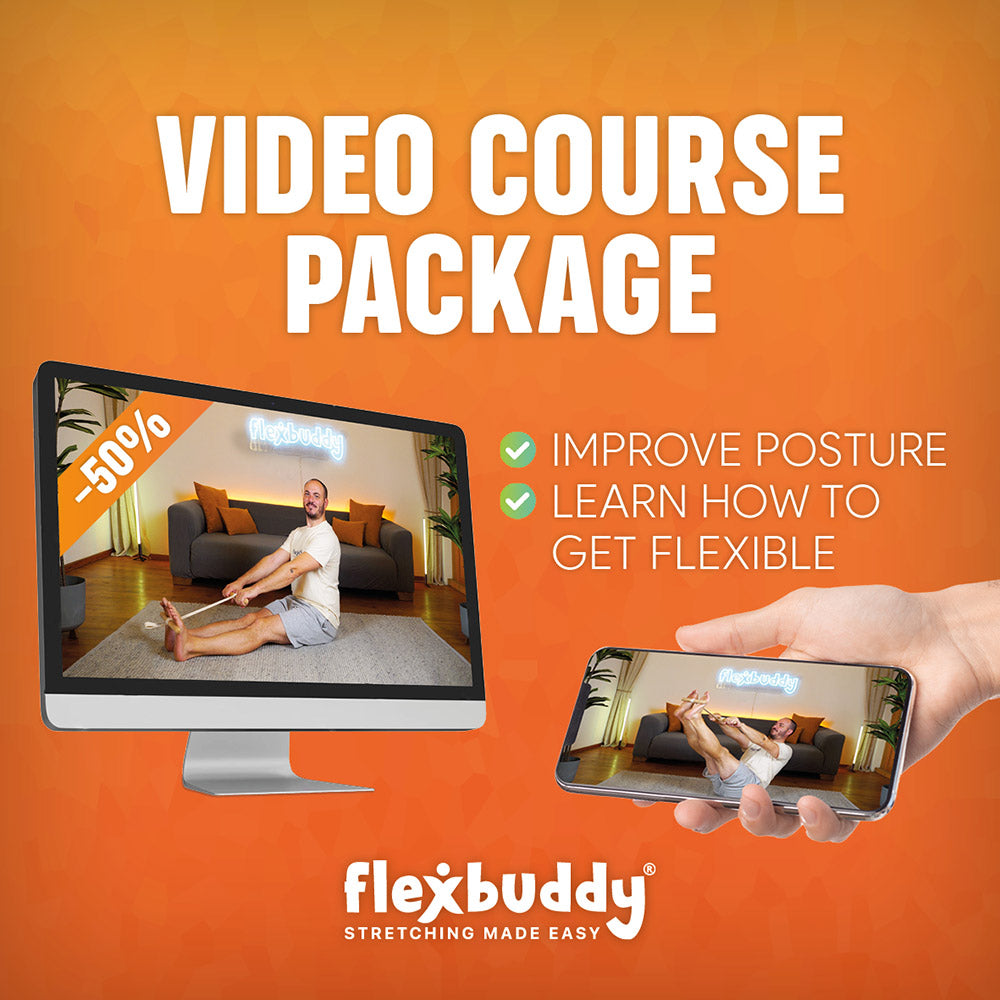
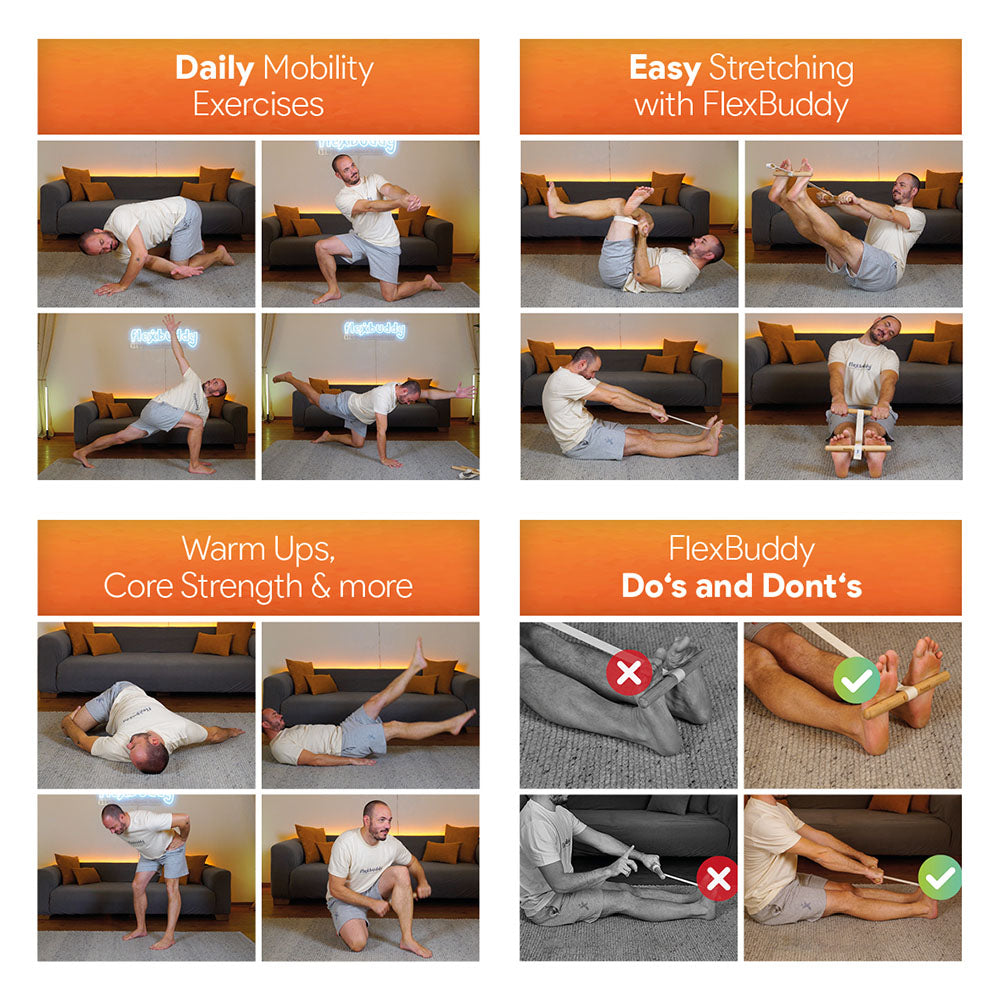
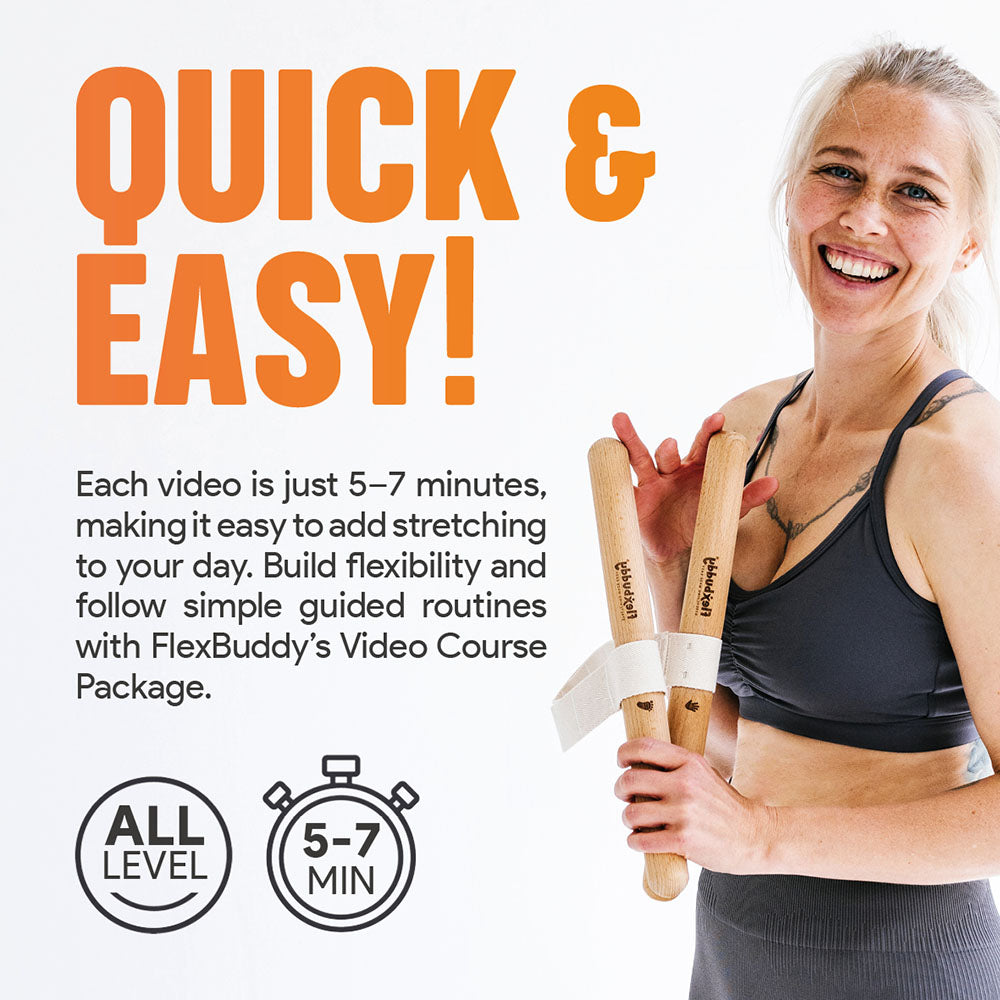
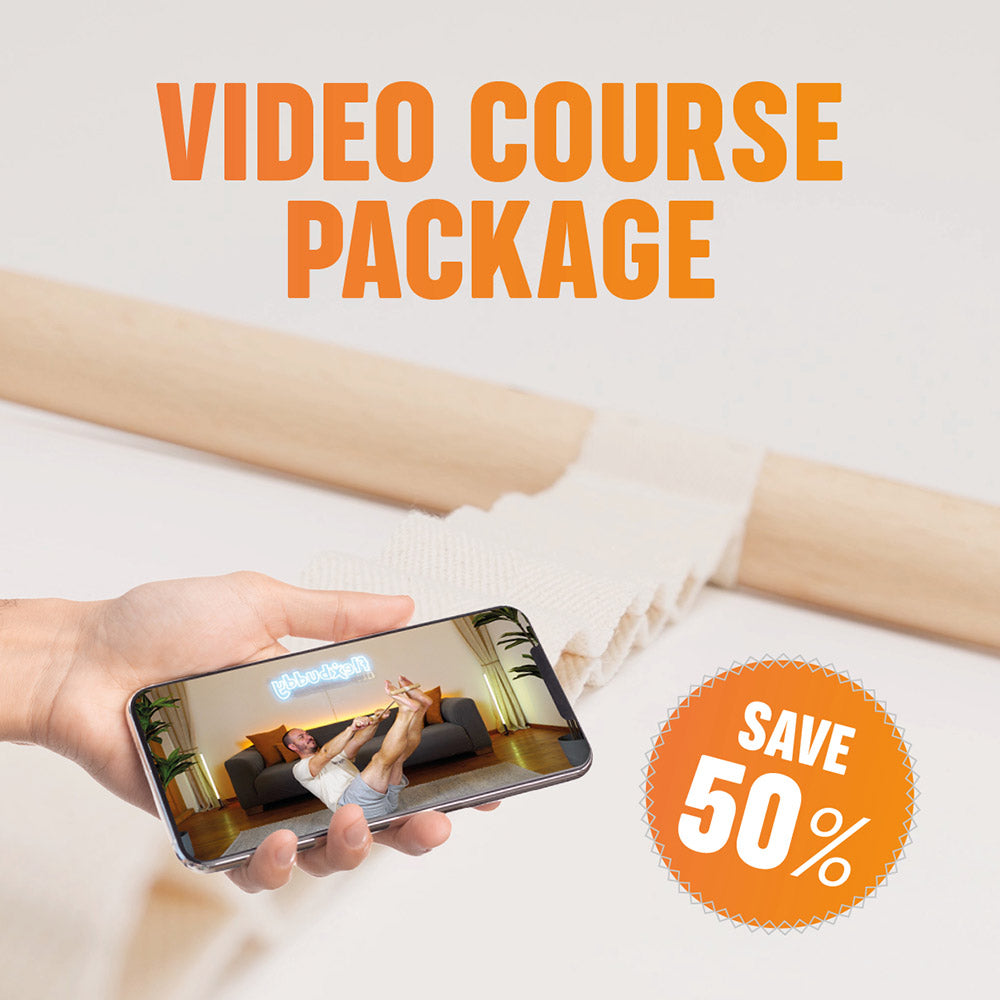
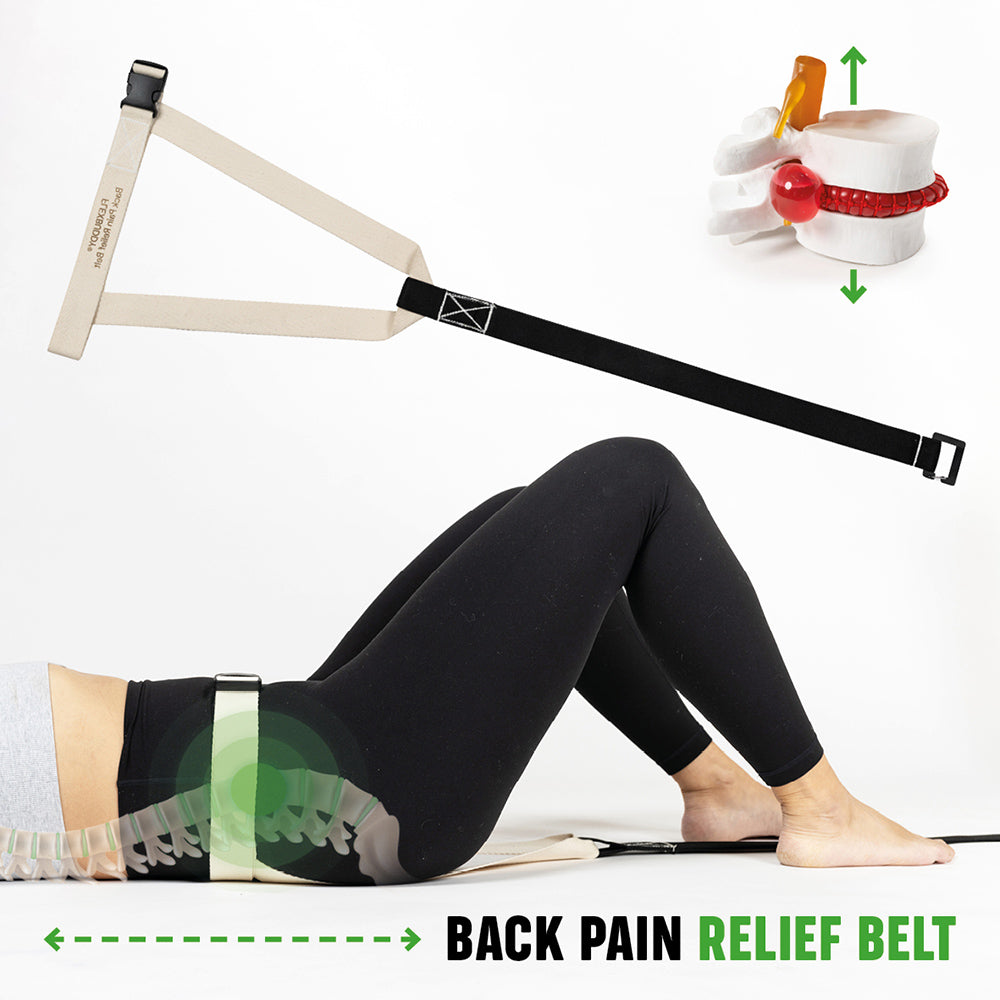
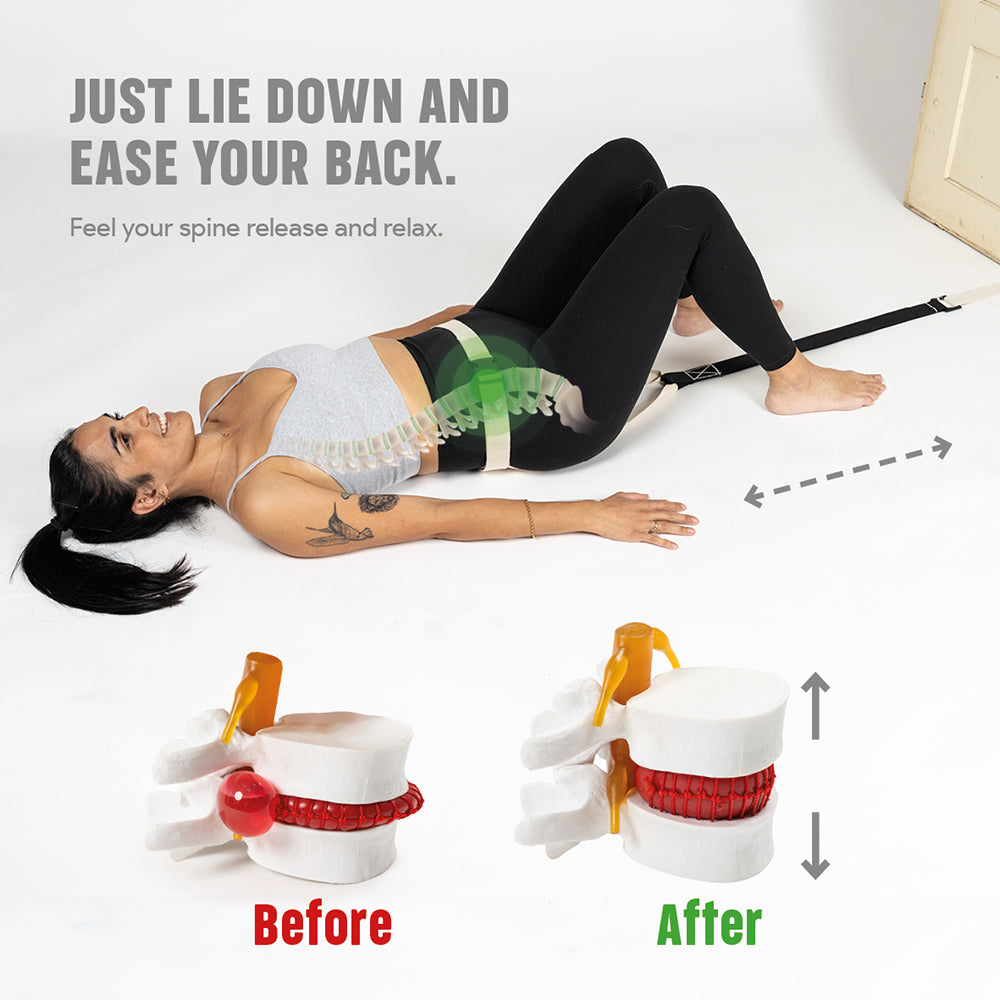
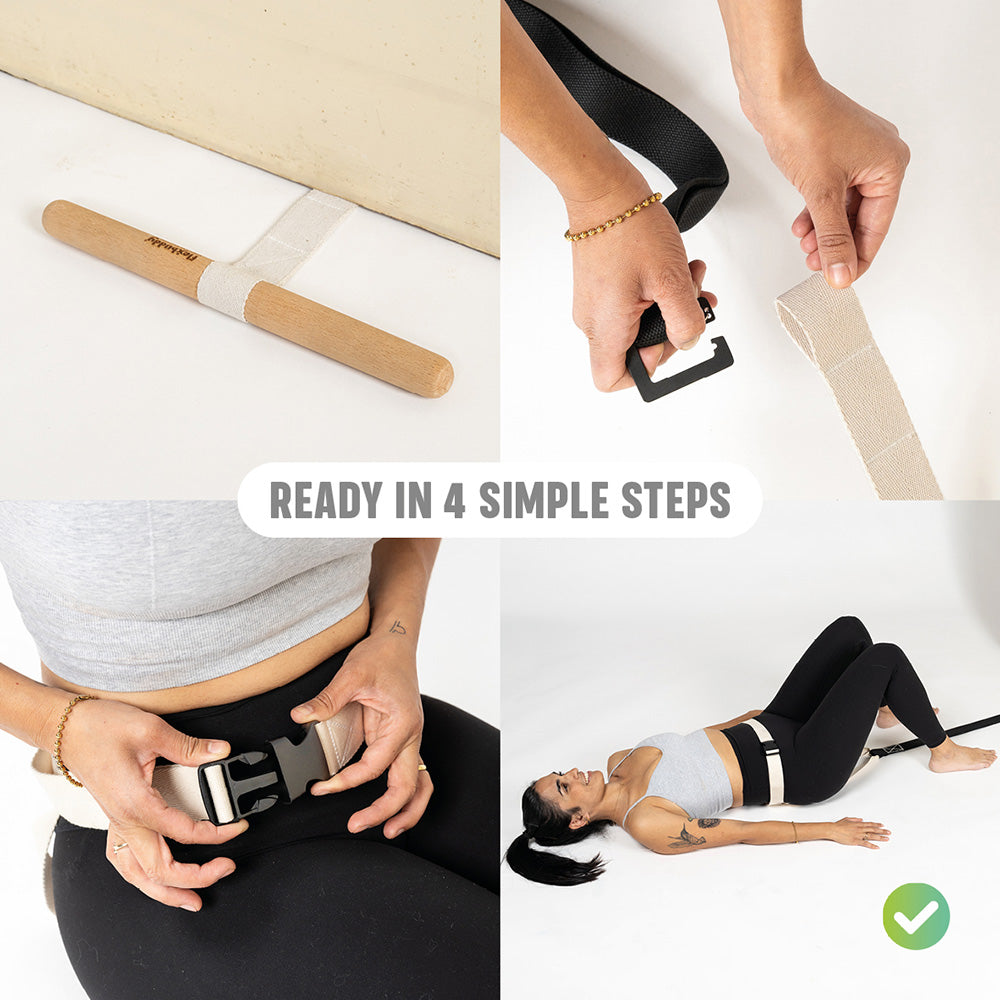
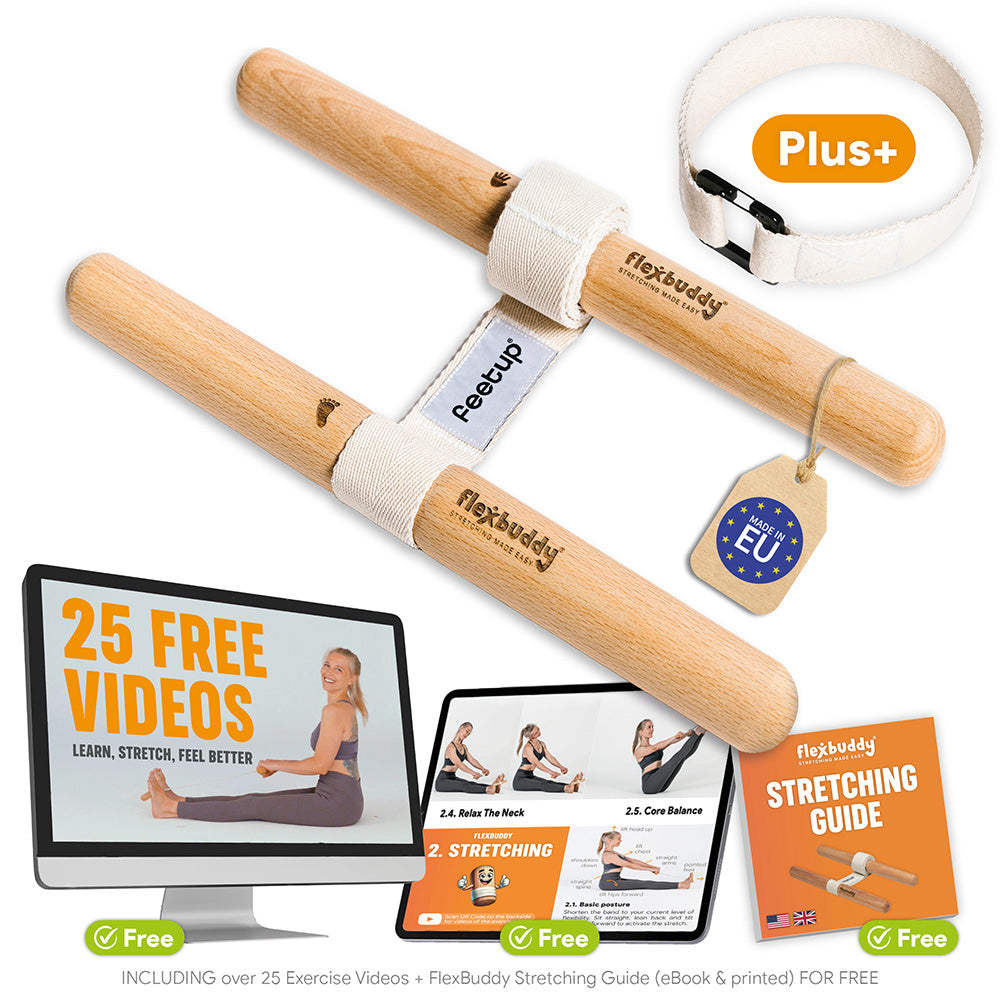
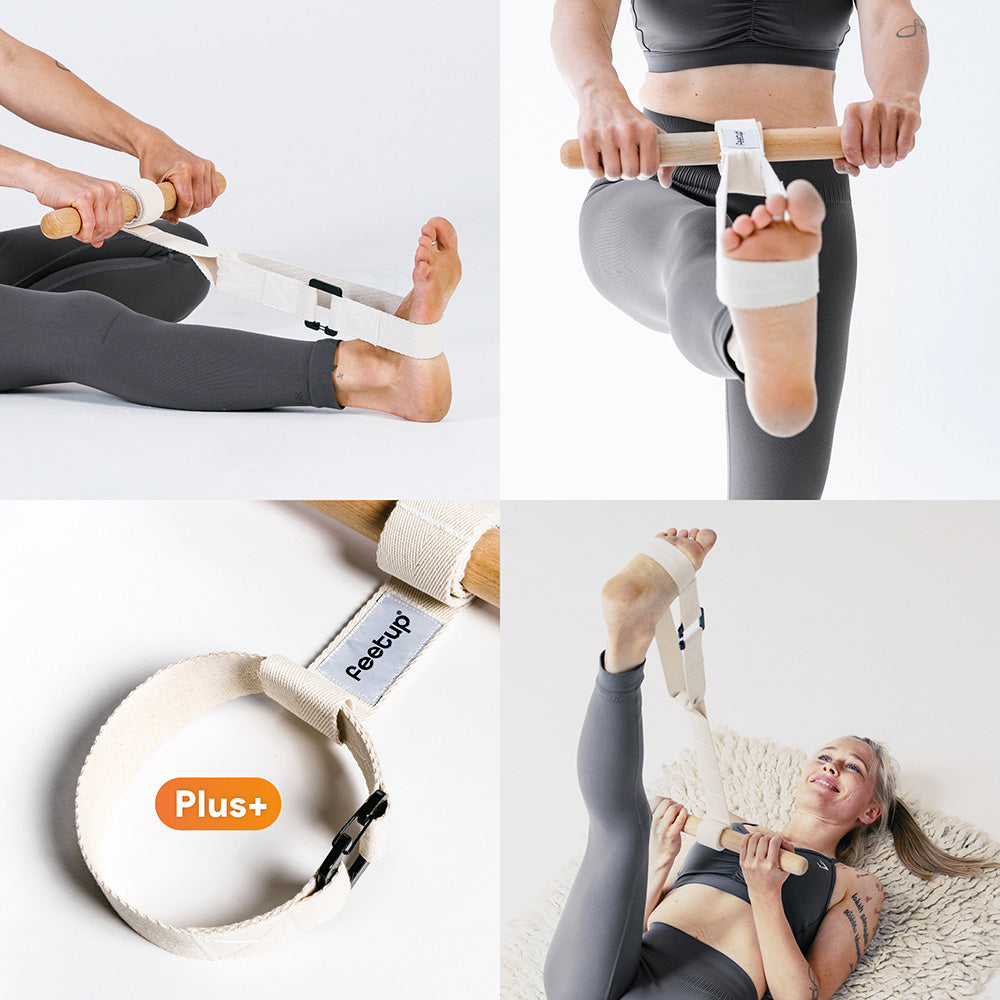
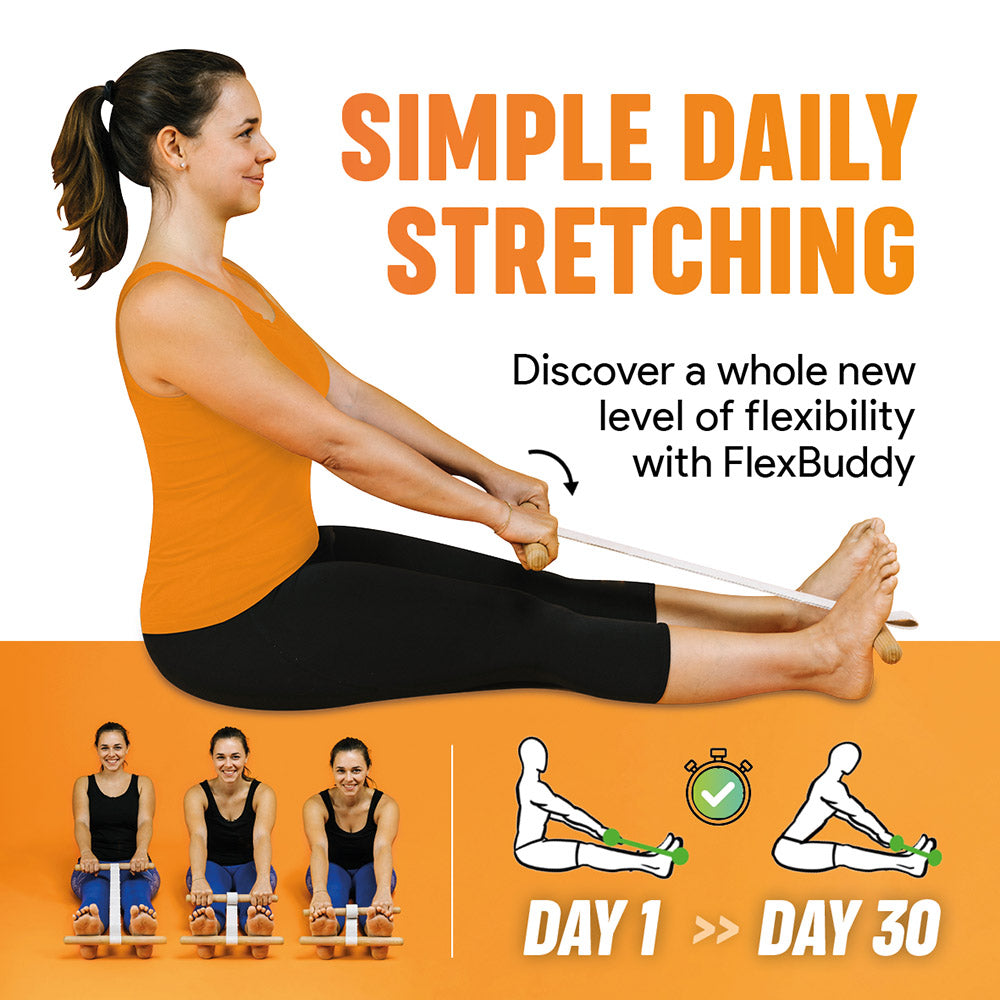
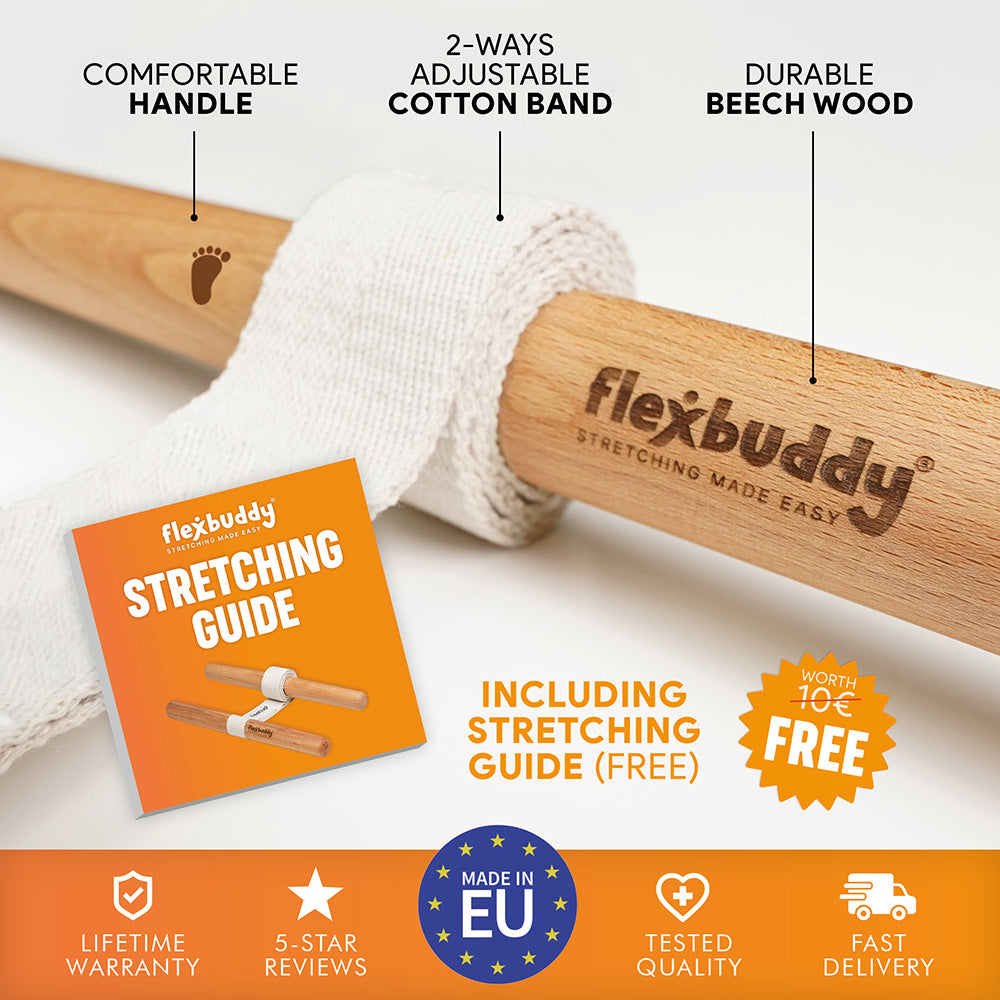
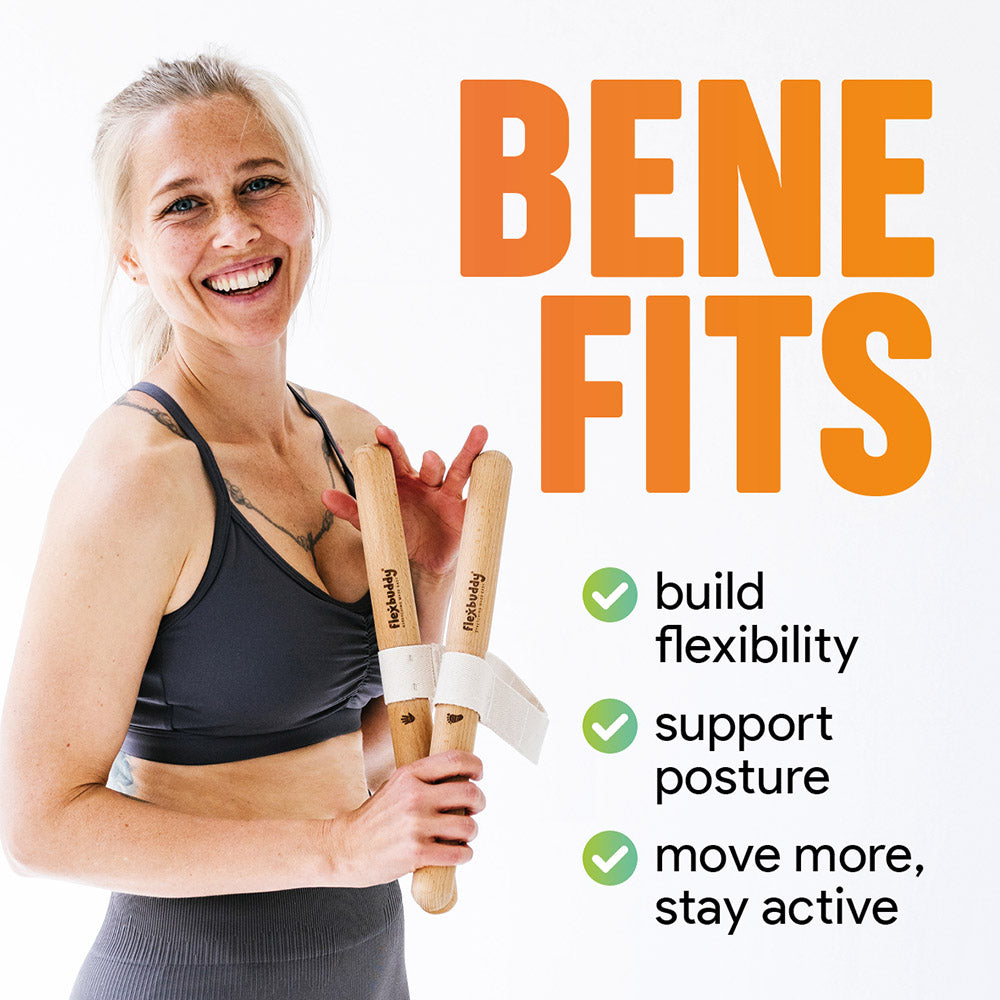
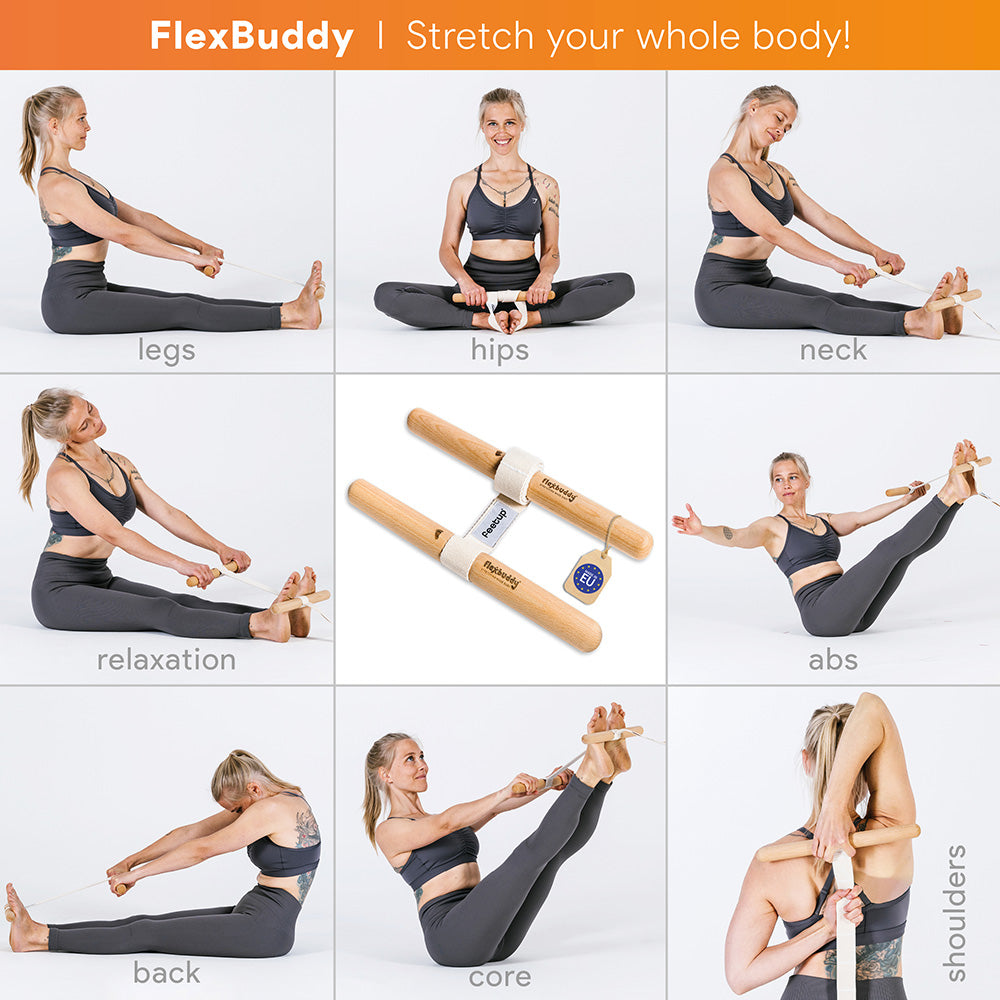
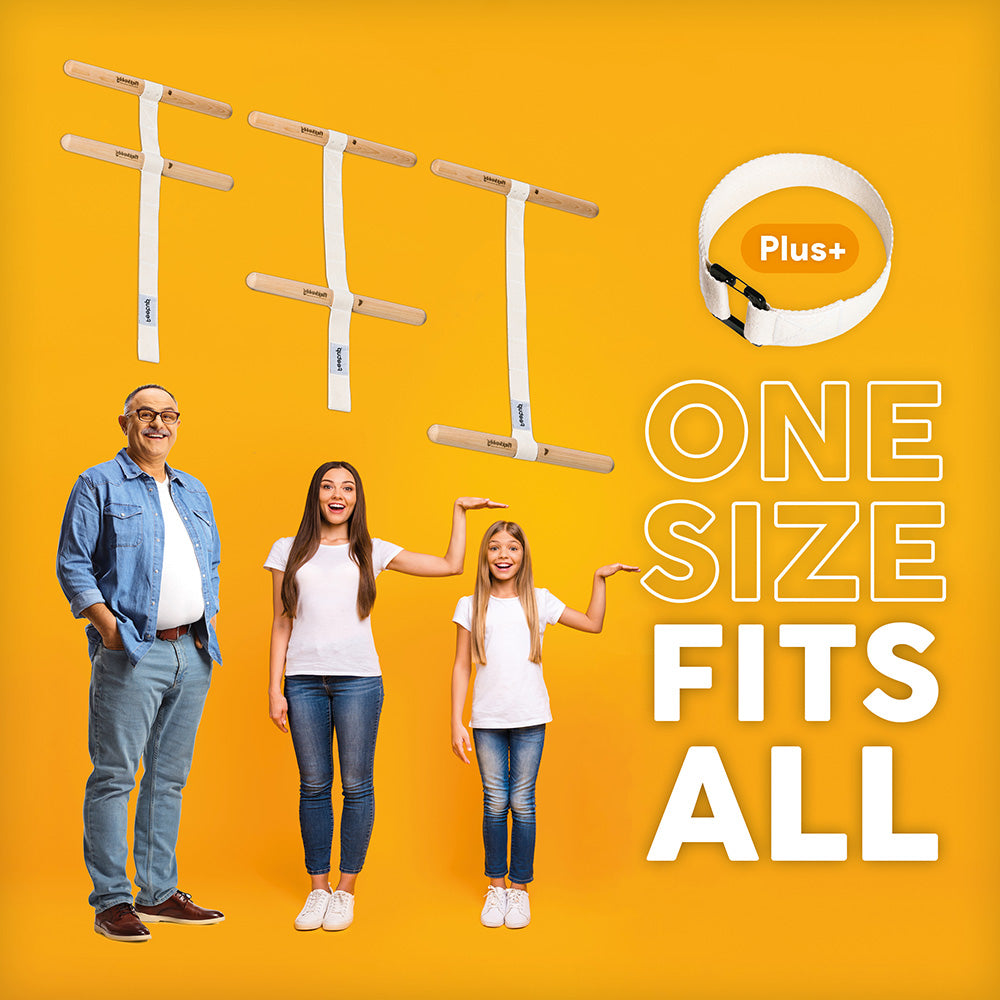
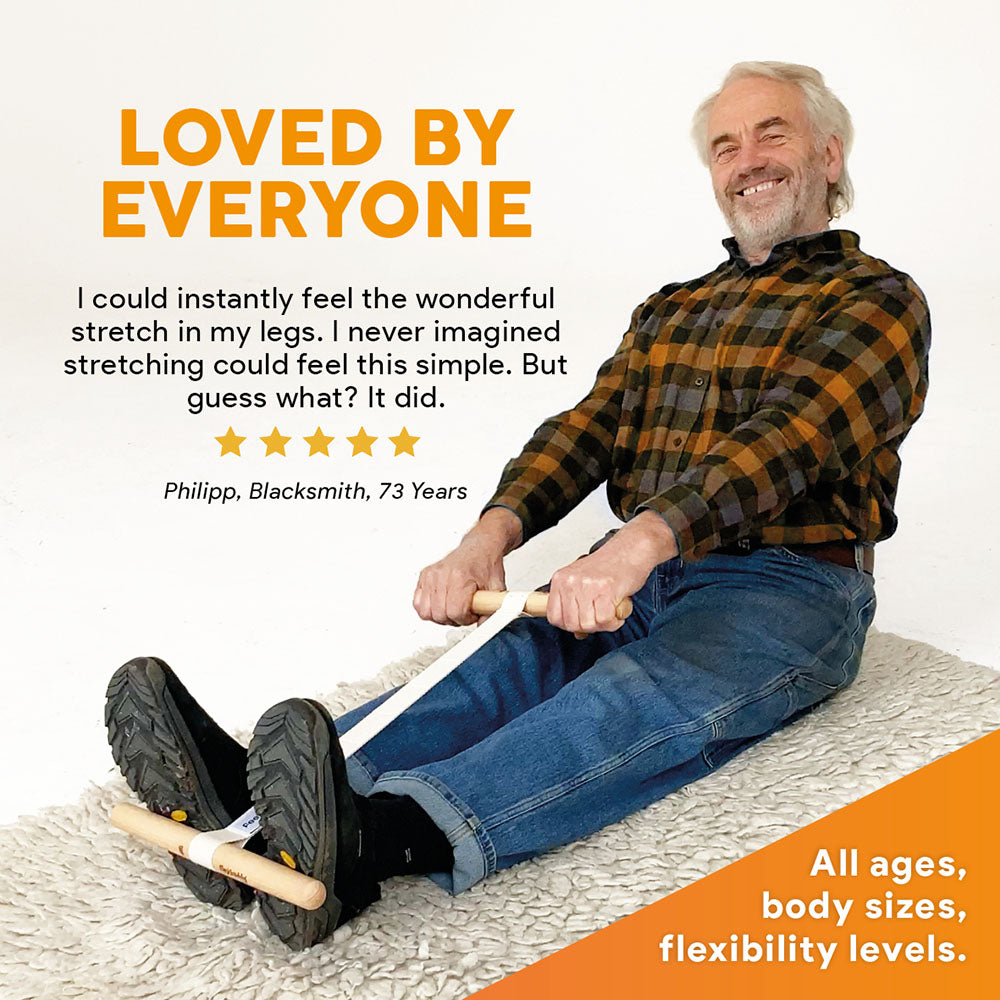
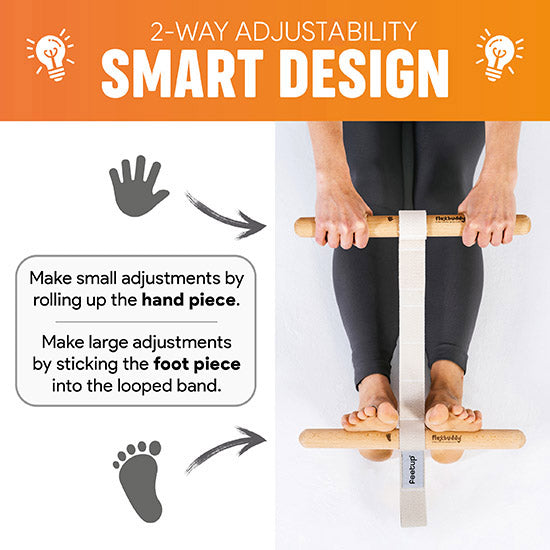
- The strap does the reaching. FlexBuddy® is two beech-wood bars joined by an adjustable cotton strap. The foot bar goes under the balls of both feet, the hand bar is held with straight arms, and your back stays long while the stretch lands in your legs.
- Setup takes a minute. Foot bar in the longest loop, sit tall, lean back, tilt the hips. Loops give big changes of length; rolling the strap around the hand bar, underhand, gives small ones. Go barefoot or wear grippy socks: shoes make the foot bar slip.
- One posture is the whole method. Sit straight, lean back, hips forward, shoulders down, chest lifted, ten deep breaths. You feel the back of the thighs let go, and nothing in the lower back.
- Two minutes a day is a real dose. Guidelines ask for about 60 seconds of stretching per muscle group on at least two to three days a week [1][2]. The two-minute routine gives you that every day, and programmes of three to eight weeks show measurable gains in range [3].
- You try it without risk. Rated 4.5 by verified buyers, with a 30-day money-back guarantee and a lifetime warranty.
So you've got a FlexBuddy, or you're standing at the checkout page wondering if you'll actually use it. You will. Most people don't quit stretching because it's hard. They quit because they never had a routine simple enough to repeat on a Tuesday night when they're tired. This guide gives you that routine: setup, the one posture everything is built on, your first five exercises, two routines and a quick fix for every first-week question.
What is in the box, and what each part does
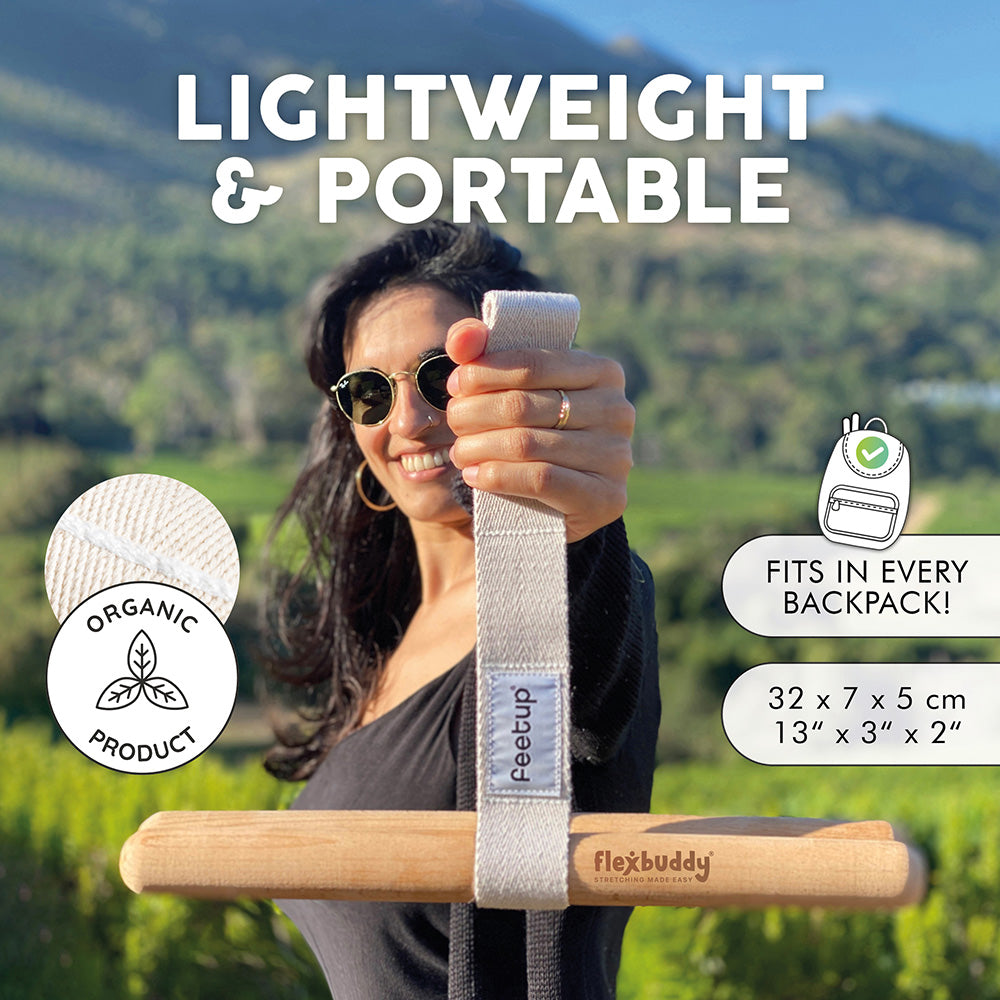
The device is one piece: two bars of beech wood joined by a natural-cotton strap with a row of sewn loops, about 32 by 7 by 5 cm, one size for people from 142 to 198 cm tall. It is patented and made in a single factory in Romania; the seams are the structural joint, and the strap is stress-tested before it ships.
- The hand bar is fixed to the strap. Held with straight arms, it spreads the pull across your palms instead of cutting into your fingers. Comfortable wooden handles, no rope burn.
- The foot bar is loose. It sits in whichever loop you choose and stays there because your feet press into it. That is why bare feet or grippy socks work and shoes do not.
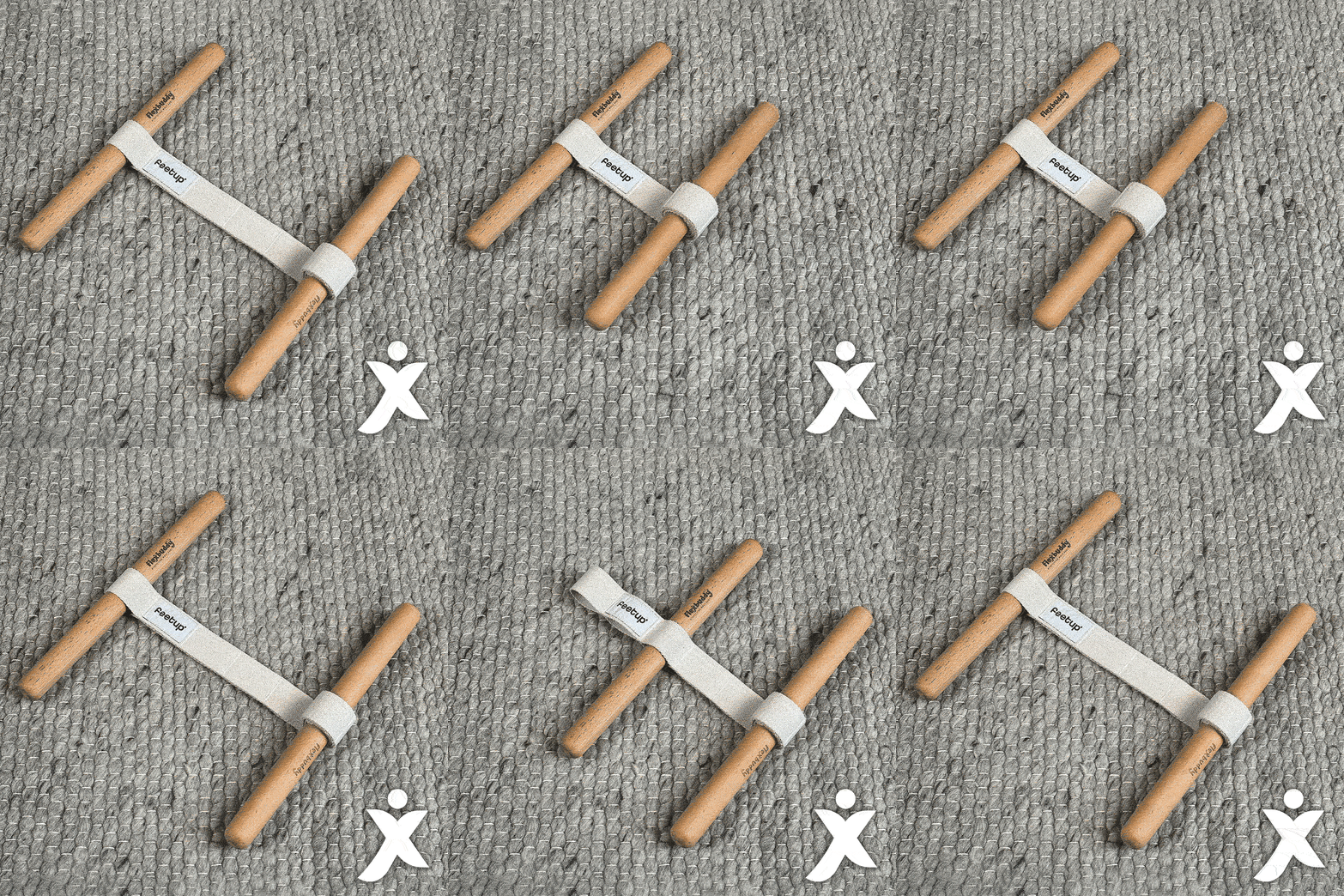
- The strap is the adjustment: loops for big steps, turns around the hand bar for fine ones. Every setting repeats, so you always know where you are.
The written instructions are the 24-page Stretching Guide, reached through the QR code that comes with the device and at flexbuddy.com, where the free exercise videos live.
Setting it up in 60 seconds
Choose the loop
Start long. Foot bar in the loop furthest from the hand bar, sit on the floor with legs straight, bar under the balls of both feet, hand bar in straight arms, lean back slightly. A mild pull in the back of the thighs while you sit upright with a long spine is your setting. Nothing yet? One loop closer. Lower back rounding? One loop back, or bend the knees. Flexibility, not height, decides the loop.
Fine-tune by rolling
Between loops, roll the strap around the hand bar; one turn shortens it by a few centimetres. One Amazon reviewer's tip is the one to remember: "roll underhand, not overhand." Rolled underhand, the strap winds into your palms rather than over your knuckles, so the load sits where the hand is strongest and the roll stays put as you lean back.
Shoes off, or grippy socks
Trainers have a curved, smooth sole, and the foot bar rides off them at exactly the moment you lean back. Bare feet or grippy socks let the bar settle just behind the balls of the feet. That is the sweet spot: under the arch the feet are free to point and the calves drop out of the stretch, and at the heel the bar slides off. Keep the feet pressing lightly into the bar and it stays where you put it.
The basic position: how it should feel
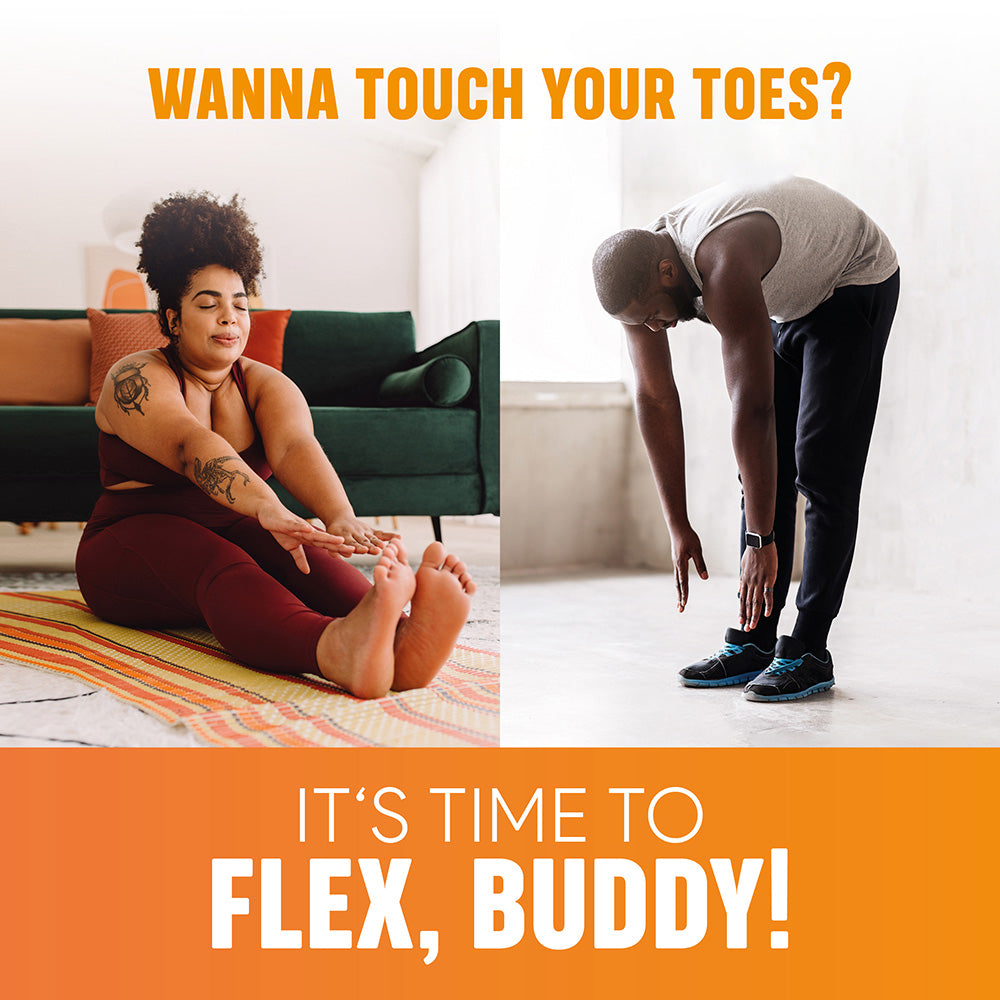
If you can't touch your toes, a classic hamstring stretch isn't just uncomfortable, it's mechanically broken: you round your back and the stretch lands everywhere except where you need it. You are not broken. You are under-moved, and you've been trying to stretch with tools (your arms) that don't reach. The strap is the fix, and you feel it within ten breaths. Here is the Basic Posture from the Stretching Guide, which every other exercise starts from.
- Shorten the strap to your current flexibility, not the one you would like to have.
- Sit on the floor, legs straight, foot bar under the balls of the feet, hand bar in both hands. Sit straight.
- Lean back. Your straight arms and the strap now carry you.
- Tilt the hips forward, as if pointing your sitting bones at the wall behind you. That tilt activates the stretch; you may feel it with the body still almost upright, and that is correct.
- Shoulders down, chest lifted, head up, arms straight.
- Hold for ten deep breaths. The guide says to spend 30 seconds here before you advance.
What you should feel: a clear, calm pull along the back of both thighs, and something closer to decompression than stretch through the back: a tall, supported, "oh, that's better" feeling. Where you should not feel it: the lower back (you have rounded), behind the knees (knees locked on a strap that is too short) or the neck (shoulders have crept up). The fix is always the same: go a step longer, not harder.
The straight spine is what makes this work. Motion analysis shows that in a forward bend the first 30 degrees come almost twice as much from the lumbar spine as from the hips [4], and sit-and-reach scores reflect the spine and pelvis as much as the hamstrings [5]. Leaning back against the strap with the hips tilted makes it a hip movement, so the hamstrings get the whole stretch. More in why you cannot touch your toes.
Your first five exercises, step by step
Five from the Stretching Guide, in the order that suits stiff beginners. Breathe slowly and stop at mild tightness every time.
1. Hamstrings Warm Up
The smartest place to start, because cold hamstrings are stubborn hamstrings. Sit with legs extended, foot bar under the balls of the feet, hand bar in a relaxed grip, as tall as you comfortably can. Gently rock forward and back in a small range for 30 to 45 seconds; the guide counts at least 30 reps per side. Feel: a light, moving pull along the back of the thighs, nothing behind the knees. Mistake: locked knees. Bend them slightly: a bent-knee warm-up you do daily beats a straight-leg one you avoid.
2. Basic Posture
The closest thing this routine has to a reset button for your back. Knees slightly bent to begin, arms straight so the strap takes some of your weight; lean back, lift the chest, tilt the hips forward. Ten deep breaths, shoulders soft. Feel: less like a stretch and more like decompression. Mistake: shrugging and gripping hard. Let the tool carry the load; the hand bar is fixed to the strap, so you need straight arms, not a strong grip.
3. Dynamic Rolling
The same position, in motion. From Basic Posture, keep light tension on the strap. Exhale and roll forward from the hips as far as a straight spine allows; inhale and roll back to tall. Three times, one slow breath per direction, no momentum. Feel: the pull in the thighs growing a little with each roll, the back staying long. Mistake: leading with the head. The chest leads; the chin stays level.
4. Static Stretch
The FlexBuddy version of the seated forward fold, and the exercise where the tool shines. Move the foot bar one loop shorter, or roll a turn onto the hand bar. Inhale and lengthen the spine; exhale, lean back and tilt the hips forward, arms long on the handles, and stay at the point of mild tension for ten deep breaths, about 30 seconds. Pause 30 seconds, repeat, three holds in all. That covers the 60 seconds per muscle group that the American College of Sports Medicine recommends on at least two days a week [1], and the two to three days a week, 15 seconds four times if you prefer, that Harvard Health summarises [2]. Feel: a gentle pull along the back of the thighs. You do not need to touch your toes for this to work; that is the whole point of holding handles instead. Mistake: pulling hard on the handles to force depth. FlexBuddy is there for control, not force. If the lower back complains, you have rounded: come up, re-lengthen, take a longer strap.
5. Relax The Neck
The exercise your 4 p.m. shoulders have been waiting for. Foot bar anchored under your feet, hold the hand bar in one hand so it gently weighs that shoulder down. Tilt your head slowly to the opposite side until a soft stretch appears along the side of the neck. Hold 20 to 30 seconds (the guide gives 30), then switch. Feel: the upper trapezius, the muscle that turns into concrete during desk days, gradually letting go; the anchor stops the shoulder shrugging up and stealing the stretch. Mistake: big movements. The neck responds to gentle, not deep. More options are in neck stretches for a stiff neck.
Bonus finisher: Foot Massage. The reward at the end, and more useful than it sounds. Sit on a chair, put the sole of one foot on the loose foot bar and roll it slowly from heel to toes, pausing on tender spots, 30 to 60 seconds per foot. Ending with something that simply feels good is what makes you come back tomorrow.
Two routines: the 2-minute starter and the 10-minute full version
FlexBuddy's promise is "at least 2 minutes daily", and the guideline arithmetic backs it: four 30-second exercises give two muscle groups their daily 60 seconds [1][2].
The 2-minute starter routine
| Exercise | Targets | Time | What you should feel |
|---|---|---|---|
| Hamstrings Warm Up | Hamstrings, lower back | 30 s | A light, moving pull along the back of the thighs |
| Basic Posture | Whole back, hamstrings, posture | 30 s (10 breaths) | Decompression; the day's rounding reversing |
| Dynamic Rolling | Hamstrings, hips, spine | 30 s (3 rolls) | The pull growing a little with each roll |
| Relax The Neck | Neck, upper traps | 15 s per side | The upper traps letting go a notch |
That is the routine in the 2-minute stretching routine for stiff people, with its morning, desk and before-bed versions.
The 10-minute full routine
| Order | Exercise | Hold or reps | Time |
|---|---|---|---|
| 1 | Hamstrings Warm Up | 30 to 45 s, knees soft | 45 s |
| 2 | Basic Posture | 10 deep breaths | 30 s |
| 3 | Dynamic Rolling | 3 slow rolls, twice | 60 s |
| 4 | Static Stretch | 10 breaths, 30 s pause, three times | 150 s |
| 5 | Single Leg Stretch | 10 breaths per side | 60 s |
| 6 | Relax The Neck | 30 s per side | 60 s |
| 7 | Shoulder Opener | 5 to 8 slow reps | 45 s |
| 8 | Foot Massage | 30 to 60 s per foot | 90 s |
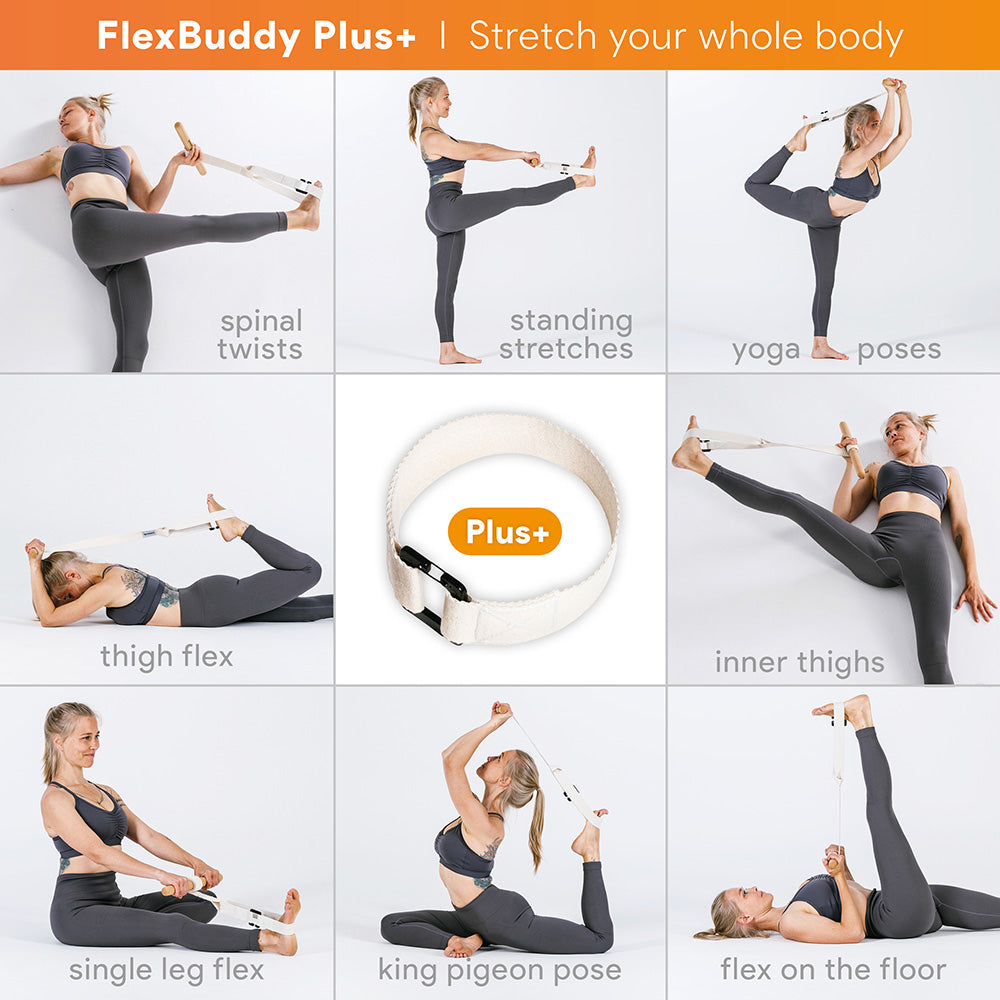
With pauses and loop changes that is about ten minutes. The Single Leg Stretch, Shoulder Opener, Spinal Twist and Inside Thigh Stretch are taught in FlexBuddy exercises for back, hips, hamstrings and shoulders. The guide's full sequence also has a relaxing thigh stretch, an alternating bend, a 30-second core balance, a yoga section (Cat-Cow, Butterfly, Shoulder Opener, Boat) and wrist and grip work; the videos show them all.
Care, storage and travel
It is beech wood and cotton, so treat it like a good wooden kitchen tool: wipe the bars with a damp cloth, let the strap air-dry, do not leave it soaking. There is nothing to re-tension, and it carries a lifetime warranty. At 32 by 7 by 5 cm it goes in hand luggage and works on a carpet, a mattress or a mat.
Storage is a habit question. Keep FlexBuddy somewhere visible, next to the desk or beside the sofa: a tool in a closet stretches no one. Anchor the routine to something that already happens daily, right after you close your laptop or while your evening tea brews.
Progression, and what to expect
Progress is a shorter strap with a long back, and you can count it in loops and turns. Shorten when a setting feels calm for all three holds.
- Weeks 1 and 2: same five exercises, same cue, every day. Measure fingertips to floor in a standing toe touch and write it down.
- Week 3: one notch shorter, a turn or a loop, as long as the back stays long and the pull stays in the thighs.
- Week 4: re-test. Most people see a few centimetres.
- From week 5: add a contract-relax cycle to the Static Stretch: at the top of the hold, press the feet gently into the foot bar without anything moving for about six seconds, then relax and lean a little further. Physiotherapists call this PNF; six seconds is the preferred contraction, and efforts of 20 to 60 per cent of maximum gained as much flexibility as all-out ones [6].
- From week 8: add hips, shoulders and calves from the exercise library, two or three at a time.
Days: you feel it, in the legs on standing up and in the neck at four in the afternoon. Weeks: you measure it. Programmes of three to eight weeks produce measurable range, as the nervous system learns to allow more stretch [3]. Months: the habit sets, and the range stays as long as the habit does. FlexBuddy's promise is "flexible in 30 days", and some get there sooner. "I am 64 and have never touched my toes. FlexBuddy changed that in a week!" wrote Bob J. Measure against your own number: progress is the point, and the toes are a milestone. How long it takes to get flexible has timelines by age and starting point.
Troubleshooting: quick fixes for the first week
Too hard, or it hurts
Go longer, not softer: a loop away, knees slightly bent, lean back less. Pain behind the knee means locked knees on a short strap; pain in the lower back means you have rounded. A burn, tingling or numbness down the leg is not a muscle stretch: stop, and read the note at the end.
Too easy
Check the posture before the strap: most "too easy" is a dropped chest. Lift it, shoulders down, hips further forward, and the stretch arrives without touching the strap. Then a turn, then a loop. If you can already sit tall and hold your feet, the Single Leg Stretch and the yoga section give you plenty more to work on.
Knee discomfort
Soften the knees. A slight bend moves the stretch off the tendons behind the knee and onto the belly of the hamstring. A knee that hurts at rest or swells is not a stretching problem.
The foot bar slips or pops out
Nearly always shoes: go barefoot or wear grippy socks, bar under the balls of the feet, feet pressing in. If the bar pops out of its loop, the strap is longer than your legs at that moment and nothing is loading it; move to a shorter loop until there is light tension with the body upright.
The strap is too long or too short
Too long is easy: a shorter loop, then turns. If it feels too short on day one, which can happen if you are near the top of the 142 to 198 cm range or very stiff, use the longest loop with nothing rolled on, bend the knees and lean back less. The stretch starts there. If it still does not suit you, the 30-day money-back guarantee is there for exactly that.
The wood feels slippery, or my grip tires
You are gripping when you should be hanging. Straighten the arms, lean the whole trunk back and let the strap take you; the hand bar is fixed, so the hands only need to cup it. Dry hands and the underhand roll help.
"A towel would do the same thing"
For a lying leg raise, a towel will get you started. The seated stretch is where FlexBuddy pulls ahead. The posture is built in: you lean back against the strap and your spine stays long. The settings repeat and shorten one notch at a time, so every session picks up where the last one ended. And the wooden handles spread the load across your palms, so your grip lasts as long as the stretch does. One trainer, Scott K., calls it "a great tool to help your clients maintain a neutral spine while stretching calves, hamstrings and lower back." The full comparison is in hamstring stretch with a strap, a towel or a device.

Start tonight with FlexBuddy
If you own one, you now have the whole method: set the loop, sit tall, lean back, tilt the hips, ten breaths, three times, two minutes a day. Keep it in sight and run the starter routine tonight. You will stand up feeling taller.
If you are still deciding: FlexBuddy® is a patented stretching device, two beech-wood bars joined by an adjustable cotton strap. It keeps your spine straight so the stretch reaches your hamstrings and calves, and two minutes a day can improve your flexibility and posture. Philipp, a blacksmith aged 73, wrote: "I never imagined that I would regain my flexibility. But I did!" It is rated 4.5 by verified buyers and comes with a 30-day money-back guarantee and a lifetime warranty, so you can try it without risk. Get your FlexBuddy, or take the two-minute quiz to find the routine for your kind of stiffness. From here, the full exercise library covers hips, shoulders and twists, the 2-minute routine turns tonight into a habit, and tight hamstrings and lower back pain explains what is going on in your legs.
Frequently asked questions
How do you use FlexBuddy?
Sit on the floor with legs straight, foot bar under the balls of both feet, hand bar in straight arms. Sit tall, lean back slightly and tilt the hips forward until you feel a mild pull in the back of the thighs; breathe for ten slow breaths. Loops for big changes of length, turns around the hand bar for small ones.
Is there a FlexBuddy instructions PDF?
Yes. The official Stretching Guide is 24 pages, covering the basic posture, warm-up, dynamic and static stretching, neck, yoga, wrist and massage exercises. It is reached through the QR code that comes with the device and at flexbuddy.com, with the free exercise videos.
What exercises can you do with FlexBuddy?
The guide names the Hamstrings Warm Up, Basic Posture, Dynamic Rolling, Static Stretch, Relax The Neck, a core balance, yoga poses (Cat-Cow, Butterfly, Shoulder Opener, Boat), wrist and grip exercises, and foot, thigh and calf massage. Start with the five in this guide; the rest are in the FlexBuddy exercises article.
Is FlexBuddy worth it?
Yes, if you want a stretching routine you will keep doing. It fixes the three things that make people give up: a seated stretch that rounds the lower back, a length you have to guess every session, and a strap that cuts into your hands. It is rated 4.5 by verified buyers and carries a 30-day money-back guarantee and a lifetime warranty, so you can try it without risk.
How long should I use FlexBuddy each day?
Two minutes a day covers the hamstrings and neck: guidelines ask for roughly 60 seconds per muscle group on at least two to three days a week [1][2], and the two-minute routine gives you that daily. Run the ten-minute routine when you have time.
Can beginners use FlexBuddy?
Yes. It is made for people who cannot reach their feet. The strap does the reaching, so you keep a long spine and control depth with the loop you choose and how far you lean. Start on the longest setting with slightly bent knees and shorten when a setting feels calm.
This article is general information, not medical advice. Tight muscles usually respond well to regular stretching. If your pain is sharp, radiates down a leg, comes with numbness, weakness, fever, bladder or bowel changes, follows an injury, or keeps getting worse, or if you have a herniated disc, recent surgery, sciatica under treatment or are pregnant, see a doctor or physiotherapist before you stretch.
References
- Garber CE, Blissmer B, Deschenes MR, et al.; American College of Sports Medicine. Position stand: quantity and quality of exercise for developing and maintaining cardiorespiratory, musculoskeletal, and neuromotor fitness in apparently healthy adults. Med Sci Sports Exerc. 2011;43(7):1334–1359. doi:10.1249/MSS.0b013e318213fefb. PMID 21694556 (abstract accessed 4 Nov 2026).
- Harvard Health Publishing. The ideal stretching routine. Harvard Medical School, 16 Mar 2026 (reviewed by H. E. LeWine, MD). https://www.health.harvard.edu/staying-healthy/the-ideal-stretching-routine (accessed 4 Nov 2026).
- Weppler CH, Magnusson SP. Increasing muscle extensibility: a matter of increasing length or modifying sensation? Phys Ther. 2010;90(3):438–449. doi:10.2522/ptj.20090012. PMID 20075147 (abstract accessed 4 Nov 2026).
- Esola MA, McClure PW, Fitzgerald GK, Siegler S. Analysis of lumbar spine and hip motion during forward bending in subjects with and without a history of low back pain. Spine. 1996;21(1):71–78. doi:10.1097/00007632-199601010-00017. PMID 9122766 (abstract accessed 4 Nov 2026).
- Muyor JM, Vaquero-Cristóbal R, Alacid F, López-Miñarro PA. Criterion-related validity of sit-and-reach and toe-touch tests as a measure of hamstring extensibility in athletes. J Strength Cond Res. 2014;28(2):546–555. doi:10.1519/JSC.0b013e31829b54fb. PMID 24476746 (abstract accessed 4 Nov 2026).
- Hindle KB, Whitcomb TJ, Briggs WO, Hong J. Proprioceptive neuromuscular facilitation (PNF): its mechanisms and effects on range of motion and muscular function. J Hum Kinet. 2012;31:105–113. doi:10.2478/v10078-012-0011-y. PMID 23487249; PMC3588663. https://pmc.ncbi.nlm.nih.gov/articles/PMC3588663/ (accessed 4 Nov 2026).