- Two tools, two jobs. Static stretching: take a muscle to mild tension and hold still, usually 10 to 30 seconds. Dynamic stretching: move a joint through its range under control, with no hold, as in leg swings or walking lunges [1].
- Before sport, move. A controlled dynamic warm-up increases range of motion and improves force, power, sprint and jump performance [2][3].
- A short hold before training is fine. Holds under 60 seconds per muscle, inside a proper warm-up, change strength and power by about 1 to 2 per cent, trivial unless you are competing [4][5].
- For flexibility that lasts, hold. A 2024 meta-analysis of 77 studies found larger range-of-motion gains from static and PNF stretching than from ballistic or dynamic stretching [6].
- Know what each tool is for. Stretching buys range and comfort; on soreness a Cochrane review measured only a few points out of 100 [7]. For fewer injuries add strength training, which cut injuries to less than a third [8].
- The rule: move before you train, hold afterwards or on its own, and give flexibility a few minutes most days.
- FlexBuddy® makes the holds count: it keeps your spine long while your hamstrings and calves stretch.
What static and dynamic stretching actually mean
Get these two right and training and flexibility both get easier. They do different jobs.
Static stretching
You take a muscle to the end of its comfortable range, feel mild tension, and stay there. The hold is typically 10 to 30 seconds, repeated two to four times; it can be passive (gravity, a partner or a strap holds you there) or active (your own opposite muscles hold the position) [1]. This is the one that builds lasting flexibility. Four examples:
- Seated hamstring stretch: legs straight, spine long, FlexBuddy or a strap around the feet, hips tipped forward until the thighs pull.
- Standing quadriceps stretch: one hand on a wall, the other holding the ankle behind you, knees together, pelvis tucked.
- Wall calf stretch: hands on a wall, one leg back, heel down, knee straight, lean in.
- Doorway chest stretch: forearms on the door frame, step through until the shoulders open.
Dynamic stretching
You move a joint through its full range, under control, and repeat. There is no hold. It rehearses the movement you are about to do, raises muscle temperature and wakes up the nervous system [2]. This is the one that gets you ready to perform. Four examples:
- Leg swings: one hand on a wall, swing a straight leg forward and back, range growing each swing.
- Walking lunges: long steps, back knee towards the floor, torso tall, alternating legs across the room.
- Arm circles: straight arms drawing large circles forwards, then backwards.
- Hip circles (open the gate): knee to hip height, out to the side and down, as if stepping over a hurdle.
Ballistic and PNF, briefly
Ballistic stretching is dynamic stretching done fast: bouncing at the end of the range. Because the speed raises the risk of injury it is no longer recommended for general use [1], and controlled movement does the job better [2]. PNF (proprioceptive neuromuscular facilitation) is a static stretch with a contraction built in: you tighten the muscle being stretched, typically at 75 to 100 per cent of maximum for about 10 seconds, then relax and sink deeper. The research points to gentler contractions of 20 to 60 per cent working just as well, and a strap can provide the resistance [1]. PNF is a flexibility tool: use it after training.
What each one does in the next hour
Both give you more range straight away
Static, dynamic and PNF stretching all increase joint range of motion straight away [3]. That is extra range you can use in the session in front of you.
Dynamic stretching warms, loosens and primes
A 2018 review found substantial evidence that dynamic stretching improves range of motion and the performance that follows: force, power, sprint and jump. It works best at moderate speed and amplitude [2], and within minutes of the activity [3]. A few minutes of swings and lunges and you start warmer, looser and stronger.
Static holds: short before, long after
Short static holds sit happily inside a warm-up. A review of 106 studies found that holds under 30 seconds had no detrimental effect on performance and holds of 30 to 45 seconds no significant effect; a meaningful drop became likely only at 60 seconds or more [4]. A 2016 review put the methods side by side: dynamic stretching lifted performance by 1.3 per cent, and when the stretching was followed by dynamic activity, as in any real warm-up, no clear effect on performance remained [3].
The long holds are the ones to keep for later. A meta-analysis of 104 studies found that static stretching immediately before a test reduced maximal strength by 5.4 per cent on average, power by 1.9 per cent and explosive performance (sprints, jumps) by 2.0 per cent, and concluded that static stretching should not be the only thing in a warm-up [9]. The dip is partly neural, partly mechanical and partly psychological [10]. So the timing writes itself: move first, hold afterwards, and your long, deep holds cost you nothing.
What each one does over months
If your goal is to touch your toes, the next hour matters less than the next twelve weeks. Here static stretching takes over.
The largest analysis to date pooled 77 studies on long-term stretch training in healthy people. Stretch training increased range of motion, and the type mattered: PNF and static stretching produced greater gains than ballistic or dynamic stretching [6]. An earlier review of 23 long-term studies also favoured static stretching and found that time per week mattered more than time per session: at least five minutes a week over at least five days was the pattern linked with gains [11]. Five minutes a week. Anyone can find that.
The classic dose trial makes it simpler still. Adults with tight hamstrings stretched five days a week for six weeks, and a single 30-second hold once a day improved knee-extension range as much as a 60-second hold or three sessions a day [12]. One 30-second hold a day did the job. Regular beats more.
That matches the guidelines. The American College of Sports Medicine recommends about 60 seconds of flexibility exercise per muscle-tendon group on at least two days a week [13], usually read as two to three sessions a week with the 60 seconds made of four 15-second or three 20-second holds [14]. Each stretch is best held 15 to 30 seconds, two to four times, after an active warm-up; older adults do well with 60-second holds, which produced greater hamstring gains than shorter ones [1]. Hold times have their own article.
You will notice progress early. In the first weeks most of the gain is increased stretch tolerance, your nervous system letting you further into the range [1], which is why gentle and daily beats hard and occasional. Make it easy: keep FlexBuddy where you sit in the evening and do your two minutes before the television goes on. How to improve flexibility at home has a weekly structure for that.
Static vs dynamic stretching: which is better for what?
Both win, each at its own moment. Find your goal below.
| Goal and timing | Use | Why | How |
|---|---|---|---|
| Before a run, a match or a gym session | Dynamic | Warms you up, opens range and lifts performance [2][3] | 2 to 3 minutes of easy movement, then 5 to 8 minutes of drills. A static hold under 30 seconds on one stubborn muscle is fine if movement follows [4][10] |
| Before maximal lifting, sprinting or jumping | Dynamic only | Long static holds cost measurable strength and power, so they go after the effort [9][4] | Skip static holds, or keep them under 30 seconds and early in the warm-up [5] |
| After a workout | Static | Muscles are warm, there is no performance to protect, and the holds feel good | 15 to 30 seconds, 2 to 4 repetitions per muscle group [1]. FlexBuddy keeps the spine long for the hamstring and calf holds |
| To become more flexible | Static or PNF | Largest long-term gains in range of motion [6] | About 60 seconds per muscle group, most days [13][11]. Two minutes a day with FlexBuddy covers hamstrings and calves |
| Stiffness from sitting | Static, plus movement breaks | Muscles held short all day need time at length; joints need to move | A straight-spine static routine in the evening; hip circles and a few lunges every hour at the desk |
| Non-specific muscle pain (tight hamstrings, achy lower back) | Gentle static | Hamstring stretching reduced pain in trials of people with low back pain (see the hamstring article) | Mild tension, straight back, breathe. Sharp, radiating or worsening pain: see a professional first |
| Older adults | Static, with a gentle dynamic start | In older adults, longer holds have produced bigger gains [1] | 30 to 60 seconds per stretch; march on the spot and do slow arm and hip circles beforehand, no fast swings |
In short: dynamic before, static after, static or PNF for flexibility.
The myth: "static stretching before exercise is bad for you"
If you like a stretch before you train, you can keep it. The myth has a real origin: from the late 1990s laboratory studies reported that force and power fell after static stretching, and advice in sport shifted towards dynamic warm-ups [3]. (Our guide to stretching for athletes covers before and after training.) But those studies measured long holds, often several minutes per muscle, on people who had not warmed up, tested within seconds of finishing [10]. Nobody warms up like that.
When researchers looked at static stretching the way people really use it, the picture changed. A 2019 review concluded that static stretches of up to 60 seconds per muscle group, inside a full warm-up (aerobic work, then dynamic stretching, then sport-specific movement), change strength and power trivially, by about 1 to 2 per cent. Holds longer than 60 seconds per muscle group caused declines of about 4 to 7.5 per cent, so those go after training. For recreational sport the authors recommend including short static stretching in the warm-up, because it helps flexibility and points to a lower risk of muscle and tendon injuries in sprinting and fast changes of direction; for athletes before competition they advise caution, because 1 to 2 per cent can decide a race [5]. A 2021 follow-up adds that after short static stretching inside a full warm-up, force at longer muscle lengths is, if anything, slightly improved [10].
So the accurate rule is simple: short holds before, movement after them, long holds once you are done. Do not make static stretching the whole warm-up [9]. An amateur runner with a cable-tight hamstring loses nothing from a 20-second hold followed by leg swings. A sprinter on the start line saves the long holds for afterwards.
Injury and soreness: what protects you
Injury
Want fewer injuries? Pair your stretching with strength. A meta-analysis of 25 randomised trials sorted injury-prevention programmes by type, and strength training cut injuries to less than a third (relative risk 0.32) [8]. Stretching plays its part inside the warm-up: the 2016 review recommends it there as a reasonable measure against muscle injuries specifically [3]. So get stronger, warm up with movement, and stretch for the range that lets you move well.
Soreness
Soreness the day after a hard session is normal, and it passes on its own. Stretching is not the lever for it: the Cochrane review of 12 randomised studies measured its effect on soreness at between half a point and four points on a 100-point scale [7]. Stretch after training for what it does give you: more range, looser legs and a few calm minutes that feel good.
A sample dynamic warm-up before you train
Eight to ten minutes and you start your session warm, loose and switched on. The NHS warm-up advises at least six minutes, starting with three minutes of marching on the spot [15]. This sequence follows that shape.
| Exercise | How | Reps or time | Prepares |
|---|---|---|---|
| March or easy jog | On the spot or around the room, arms pumping, breathing rising | 2 to 3 minutes | Temperature, heart rate |
| Leg swings, front to back | One hand on a wall, swing a straight leg forward and back, range growing each swing | 10 to 15 per leg | Hamstrings, hip flexors |
| Walking lunges | Long step, back knee towards the floor, torso tall; add a gentle twist towards the front leg | 8 per leg | Quadriceps, glutes, hip flexors, trunk |
| Hip circles (open and close the gate) | Knee to hip height, out to the side, down; then reverse | 8 per side each way | Hip rotation |
| Inchworms | Fold forward, walk the hands out to a plank, walk the feet back in with straight legs | 5 | Hamstrings, calves, shoulders |
| Arm circles and torso rotations | Big circles forwards then backwards; then rotate the trunk with arms loose | 10 each | Shoulders, upper back |
| Build-up strides (runners) | Accelerate smoothly over 20 metres (about 22 yards) to near race pace, walk back | 3 to 4 | Running mechanics |
If a muscle still feels like a brake after this, a single 20-second static hold followed by two more sets of swings fits the research [4][5]. Runners get a more specific version in stretching for runners.
A sample static cool-down after you train, or on its own
This is the part that makes you more flexible. The same stretches work after a session and on rest days. Mild tension, slow breathing, no bouncing (one of the common stretching mistakes). About eight minutes; the first two rows alone, done daily, are the two-minute routine.
| Stretch | Position | Hold | Reps |
|---|---|---|---|
| Seated hamstring stretch | Legs straight, FlexBuddy or a strap around the feet, spine long, chest up, fold from the hips | 20 to 30 seconds (10 slow breaths) | 2 to 3 |
| Calf stretch | Seated with FlexBuddy or a strap under the forefoot and the knee straight, or standing at a wall with the heel down | 20 to 30 seconds | 2 per leg |
| Standing quadriceps stretch | Ankle in hand behind you, knees together, pelvis tucked, hand on a wall | 20 to 30 seconds | 2 per leg |
| Half-kneeling hip flexor stretch | Back knee on a cushion, tuck the pelvis and shift forward until the front of the back hip pulls | 20 to 30 seconds | 2 per side |
| Figure-four glute stretch | On your back, ankle on the opposite knee, draw the lower thigh towards you | 20 to 30 seconds | 2 per side |
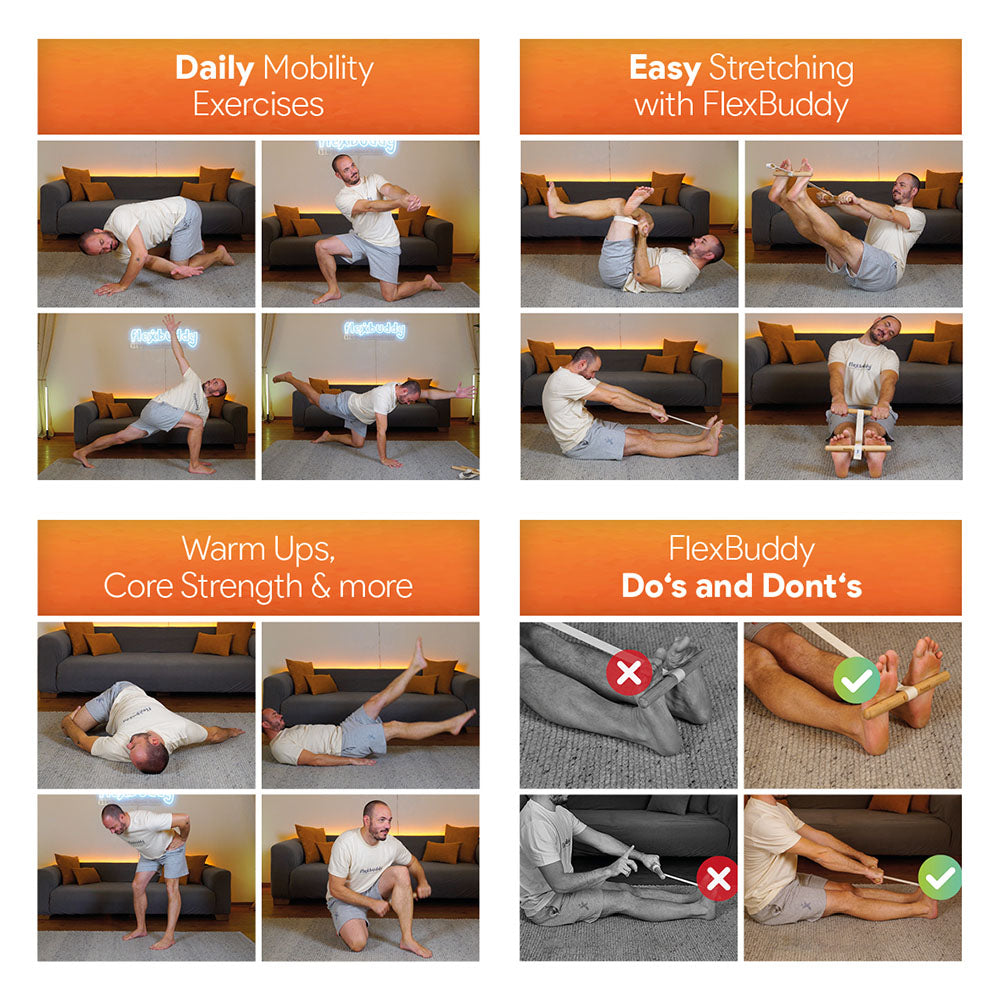
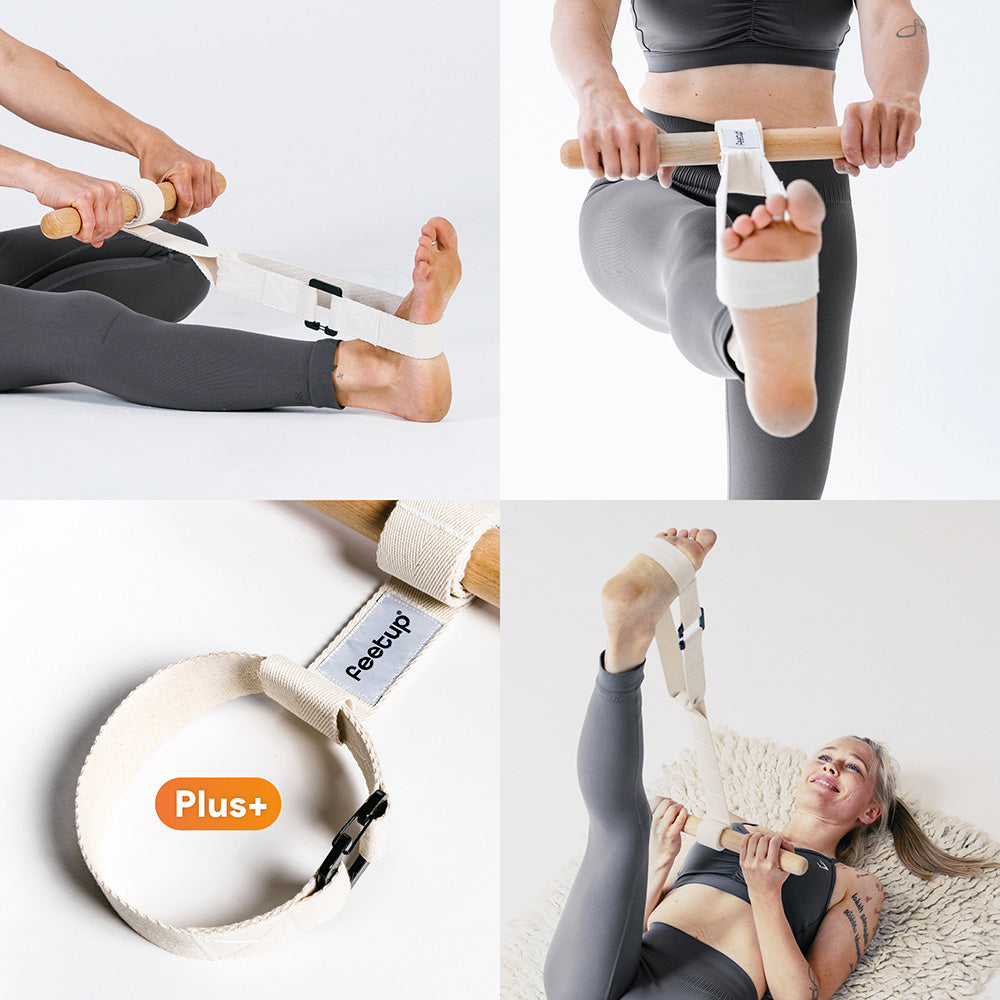
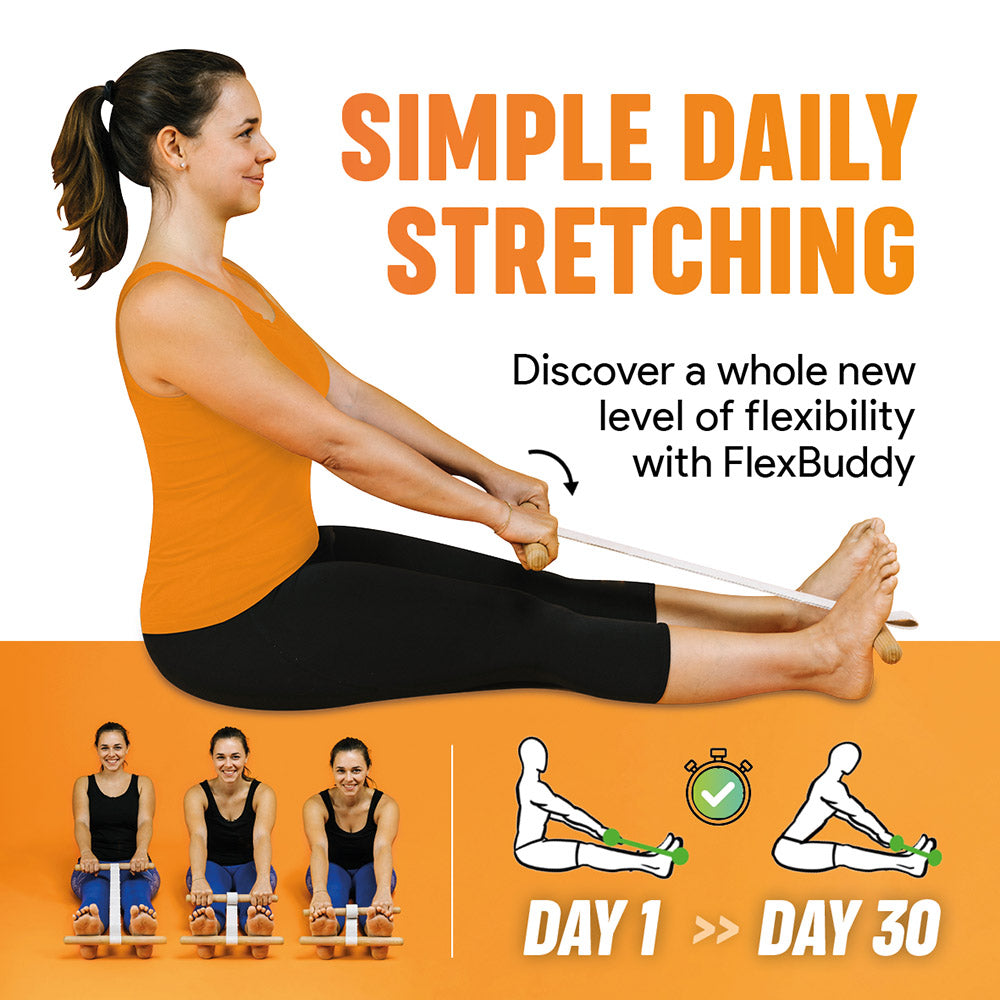
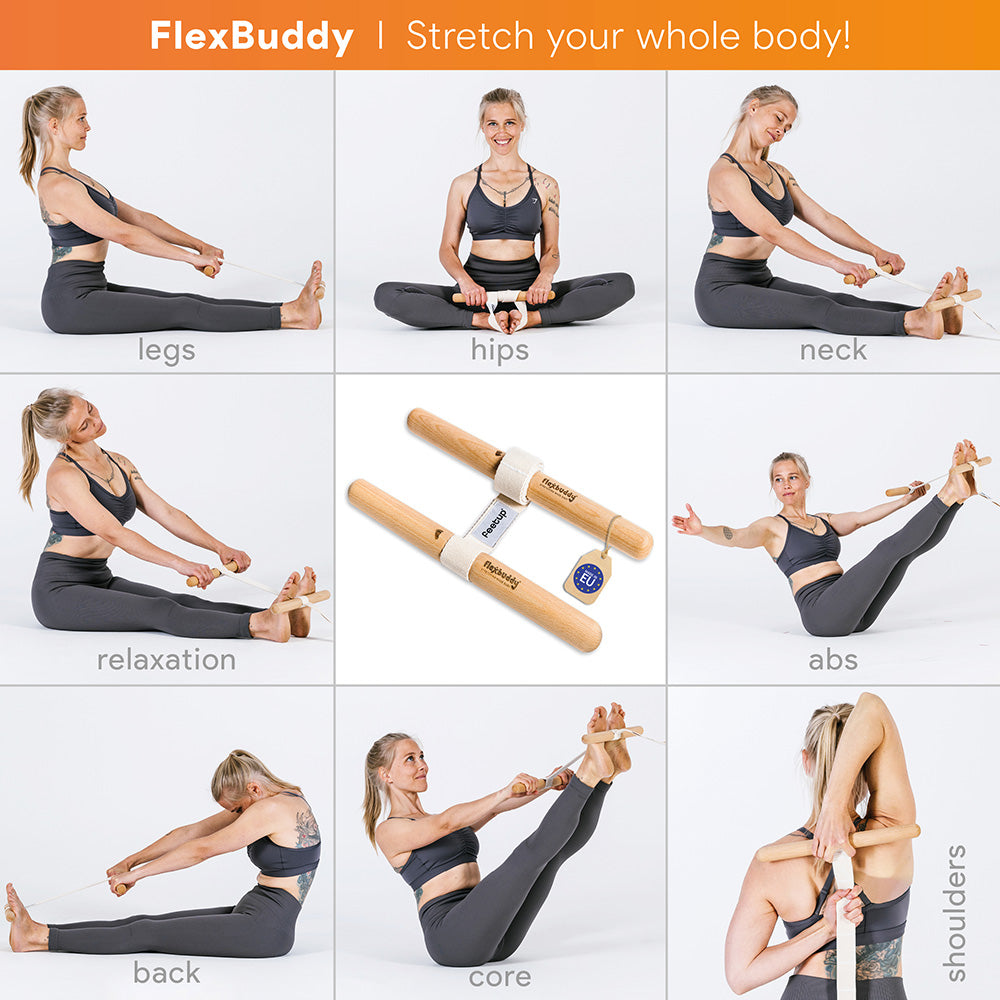
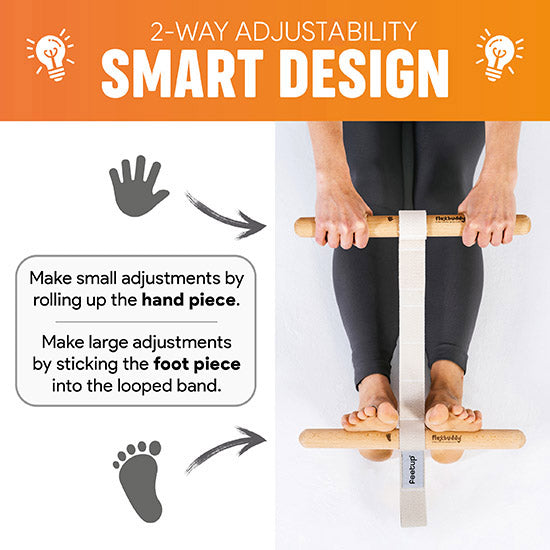
Getting the hamstring hold right. FlexBuddy foot bar under your soles, hand bar in both hands. Sit tall, lean back a little and tilt the hips forward. The strap carries the pull, so your spine stays long and the stretch lands in the hamstrings and calves.
Older adult? Take each hold towards 60 seconds and drop a repetition [1]. At any age, the hamstring and calf stretches only count if the spine stays long; folding at the lower back moves the stretch into the spine, the mistake explained in why you can't touch your toes.

Make every hold count with FlexBuddy
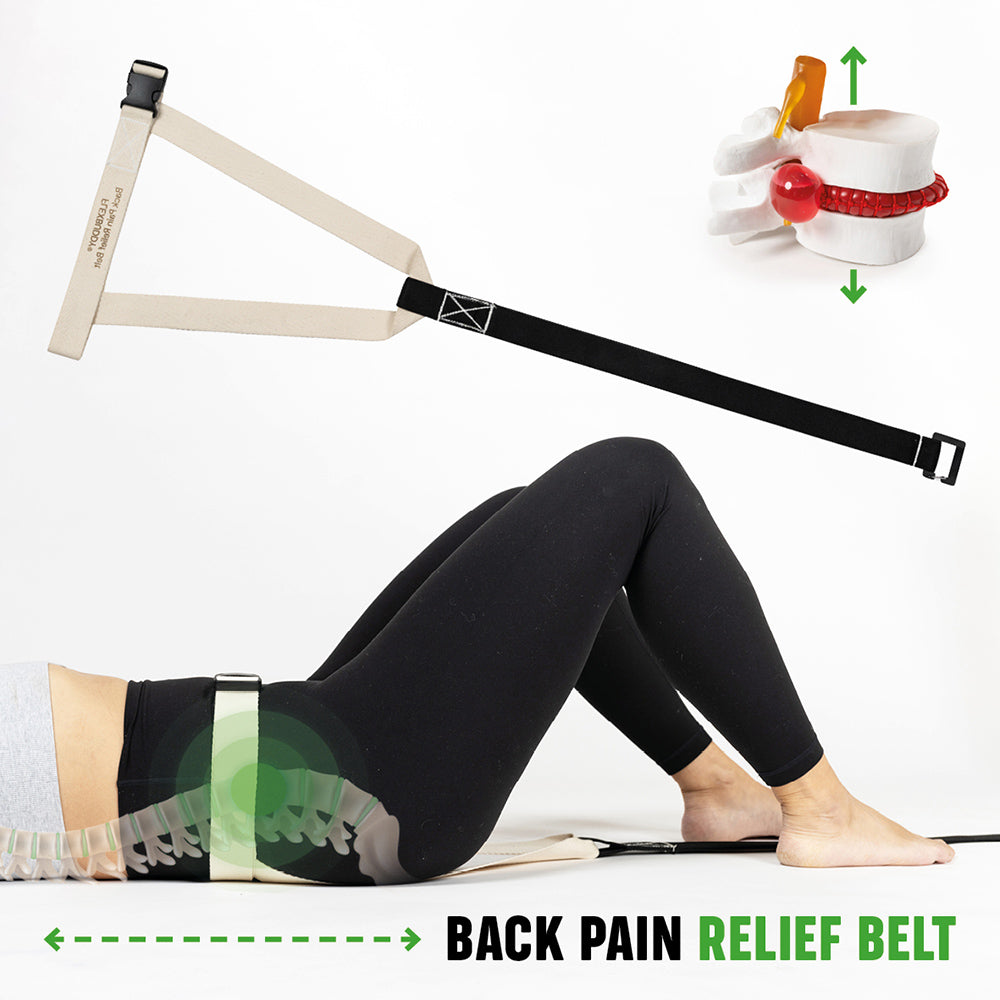
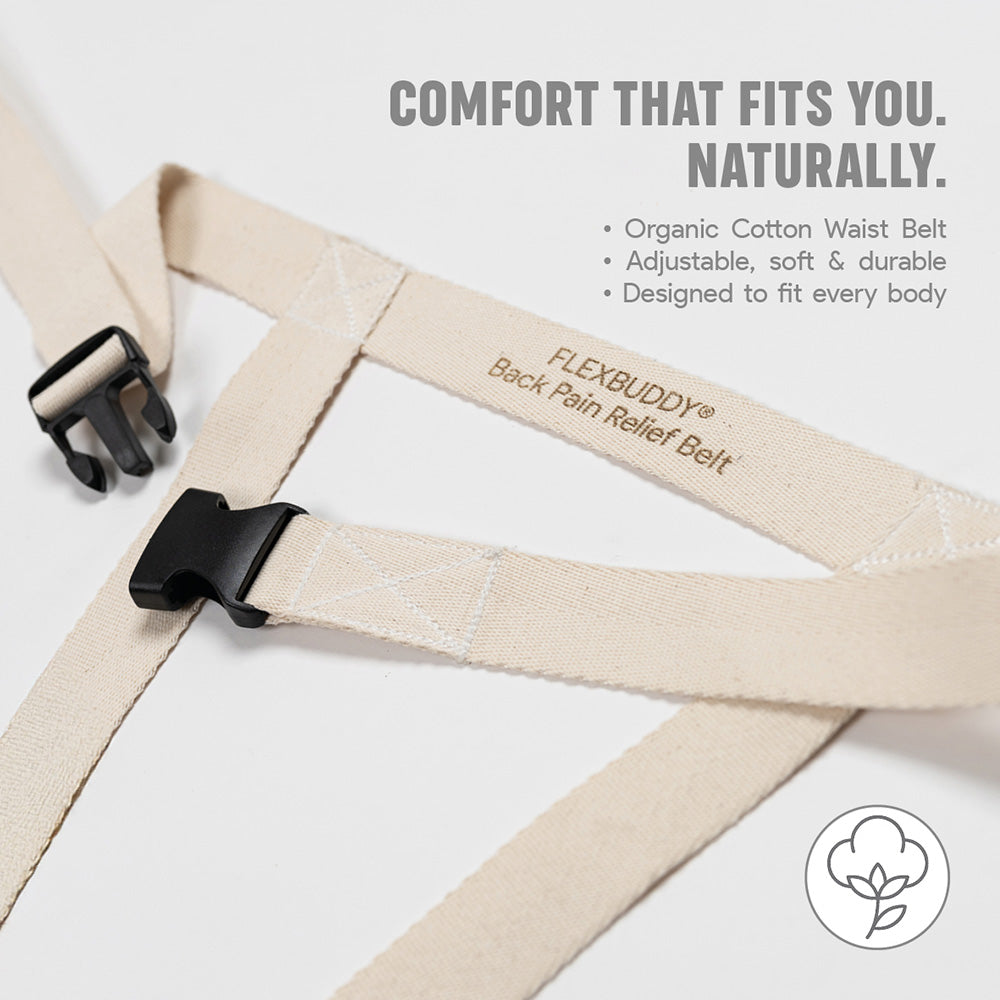
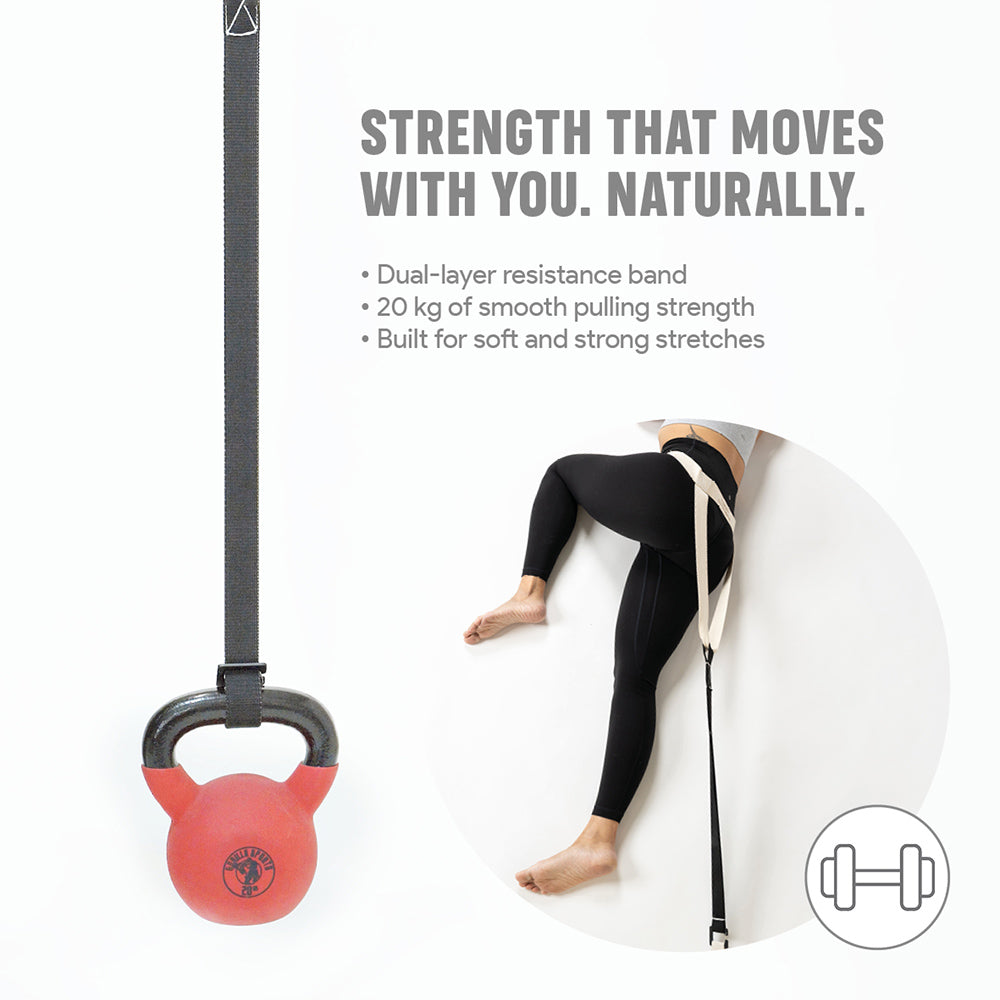
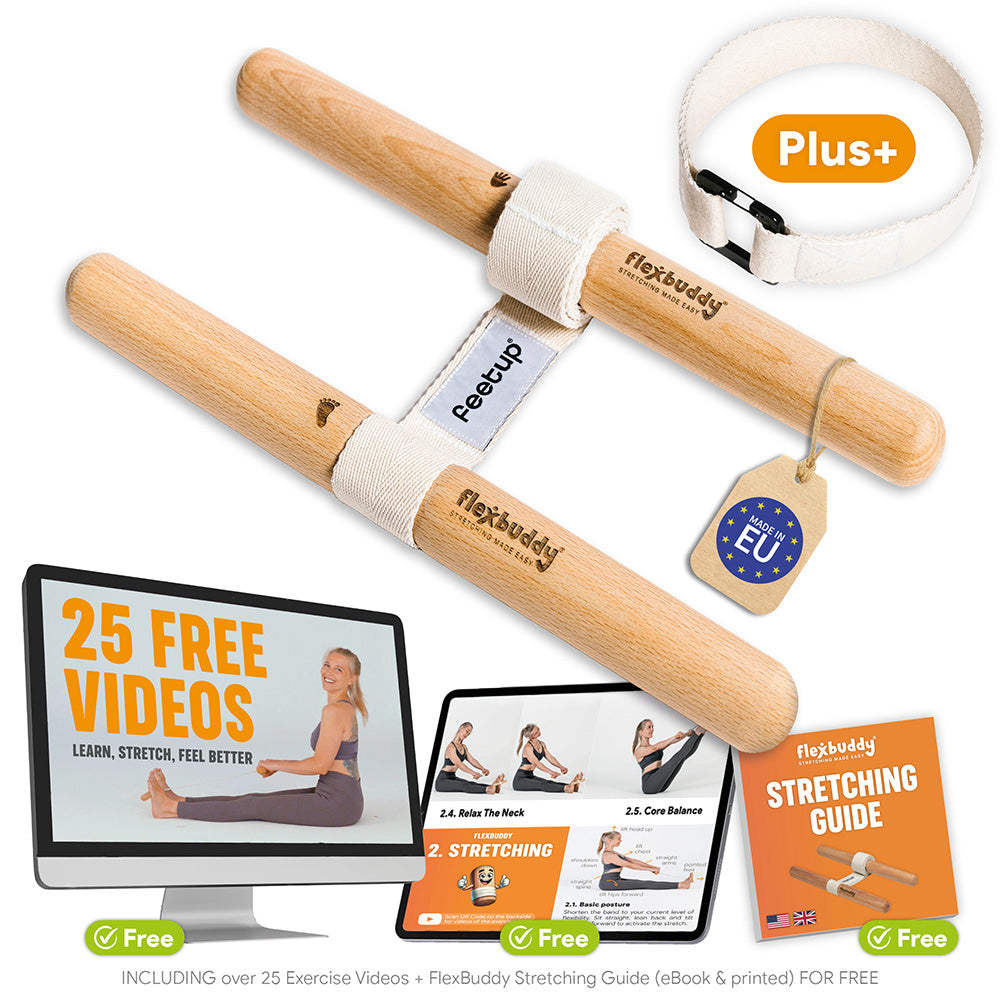
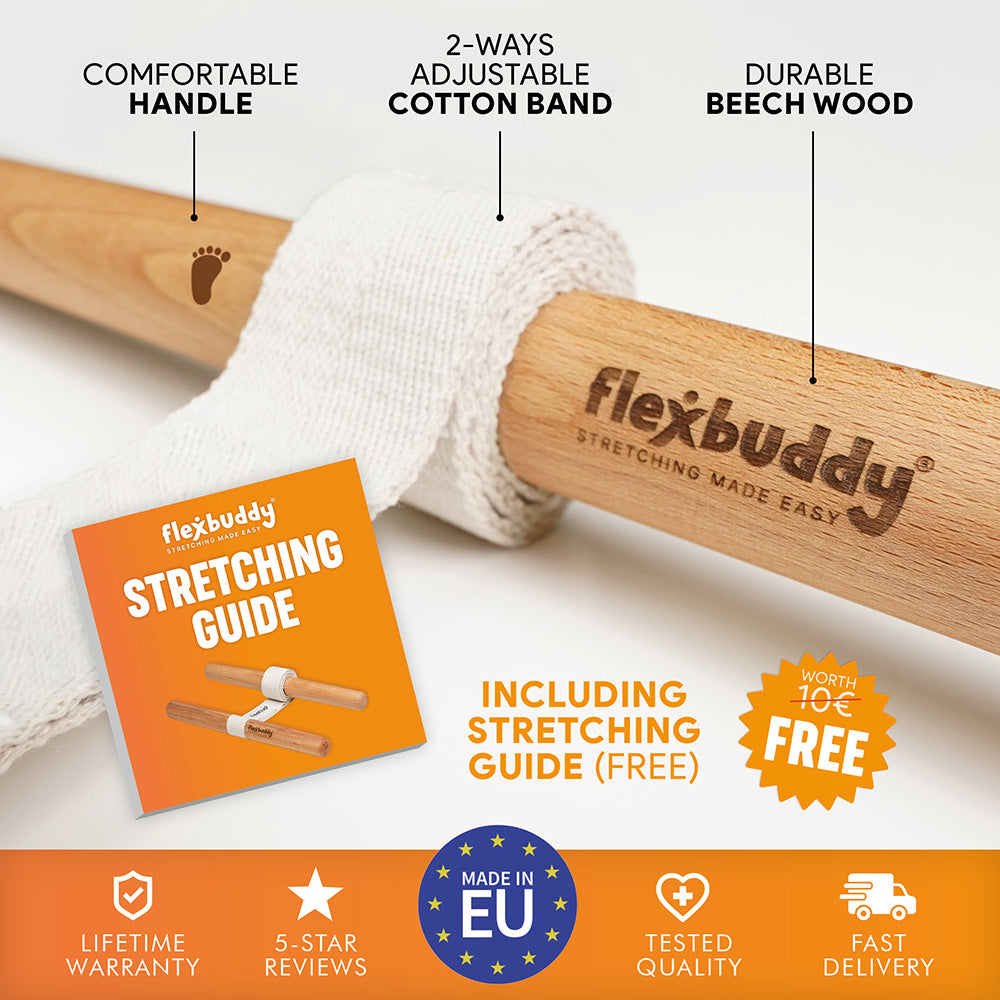
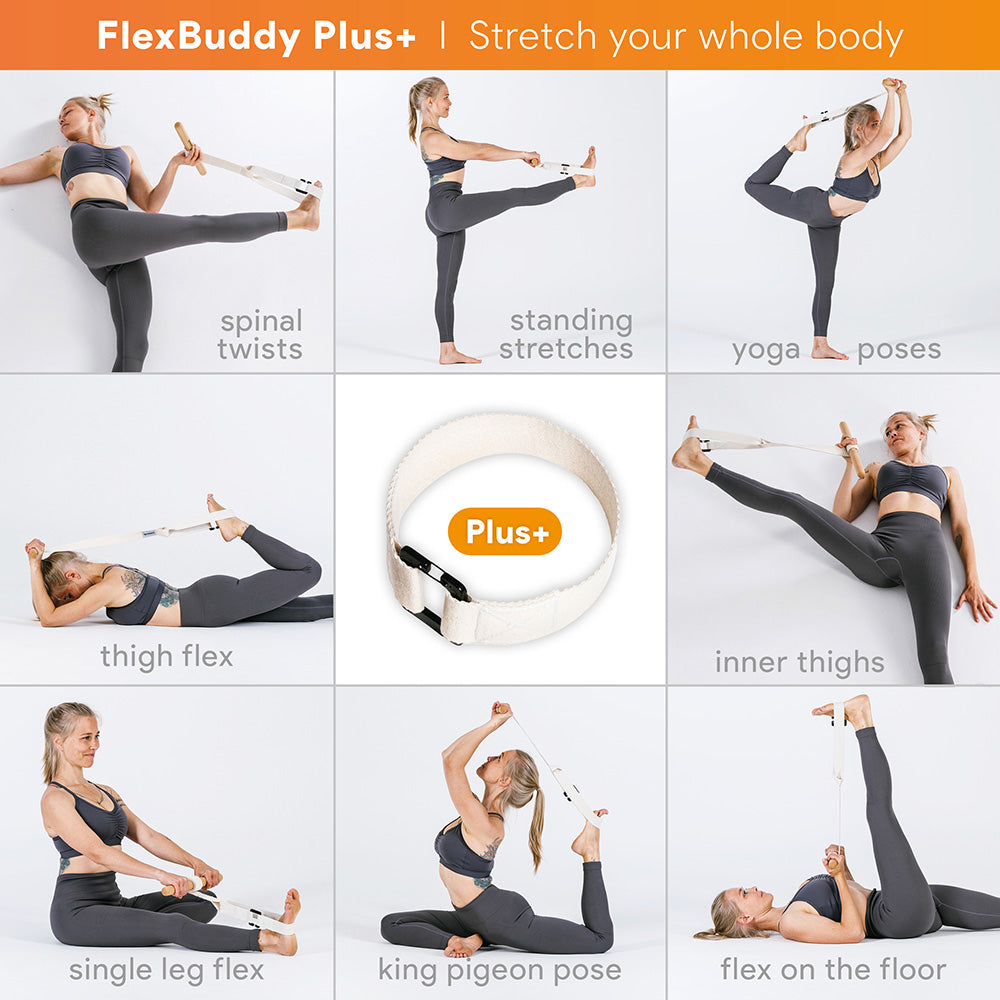
Static holds are where lasting flexibility comes from, and the two that matter most, hamstrings and calves, are the two most people do with a rounded back. FlexBuddy® fixes that. It is a patented stretching device: two beech-wood bars joined by an adjustable cotton strap, one bar under the soles of your feet, the other in your hands. Sit tall, lean back, tilt the hips, ten slow breaths, three times, which is about two minutes. The strap carries the pull, so your spine stays long and the stretch goes to the legs. Shorten the strap by a loop as your range grows, or roll the hand bar for a finer step. For a PNF version, press the feet gently into the bar for ten seconds, relax, and sink a little deeper.
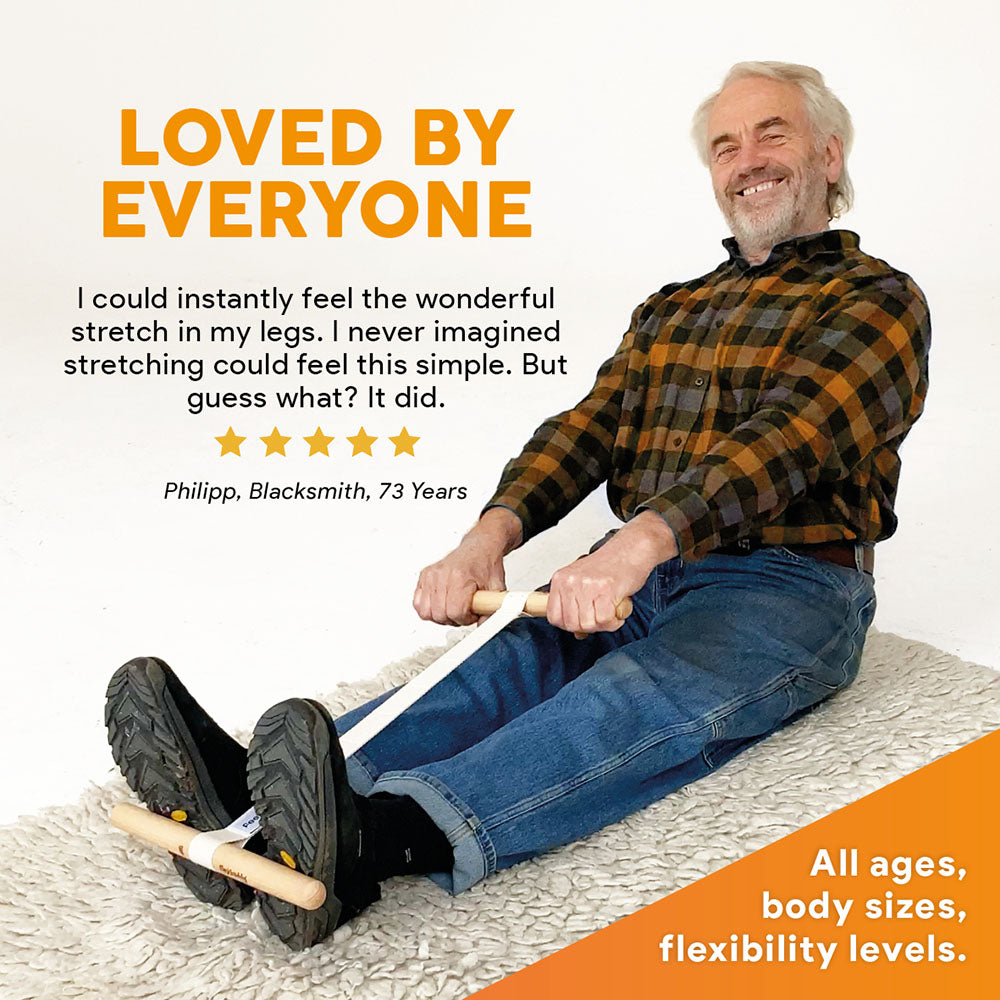
Use it after training and on rest days. Bob J. wrote: "I am 64 and have never touched my toes. FlexBuddy changed that in a week!" It is rated 4.5 by verified buyers and comes with a 30-day money-back guarantee and a lifetime warranty. Get your FlexBuddy, or take the two-minute quiz to find the routine that fits your kind of stiffness.
Frequently asked questions
Static vs dynamic stretching: which is better?
Both, each for its own job. Dynamic is better before exercise: it warms you up, opens range and improves performance [2]. Static (and PNF) is better for building flexibility over weeks, with larger long-term gains in range of motion [6].
Should I do static or dynamic stretching before a workout?
Dynamic, for eight to ten minutes, through the ranges you are about to use. You start warmer and looser. If one muscle feels tight, a static hold under 30 seconds followed by more movement has no measurable cost [4]. Do not make static holds the whole warm-up [9].
Static vs dynamic stretching before running?
Dynamic before running: easy jogging, leg swings, walking lunges, hip circles and a few build-up strides. Save static holds for after the run. Before a race keep any static holds under 30 seconds: 1 to 2 per cent of power is trivial on a training run and not on a start line [5].
What are examples of static and dynamic stretches?
Static: seated hamstring stretch, standing quadriceps stretch, wall calf stretch, doorway chest stretch, each held 15 to 30 seconds. Dynamic: leg swings, walking lunges, arm circles, hip circles, inchworms, each repeated 8 to 15 times with no hold.
Should I stretch after a workout?
Yes. Your muscles are warm, there is no performance to protect, and this is where lasting flexibility is built. Hold each stretch 15 to 30 seconds, two to four times [1]. FlexBuddy makes the hamstring and calf holds easy to do with a long spine.
Is static stretching before a workout bad?
No. Short holds are fine. Holds under 60 seconds per muscle, inside a full warm-up, change strength and power by around 1 to 2 per cent [5]. Only holds of 60 seconds or more on cold muscles, with nothing after them, reduce them measurably [4][3]. Keep pre-exercise holds short and follow them with movement.
This article is general information, not medical advice. Tight muscles usually respond well to regular stretching. If your pain is sharp, radiates down a leg, comes with numbness, weakness, fever, bladder or bowel changes, follows an injury, or keeps getting worse, see a doctor or physiotherapist before you stretch.
References
- Page P. Current concepts in muscle stretching for exercise and rehabilitation. Int J Sports Phys Ther. 2012;7(1):109–119. PMC3273886. https://pmc.ncbi.nlm.nih.gov/articles/PMC3273886/ (accessed 4 Nov 2026).
- Opplert J, Babault N. Acute effects of dynamic stretching on muscle flexibility and performance: an analysis of the current literature. Sports Med. 2018;48(2):299–325. doi:10.1007/s40279-017-0797-9. PMID 29063454.
- Behm DG, Blazevich AJ, Kay AD, McHugh M. Acute effects of muscle stretching on physical performance, range of motion, and injury incidence in healthy active individuals: a systematic review. Appl Physiol Nutr Metab. 2016;41(1):1–11. doi:10.1139/apnm-2015-0235. PMID 26642915.
- Kay AD, Blazevich AJ. Effect of acute static stretch on maximal muscle performance: a systematic review. Med Sci Sports Exerc. 2012;44(1):154–164. doi:10.1249/MSS.0b013e318225cb27. PMID 21659901.
- Chaabene H, Behm DG, Negra Y, Granacher U. Acute effects of static stretching on muscle strength and power: an attempt to clarify previous caveats. Front Physiol. 2019;10:1468. doi:10.3389/fphys.2019.01468. PMID 31849713; PMC6895680.
- Konrad A, Alizadeh S, Daneshjoo A, et al. Chronic effects of stretching on range of motion with consideration of potential moderating variables: a systematic review with meta-analysis. J Sport Health Sci. 2024;13(2):186–194. doi:10.1016/j.jshs.2023.06.002. PMID 37301370; PMC10980866.
- Herbert RD, de Noronha M, Kamper SJ. Stretching to prevent or reduce muscle soreness after exercise. Cochrane Database Syst Rev. 2011;(7):CD004577. doi:10.1002/14651858.CD004577.pub3. PMID 21735398.
- Lauersen JB, Bertelsen DM, Andersen LB. The effectiveness of exercise interventions to prevent sports injuries: a systematic review and meta-analysis of randomised controlled trials. Br J Sports Med. 2014;48(11):871–877. doi:10.1136/bjsports-2013-092538. PMID 24100287.
- Simic L, Sarabon N, Markovic G. Does pre-exercise static stretching inhibit maximal muscular performance? A meta-analytical review. Scand J Med Sci Sports. 2013;23(2):131–148. doi:10.1111/j.1600-0838.2012.01444.x. PMID 22316148.
- Behm DG, Kay AD, Trajano GS, Blazevich AJ. Mechanisms underlying performance impairments following prolonged static stretching without a comprehensive warm-up. Eur J Appl Physiol. 2021;121(1):67–94. doi:10.1007/s00421-020-04538-8. PMID 33175242.
- Thomas E, Bianco A, Paoli A, Palma A. The relation between stretching typology and stretching duration: the effects on range of motion. Int J Sports Med. 2018;39(4):243–254. doi:10.1055/s-0044-101146. PMID 29506306.
- Bandy WD, Irion JM, Briggler M. The effect of time and frequency of static stretching on flexibility of the hamstring muscles. Phys Ther. 1997;77(10):1090–1096. doi:10.1093/ptj/77.10.1090. PMID 9327823.
- Garber CE, Blissmer B, Deschenes MR, et al.; American College of Sports Medicine. Position stand: quantity and quality of exercise for developing and maintaining cardiorespiratory, musculoskeletal, and neuromotor fitness in apparently healthy adults. Med Sci Sports Exerc. 2011;43(7):1334–1359. doi:10.1249/MSS.0b013e318213fefb. PMID 21694556.
- Harvard Health Publishing. The ideal stretching routine. Harvard Medical School, 16 Mar 2026 (reviewed by H. E. LeWine, MD). https://www.health.harvard.edu/staying-healthy/the-ideal-stretching-routine (accessed 4 Nov 2026).
- NHS. How to warm up before exercising. https://www.nhs.uk/live-well/exercise/how-to-warm-up-before-exercising/ (accessed 4 Nov 2026).