- You can get flexible at home. No gym, no class. A review of 23 long-term studies found gains when a muscle group got at least five minutes of stretching a week, spread over at least five days [1].
- Short holds are enough. Hold each static stretch for 15 to 30 seconds and repeat it two to four times [2]. The ACSM target is 60 seconds in total per exercise, on at least two days a week [3]. In one trial a 30-second hold gained as much as a 60-second one [4].
- You feel it before you see it. Stretches feel calmer first, daily movement gets easier second, visible range comes third. Over the first three to eight weeks your nervous system learns to let you go further [5].
- Gentle is the rule. Mild tension only. Sharp pain, tingling or numbness means back off, and if it persists, see a professional before you carry on.
- Keep the habit and you keep the range. In one study, six weeks of gains were gone four weeks after the stretching stopped [6]. A small habit you keep beats a big programme you drop.
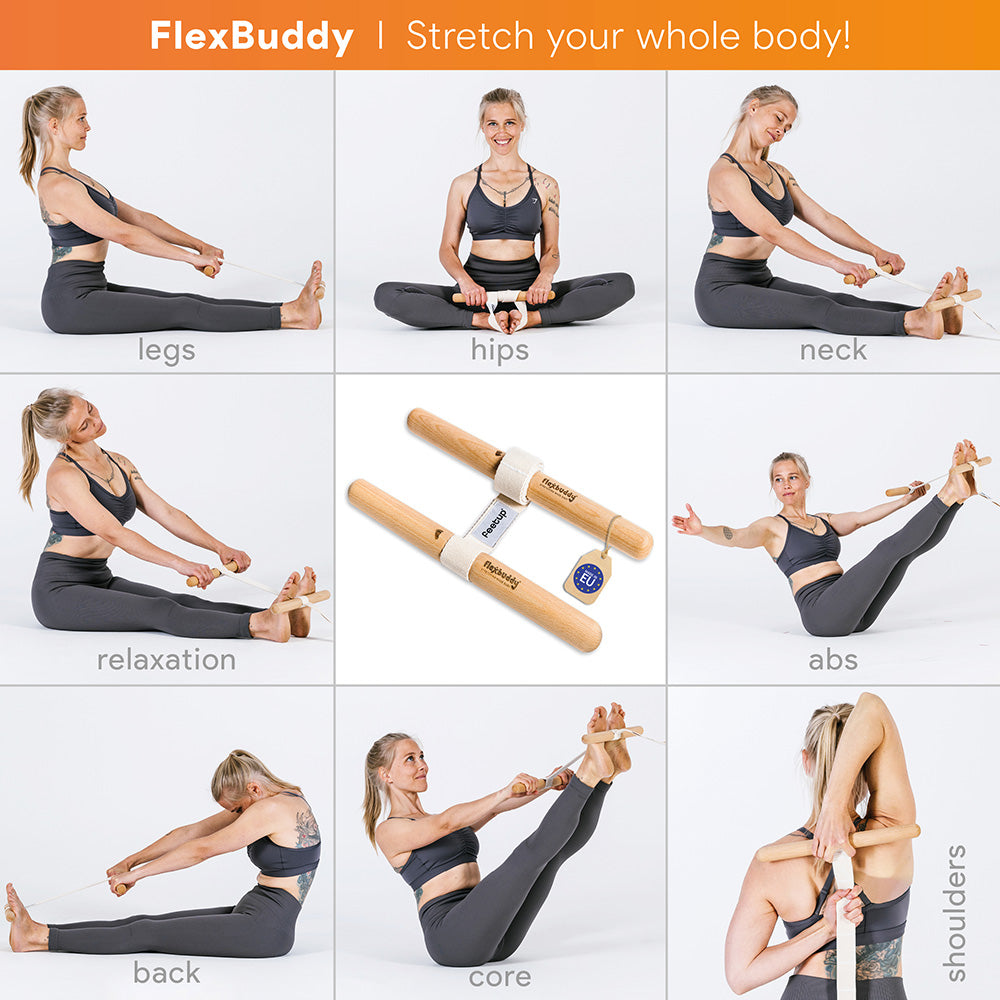
- FlexBuddy® gives you the whole plan. Five exercises cover legs, hips, shoulders and balance: Alternating Stretch, Single Leg Stretch, Butterfly Pose, Shoulder Opener and Standing Hand-to-Foot Pose. Eight to ten minutes, spine held tall.
You don't need a gym, a class or an hour a day to get more flexible. You need a few square metres of floor, five exercises that cover the whole body, and a setup comfortable enough that you look forward to it. Ten minutes on your living room floor is enough, and you can start tonight. Here is the plan.
Why home beats the gym for flexibility
Flexibility is the one fitness quality where the gym gives you no head start. There's no machine for it, no weight stack, no class timetable to fit around. What flexibility needs is the shortest possible gap between "I should stretch" and "I am stretching", and nothing beats your own living room floor for that.
The research is on your side. When reviewers pooled 23 long-term stretching studies, the time spent stretching per week and the number of days per week were what tracked with improvement [1]. Short and regular wins, and home is where that is easiest.
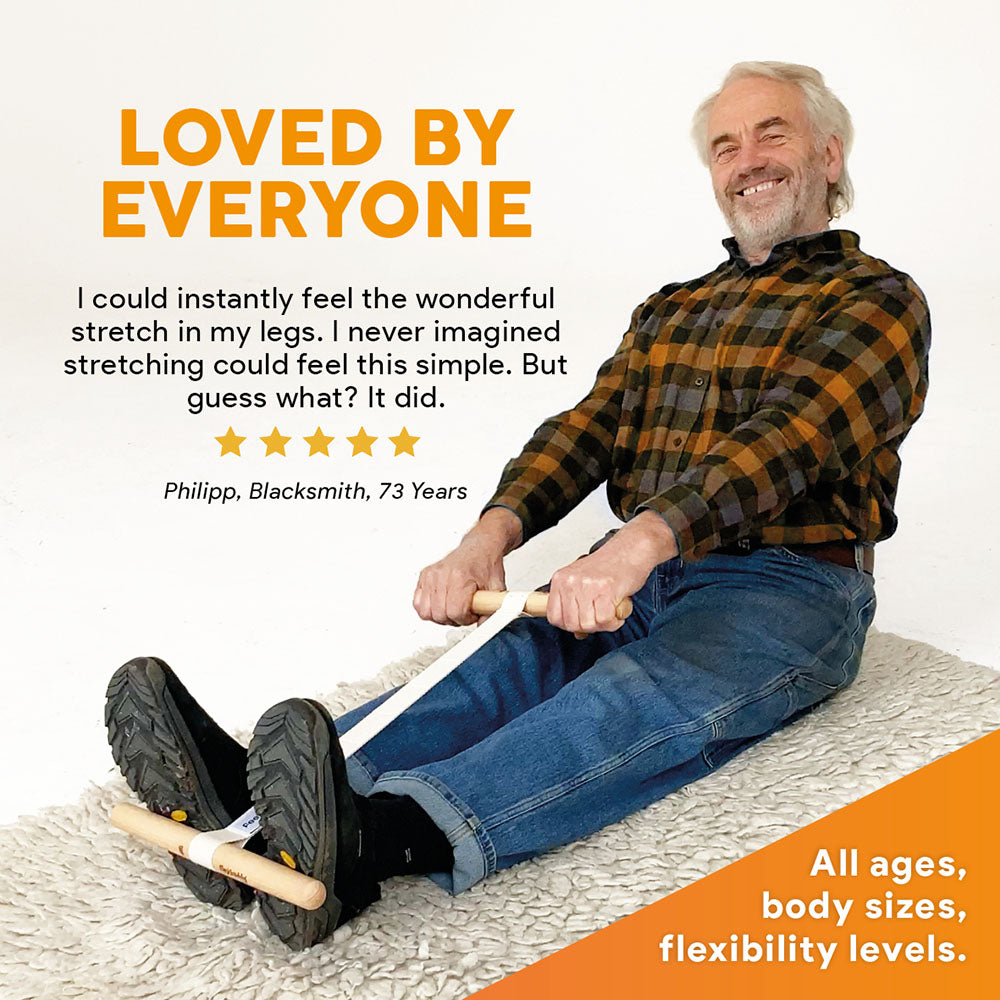
The one thing a class gives you is a teacher who says "straighten your back". It matters. Round and strain towards your feet, and the spine does the reaching while the muscles you meant to stretch never get to their end range. FlexBuddy does the teacher's job: its handles give you the reach, so your spine stays long and the stretch lands where it should, with the depth controlled by your grip.
What actually changes when you get more flexible
Good news for anyone who feels naturally stiff: getting flexible is a matter of teaching your body, not forcing it. A review in the journal Physical Therapy concluded that the extra range seen after a single session, and after short programmes of three to eight weeks, comes mostly from modified sensation: the nervous system lets you go further before it calls a halt [5].
That is why calm, repeated, comfortable stretching works so well. You are teaching a nervous system, not bending a bar, and you will notice it in the first week, when a position that felt tight on day one starts to feel friendly.
The method in this plan has the best record. A 2024 meta-analysis of 77 studies found that stretch training increases range of motion, and that static stretching and contract-relax (PNF) stretching produced larger long-term gains than ballistic or dynamic stretching [7]. Slow holds win.
Stretching also holds its own against the weights room: in a meta-analysis of randomised trials, it improved range of motion as much as strength training did [8]. Squats and lunges done through a full range count too.
How much stretching you need: the dose in plain numbers
Less than you think.
How long to hold
Hold for 15 to 30 seconds and repeat two to four times, after a short active warm-up [2]. A trial of adults aged 21 to 39 with tight hamstrings tested this directly: everyone stretched five days a week for six weeks, and a 30-second hold improved knee range as much as a 60-second hold did, and once a day did as well as three times a day [4]. More in how long to hold a stretch. Over 65, go longer: holds of up to 60 seconds were associated with better hamstring gains in older adults [2].
How much per week
The American College of Sports Medicine recommends a total of 60 seconds per flexibility exercise, on at least two days a week [3]. Take that as the floor. The review of 23 studies points to at least five minutes a week per muscle group, across at least five days [1]. And you never need to overdo it. A 2025 meta-analysis of 189 studies and 6,654 adults found that the benefit is all in by about four minutes per session or ten minutes per week for a given muscle [9].
How many days
Three days a week works: in adults with tight hamstrings, stretching three times a week beat once a week and was about as good as five times a week [10]. Most days works better still: in an eight-week study, people who stretched at least six times a week gained more hip range than those who stretched three times a week (24% against 16.8%) [11]. So aim for most days, and know that three still counts. How often you should stretch goes through those trials one by one.
Who gains the most? The stiffest people. In the 189-study analysis, adults with poor baseline flexibility improved more than adults with average flexibility, and stretching worked just as well whatever their age, sex or training background [9]. Too stiff to start? This plan was written for you.
Before you start: space, kit and how far to go
- Space and kit: enough floor to sit with your legs straight and apart, a wall within reach, a mat, and one FlexBuddy. A cushion under the sitting bones helps if your lower back rounds the moment you sit down.
- Warm-up: stretching guidance assumes a short active warm-up first [2]. At home that means a couple of minutes of walking about or climbing the stairs; the first exercise is itself a moving warm-up.
- Intensity: mild, breathable tension. You should be able to breathe slowly and talk. Sharp pain, tingling or numbness means you have gone too far, or that something other than a tight muscle is involved.
- Position: long spine, fold at the hips. If your back rounds to get you further, come back up, lift the chest, and take less range.
The plan at a glance
Five exercises, eight to ten minutes. Holds follow the 15 to 30 second convention [2], and the two seated stretches each add up to about the 60 seconds per exercise the ACSM recommends [3].
| Exercise | Targets | Hold and reps | Best for |
|---|---|---|---|
| 1. Alternating Stretch | Hamstrings, sides of the trunk, warm-up | Slow flow, 45–60 s in total | Starting every session |
| 2. Single Leg Stretch | Hamstrings, one side at a time | 20–30 s × 2 per side | Evening out the legs |
| 3. Butterfly Pose | Inner thighs, hips | 20–30 s × 2 | Hip width and ease |
| 4. Shoulder Opener | Chest, front of the shoulders | 5–8 slow reps | Upper-body opening |
| 5. Standing Hand-to-Foot Pose | Hamstrings, balance | 15–20 s × 2 per side | The graduation exercise |
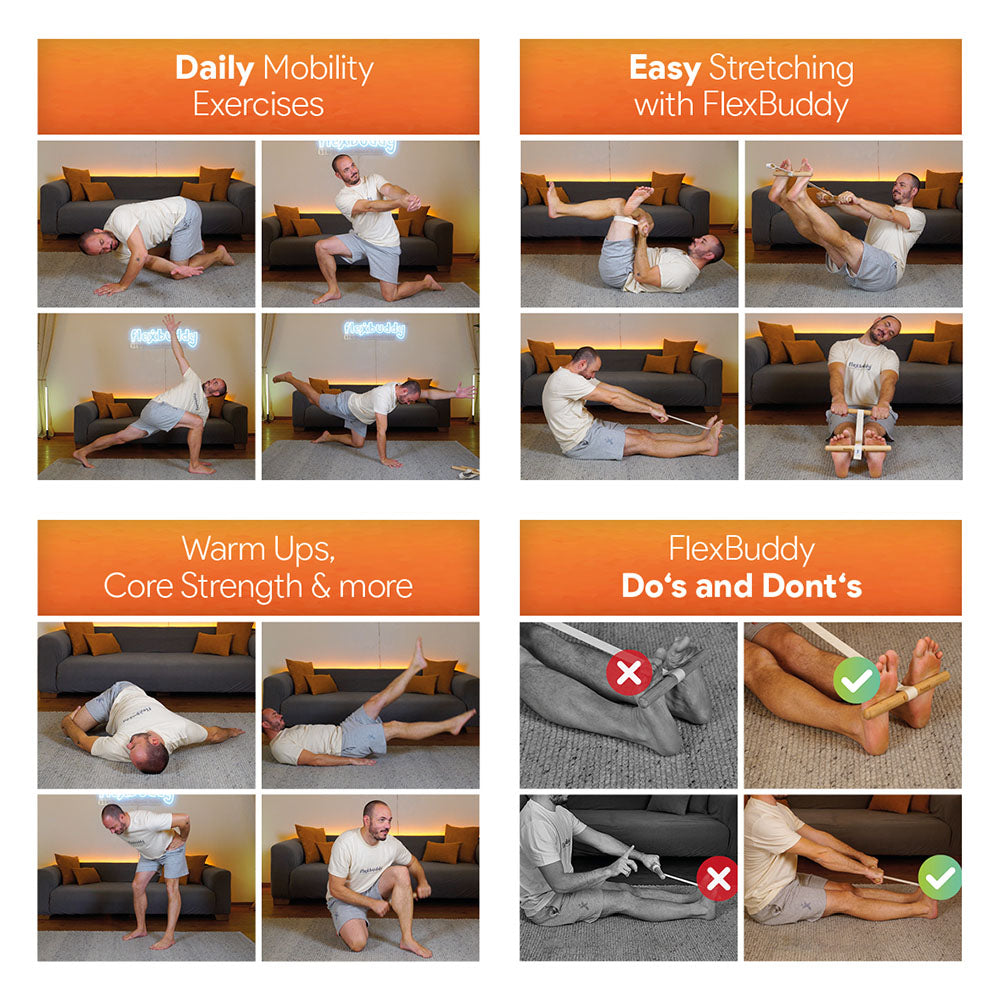
If you have never set the device up, how to use FlexBuddy shows the basic posture and the two ways of adjusting the strap. Every exercise below can be watched on the free video page.
The five exercises, step by step
1. Alternating Stretch
How to do it with FlexBuddy:
- Sit with your legs extended and comfortably apart, the foot bar under the sole of one foot.
- Hinge gently towards that leg for a breath or two, rise, then move the bar to the other foot.
- Keep alternating sides in a slow, flowing rhythm for 45 to 60 seconds.
What you will feel: a gentle, travelling stretch: the back of each thigh in turn, plus a light opening along the sides of your trunk as you move.
Why it starts the session: alternating movement warms both legs without parking in any one position. Ideal on stiff mornings.
2. Single Leg Stretch
How to do it with FlexBuddy:
- One leg extended, the other knee bent with that foot resting against the inner thigh.
- Place the foot bar under the extended foot, hold the hand bar, sit tall.
- Exhale and hinge gently towards the straight leg. Hold 20 to 30 seconds of mild tension, ease off, repeat once, then switch legs.
What you will feel: a clear pull along the back of the extended thigh, and a useful report on which side is tighter.
Beginner tip: the tighter side gets one extra round. That's how the legs even out instead of drifting further apart.
3. Butterfly Pose
How to do it with FlexBuddy:
- Soles of the feet together, knees falling outward, FlexBuddy hooked around both feet.
- Use light tension on the handles to sit tall; if it feels comfortable, hinge slightly forward from the hips.
- Stay 20 to 30 seconds, breathing slowly, letting the knees sink at their own pace. Rest and repeat once.
What you will feel: the inner thighs and hips opening, knees getting heavier with each exhale.
Common mistake: pressing the knees down. Gravity and breath do it better, every time.
4. Shoulder Opener
How to do it with FlexBuddy:
- Stand or sit tall, holding FlexBuddy by both handles in front of you, arms straight.
- Slowly raise it overhead and slightly behind you, only as far as stays comfortable.
- Pause briefly, lower with control, and repeat 5 to 8 times.
What you will feel: the chest and the front of the shoulders opening, and your posture lifting with them. This is flexibility work for the upper half, which home stretchers love to skip.
Why it's here: the fixed handle width keeps both shoulders moving evenly, and open shoulders on top of a flexible lower body is the complete result.
5. Standing Hand-to-Foot Pose, the graduation exercise
How to do it with FlexBuddy:
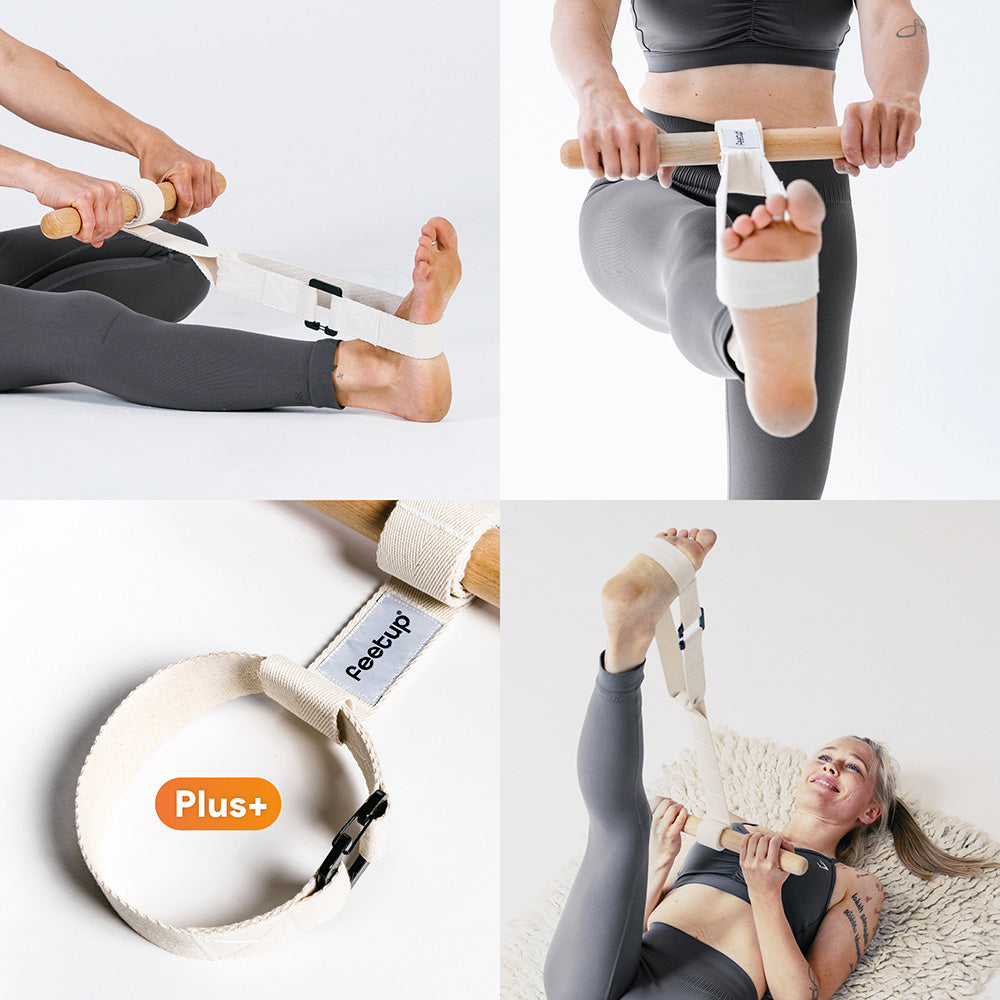
- Stand tall, near a wall if you like backup. Place the foot bar under one foot and hold the handles.
- Lift that leg forward to a comfortable height, knee bent at first, letting the strap carry the leg's weight.
- Slowly work towards straightening the lifted leg. Height is irrelevant; control is everything.
- Hold 15 to 20 seconds, breathing steadily. Lower, repeat once, then change sides.
What you will feel: the hamstrings working on the lifted leg, and your balance waking up.
Why it's last: this is flexibility you can use: strength, balance and range in one standing position. The handles turn a wobbly yoga posture into a supported exercise. When this feels stable, your home programme is visibly working. If balance is a concern, keep one hand on the wall.
The weekly structure that actually works
Run the five exercises most days: aim for five days a week, accept three. Three is the lowest frequency that clearly beat once a week in a trial [10], and five puts the plan's two hamstring holds per leg (about a minute a day) at the five-minutes-a-week mark that the long-term studies point to [1]. The session should leave you feeling oiled, not punished.
| Weeks | What you do | How often | What to expect |
|---|---|---|---|
| 1–2 | All five exercises at the easiest strap setting; learn the long-spine position | 3–5 days a week | Stretches feel calmer and more comfortable every session |
| 3–6 | Same five; shorten the strap one small step when a hold feels easy and the spine stays long | 5 days a week | Everyday bending, sitting on the floor and getting up feel easier |
| 7–12 | Same five; straighten the lifted leg more in the standing pose; add an extra round on your tighter side | 5 days a week, or most days | Visible range: hands further down the shins, knees lower in Butterfly |
| After that | Maintenance: the full plan, or a two-minute version on busy days | Most days, never fewer than 2 [3] | The range stays as long as the habit does |
For the days when ten minutes is not going to happen, the two-minute daily routine keeps the chain unbroken. For desk-day damage control, there's the sitting-all-day routine.
What progress really looks like
Progress comes in three waves, and the first arrives fast: calm first (week one), easier daily movement second (weeks two to three), visible range third (months). Tolerance accounts for most of the gain across the first three to eight weeks [5], which is why a stretch feels much easier long before you reach for a tape measure.
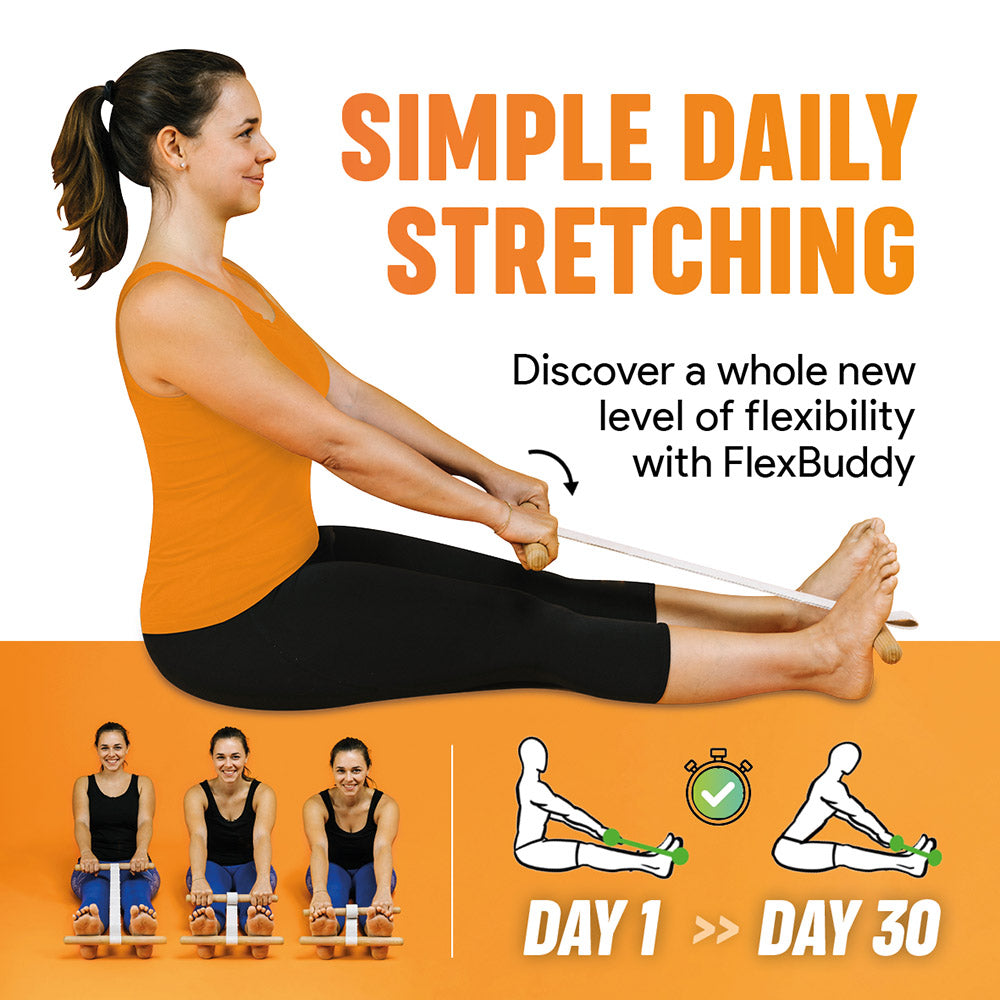
Six weeks is your first checkpoint. That is the length of the trial in which a daily 30-second hamstring stretch, five days a week, produced a measurable increase in range [4]. Measure something simple on day one and again at week six, such as how far down your shins your fingertips reach with a long spine.
Age is no barrier. In a United States survey of 1,683 adults, hip and knee range in the oldest group was generally only 3 to 5 degrees lower than in the youngest, and the authors concluded that up to age 74 a substantial loss of joint mobility should not be put down to ageing [12]. So start at any age.
And what you build does not vanish overnight. In one study, people who stretched for four weeks and then stopped for four still held part of their gain at the end [11]. Keep going and you keep all of it. For realistic timelines by age and starting point, see how long it takes to get flexible.
Making the habit stick at home
A stretching habit lasts when the positions feel good and the routine has a fixed time and place. FlexBuddy takes care of the first. For the second, tie the routine to something that already happens every day in the same place, such as brushing your teeth or the start of the evening news. In the research summarised for doctors in the British Journal of General Practice, a daily behaviour took an average of 66 days to become automatic, with wide variation between people, and missing an occasional day did not derail the process [13]. The authors suggest telling people to expect about ten weeks [13]. After that it runs itself.
- Same cue, same spot. Leave the mat and the FlexBuddy where you can see them. Kit in a cupboard is a decision; kit on the floor is a prompt.
- Shrink it, don't skip it. On a busy day, do the Alternating Stretch and one round of the Single Leg Stretch. The habit survives.
- One missed day is nothing. Carry on the next day at the same cue.
Common mistakes when you stretch at home
- Bouncing. Long-term studies favour slow static holds over ballistic stretching [7].
- Holding for minutes. No need. For younger adults a 30-second hold does as much as a longer one [4], and about ten minutes a week per muscle gives you all the gain there is [9]. Spread the time over more days instead.
- Chasing pain. Gentle stretching gets you the same result: stretch intensity did not change the size of the improvement in the largest analysis to date [9].
- Only stretching what is already loose. The exercise you like least usually does the most for you.
There is a fuller list, with the fix for each, in the most common stretching mistakes.
When stretching at home is not the right first step
Some things that feel like stiffness are not stiffness. See a doctor or physiotherapist before starting if you have pain that is sharp, that travels down an arm or leg, or that is getting worse; numbness, tingling or weakness; a recent injury, fall or operation; or a diagnosed disc problem or sciatica that is under care. Pregnancy and very mobile joints call for individual advice too. Stretching improves how far and how comfortably you move; it is not a remedy for a medical condition.

Your home flexibility teacher: FlexBuddy
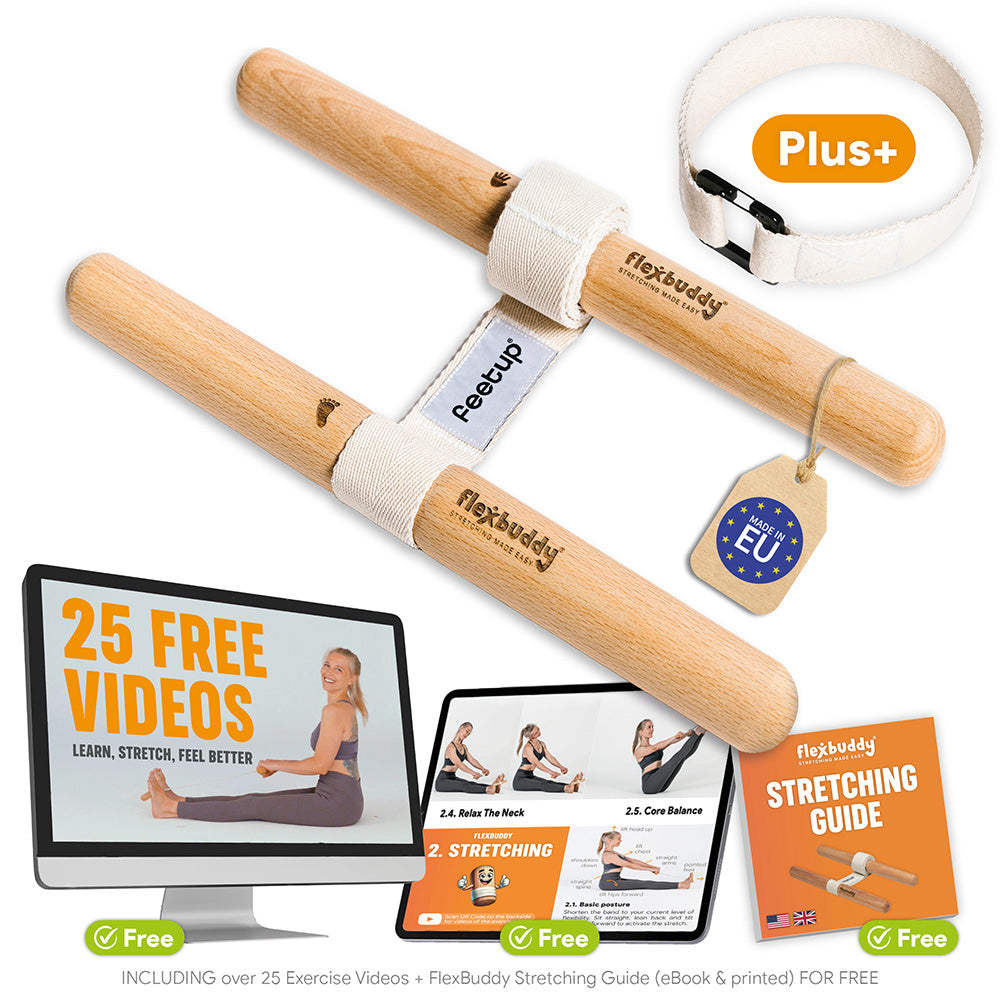
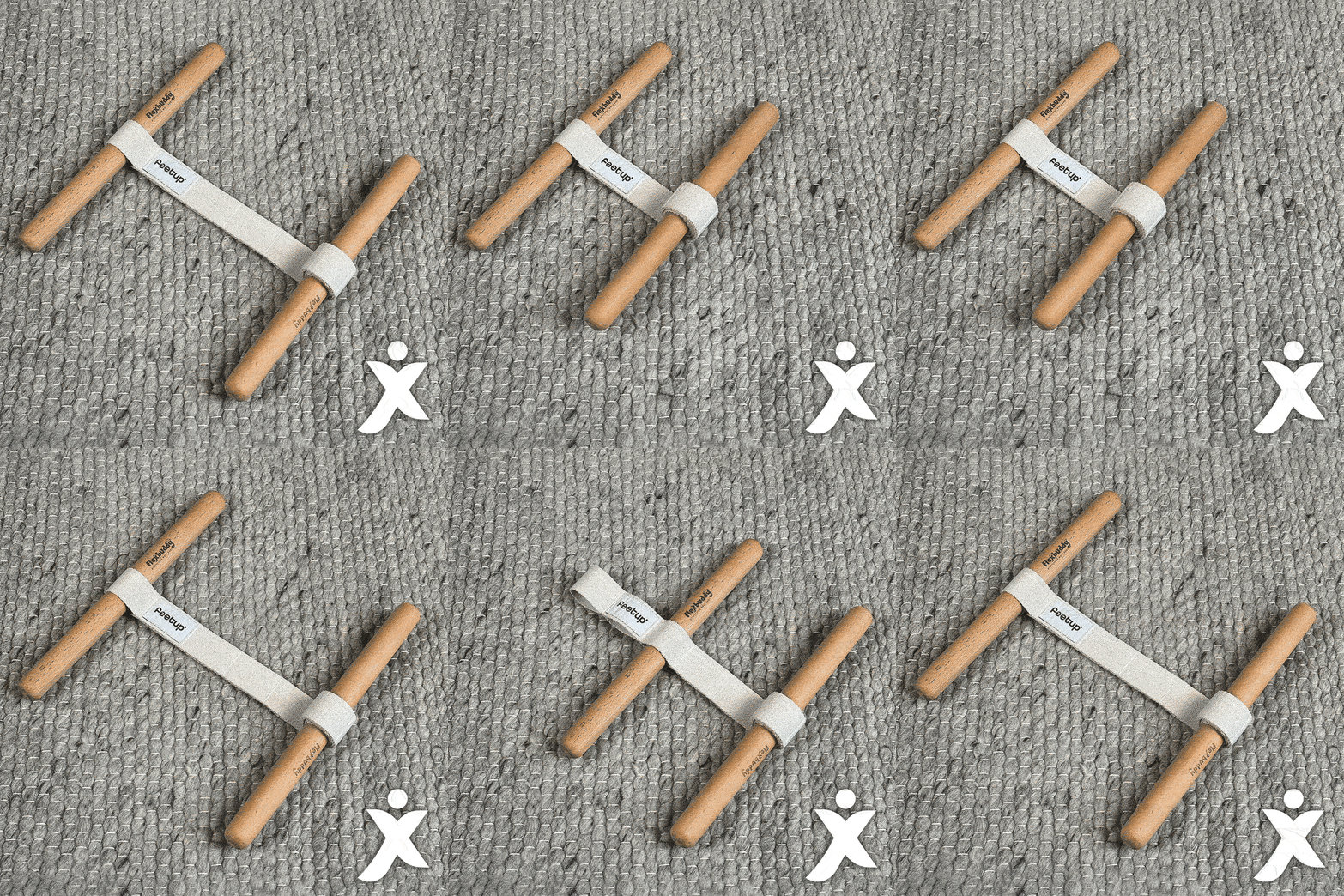
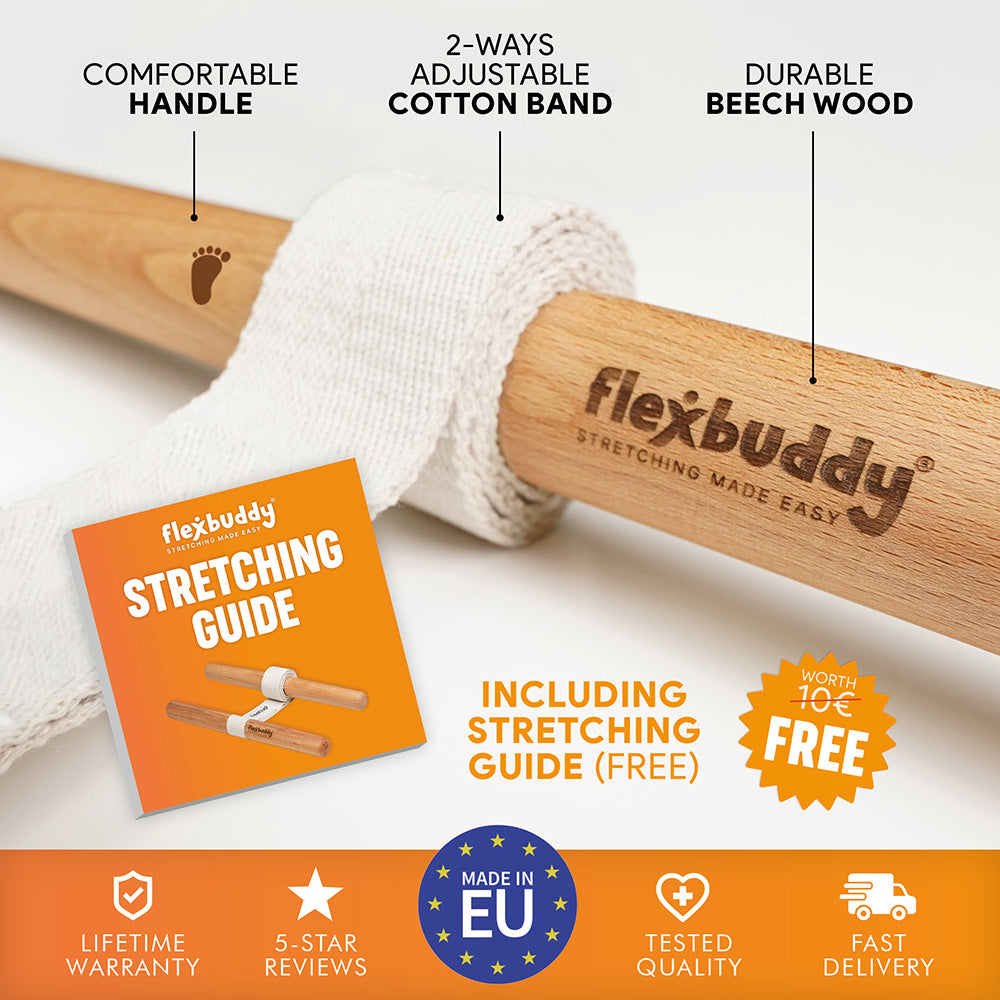
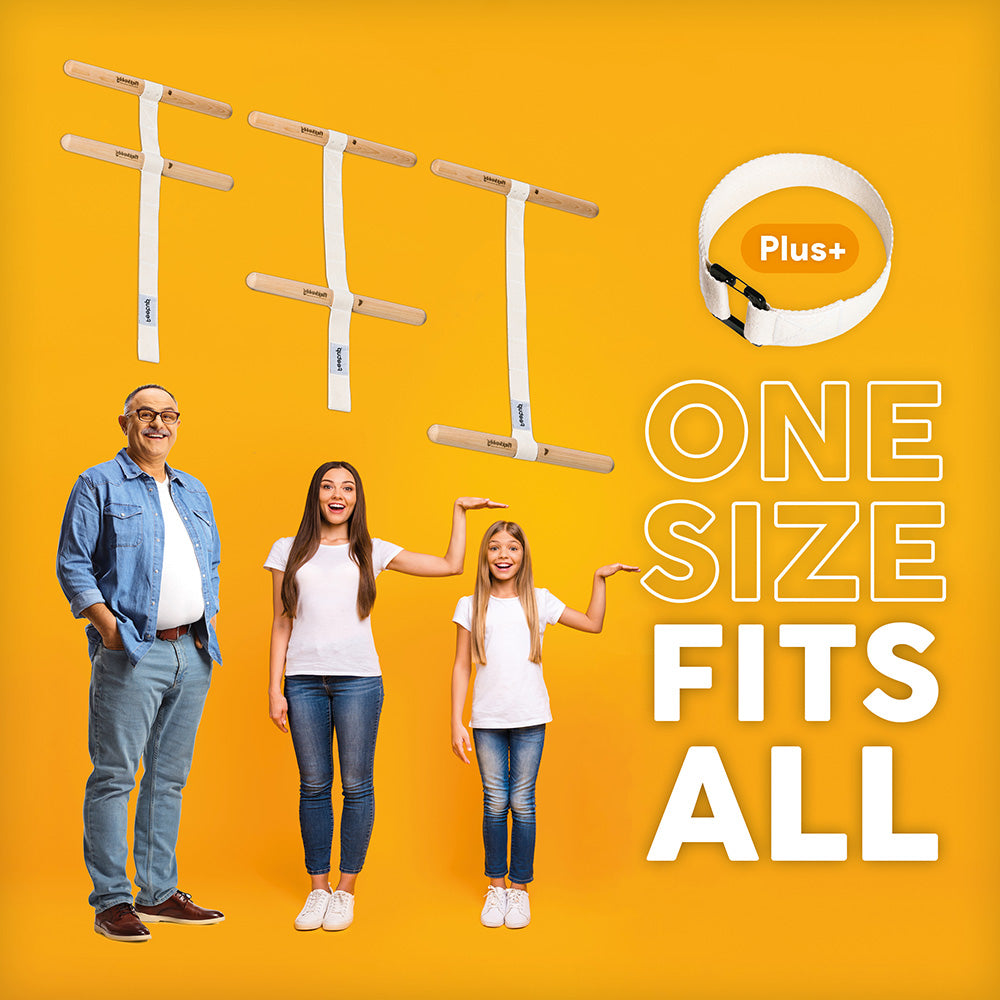
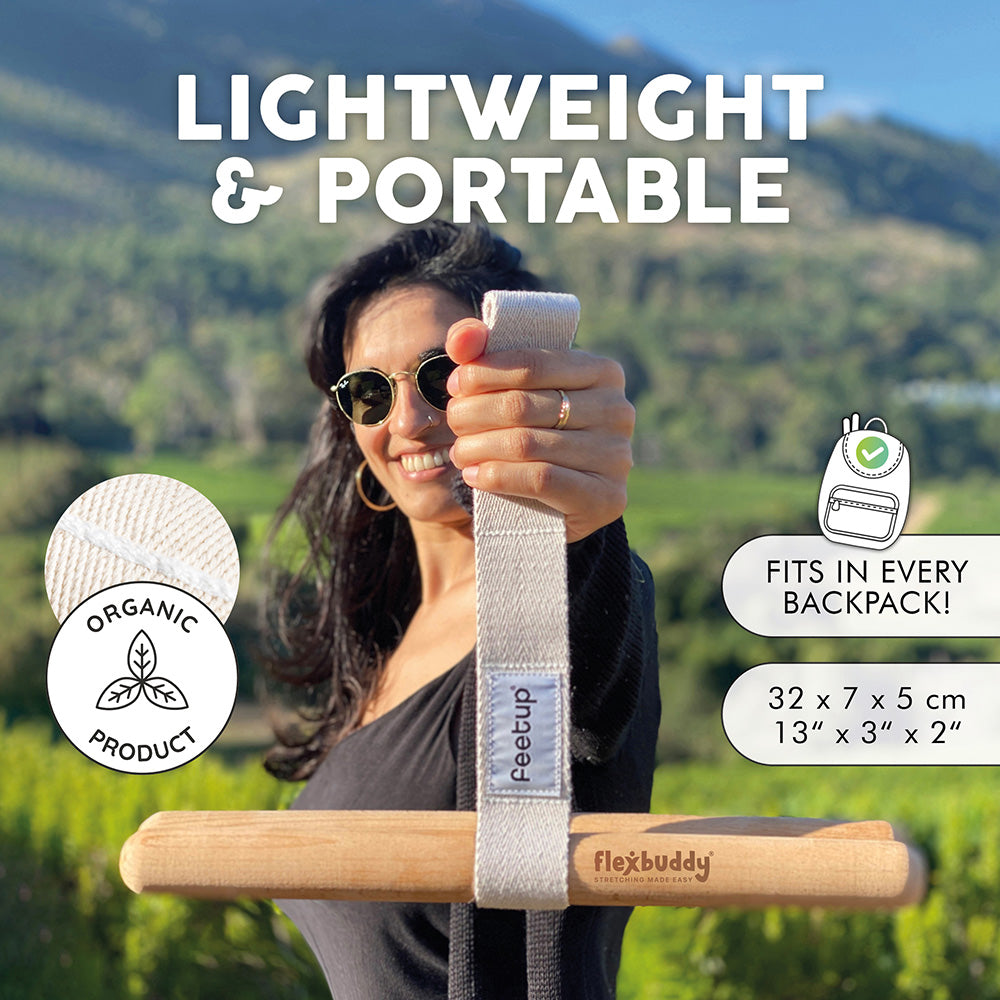
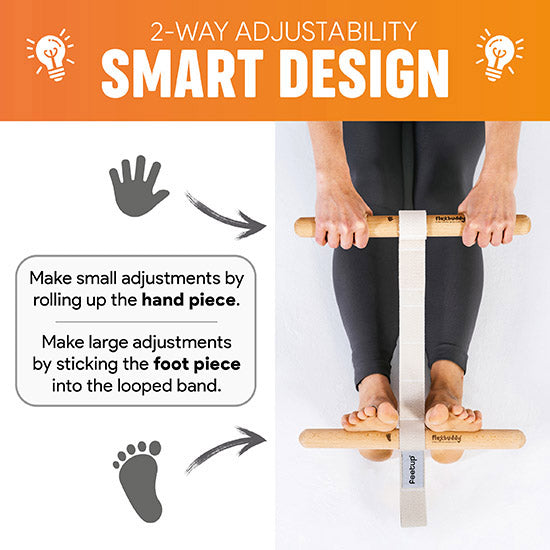
Stretching at home has no teacher to say "straighten your back". FlexBuddy® does that job. It is a patented stretching device made of two beech-wood bars joined by an adjustable natural-cotton strap. The foot bar goes under your soles, the hand bar in both hands, and the strap supplies the reach your hamstrings do not have yet, so you sit tall and fold at the hips. Adjustment is two-way: move the foot bar to another loop for big steps, roll the strap round the hand bar for fine ones. Comfortable wooden handles, no rope burn, one size for every body.
Bob J.: "I am 64 and have never touched my toes. FlexBuddy changed that in a week!" Stylianos T.: "I can now bend 15 cm more than before in the space of 6 months." FlexBuddy is rated 4.5 by verified buyers and comes with a 30-day money-back guarantee and a lifetime warranty, so you can try it without risk. Get your FlexBuddy, or take the two-minute quiz to find the best starting point for your body.
Frequently asked questions
How long does it take to improve flexibility at home?
You will feel it in the first week or two, as stretches get calmer. Daily movement eases in two to three weeks, and visible range builds over months. Trials show measurable hamstring gains after six weeks of a daily 30-second stretch, five days a week [4]. Turning up often is the lever, not long sessions [1].
How long should I hold each stretch?
Just 15 to 30 seconds, repeated two to four times [2], for about 60 seconds in total per exercise [3]. In adults under 40, a 30-second hold gained as much as a 60-second one [4]. Over 65, longer holds of up to 60 seconds are linked to better gains [2].
Should stretching be uncomfortable to work?
No. Mild, breathable tension is where the gains are. Pain makes muscles guard, which is the opposite of flexibility, and in the largest analysis to date stretching harder brought no bigger gains [9].
Do I need any equipment besides FlexBuddy?
No. FlexBuddy, a bit of floor, and a mat or cushion if you like. Nothing else stands between you and tonight's session.
Is there a guided version of this plan?
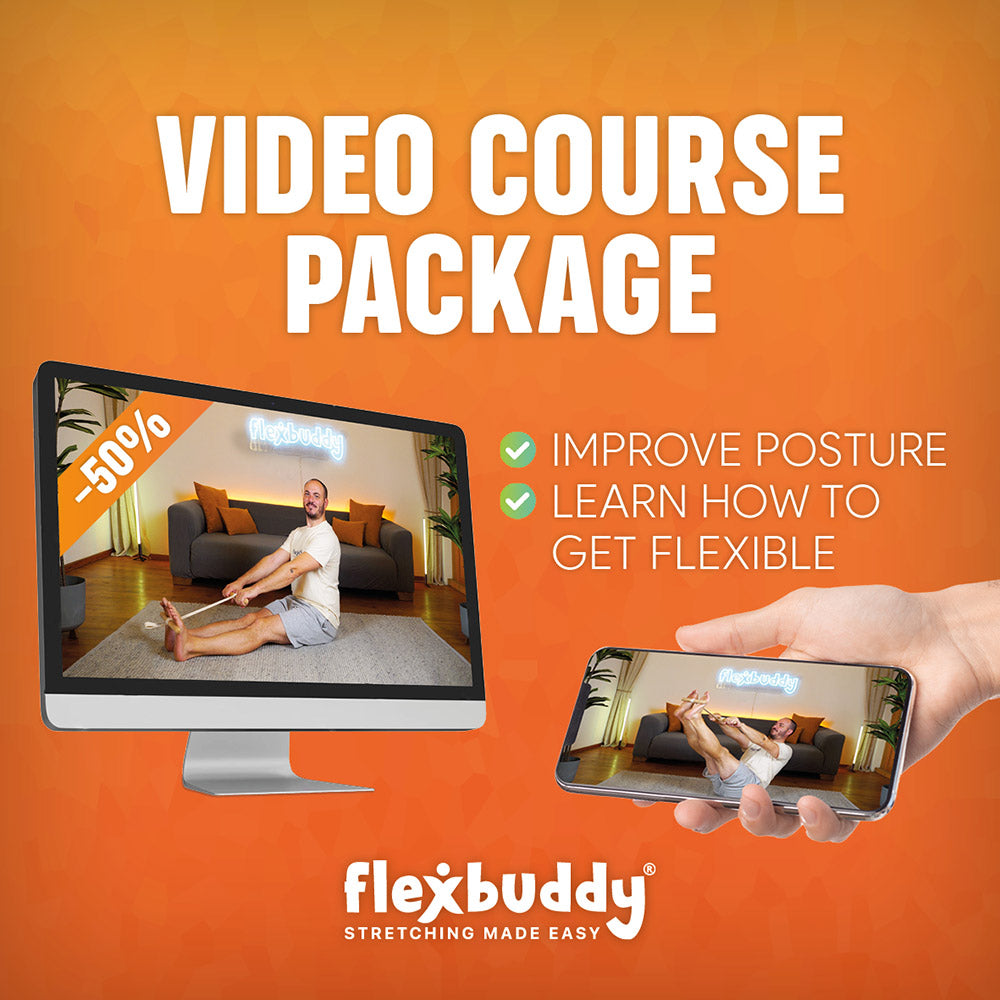
Yes. The exercises are shown on the free video page, and the Video Course Package adds twelve follow-along routines, from quick daily sessions to a dedicated Routine to Touch Toes.
This article is general information, not medical advice. Tight muscles usually respond well to regular stretching. If your pain is sharp, radiates down a leg, comes with numbness, weakness, fever, bladder or bowel changes, follows an injury, or keeps getting worse, see a doctor or physiotherapist before you stretch.
References
- Thomas E, Bianco A, Paoli A, Palma A. The relation between stretching typology and stretching duration: the effects on range of motion. Int J Sports Med. 2018;39(4):243–254. doi:10.1055/s-0044-101146. PMID 29506306. https://pubmed.ncbi.nlm.nih.gov/29506306/ (accessed 14 Nov 2026).
- Page P. Current concepts in muscle stretching for exercise and rehabilitation. Int J Sports Phys Ther. 2012;7(1):109–119. PMID 22319684; PMC3273886. https://pmc.ncbi.nlm.nih.gov/articles/PMC3273886/ (accessed 14 Nov 2026).
- Garber CE, Blissmer B, Deschenes MR, et al.; American College of Sports Medicine. Position stand: quantity and quality of exercise for developing and maintaining cardiorespiratory, musculoskeletal, and neuromotor fitness in apparently healthy adults: guidance for prescribing exercise. Med Sci Sports Exerc. 2011;43(7):1334–1359. doi:10.1249/MSS.0b013e318213fefb. PMID 21694556. https://pubmed.ncbi.nlm.nih.gov/21694556/ (accessed 14 Nov 2026).
- Bandy WD, Irion JM, Briggler M. The effect of time and frequency of static stretching on flexibility of the hamstring muscles. Phys Ther. 1997;77(10):1090–1096. doi:10.1093/ptj/77.10.1090. PMID 9327823. https://pubmed.ncbi.nlm.nih.gov/9327823/ (accessed 14 Nov 2026).
- Weppler CH, Magnusson SP. Increasing muscle extensibility: a matter of increasing length or modifying sensation? Phys Ther. 2010;90(3):438–449. doi:10.2522/ptj.20090012. PMID 20075147. https://pubmed.ncbi.nlm.nih.gov/20075147/ (accessed 14 Nov 2026).
- Willy RW, Kyle BA, Moore SA, Chleboun GS. Effect of cessation and resumption of static hamstring muscle stretching on joint range of motion. J Orthop Sports Phys Ther. 2001;31(3):138–144. doi:10.2519/jospt.2001.31.3.138. PMID 11297019. https://pubmed.ncbi.nlm.nih.gov/11297019/ (accessed 14 Nov 2026).
- Konrad A, Alizadeh S, Daneshjoo A, et al. Chronic effects of stretching on range of motion with consideration of potential moderating variables: a systematic review with meta-analysis. J Sport Health Sci. 2024;13(2):186–194. doi:10.1016/j.jshs.2023.06.002. PMID 37301370; PMC10980866. https://pubmed.ncbi.nlm.nih.gov/37301370/ (accessed 14 Nov 2026).
- Afonso J, Ramirez-Campillo R, Moscão J, et al. Strength training versus stretching for improving range of motion: a systematic review and meta-analysis. Healthcare (Basel). 2021;9(4):427. doi:10.3390/healthcare9040427. PMID 33917036; PMC8067745. https://pubmed.ncbi.nlm.nih.gov/33917036/ (accessed 14 Nov 2026).
- Ingram LA, Tomkinson GR, d'Unienville NMA, et al. Optimising the dose of static stretching to improve flexibility: a systematic review, meta-analysis and multivariate meta-regression. Sports Med. 2025;55(3):597–617. doi:10.1007/s40279-024-02143-9. PMID 39614059. https://pubmed.ncbi.nlm.nih.gov/39614059/ (accessed 14 Nov 2026).
- Marques AP, Vasconcelos AA, Cabral CM, Sacco IC. Effect of frequency of static stretching on flexibility, hamstring tightness and electromyographic activity. Braz J Med Biol Res. 2009;42(10):949–953. doi:10.1590/S0100-879X2009001000012. PMID 19784479. https://pubmed.ncbi.nlm.nih.gov/19784479/ (accessed 14 Nov 2026).
- Cipriani DJ, Terry ME, Haines MA, Tabibnia AP, Lyssanova O. Effect of stretch frequency and sex on the rate of gain and rate of loss in muscle flexibility during a hamstring-stretching program: a randomized single-blind longitudinal study. J Strength Cond Res. 2012;26(8):2119–2129. doi:10.1519/JSC.0b013e31823b862a. PMID 22027850. https://pubmed.ncbi.nlm.nih.gov/22027850/ (accessed 14 Nov 2026).
- Roach KE, Miles TP. Normal hip and knee active range of motion: the relationship to age. Phys Ther. 1991;71(9):656–665. doi:10.1093/ptj/71.9.656. PMID 1881956. https://pubmed.ncbi.nlm.nih.gov/1881956/ (accessed 14 Nov 2026).
- Gardner B, Lally P, Wardle J. Making health habitual: the psychology of 'habit-formation' and general practice. Br J Gen Pract. 2012;62(605):664–666. doi:10.3399/bjgp12X659466. PMID 23211256; PMC3505409. https://pmc.ncbi.nlm.nih.gov/articles/PMC3505409/ (accessed 14 Nov 2026).