- Good news first: your pelvis is normal. In an anterior pelvic tilt the front of the pelvis tips down and the lower back arches; in a posterior tilt the tailbone tucks under and the lower back flattens [1].
- A forward tilt is what healthy looks like. Among healthy, pain-free young adults, 85% of the men and 75% of the women had one [2].
- The angle does not rule your back. People with and without low back pain stand with the same tilt [3], and on average the flatter lower back belongs to the people in pain [4]. What differs is how they move, and movement is trainable.
- Forget the number. Bone shape alone moves the standard measurement by up to 23 degrees [5]. Go by how your hips and back feel.
- Five exercises cover both sides of the pelvis. About 60 seconds per stretch; strength two to three days a week [6][7].
- Your hips answer fast. One session of hip-flexor stretching added 2.6 degrees of hip extension and took 1.2 degrees off the standing tilt [8], and eight weeks of abdominal training built strength [9].
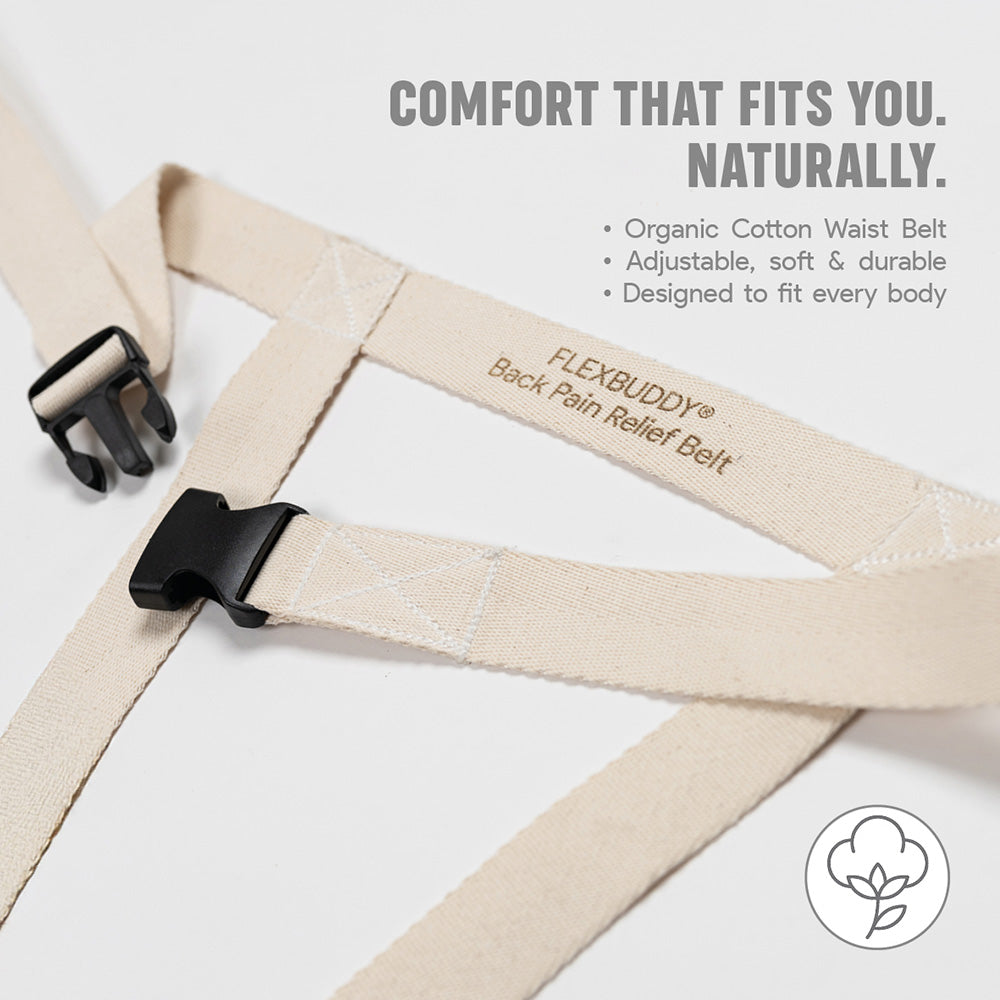
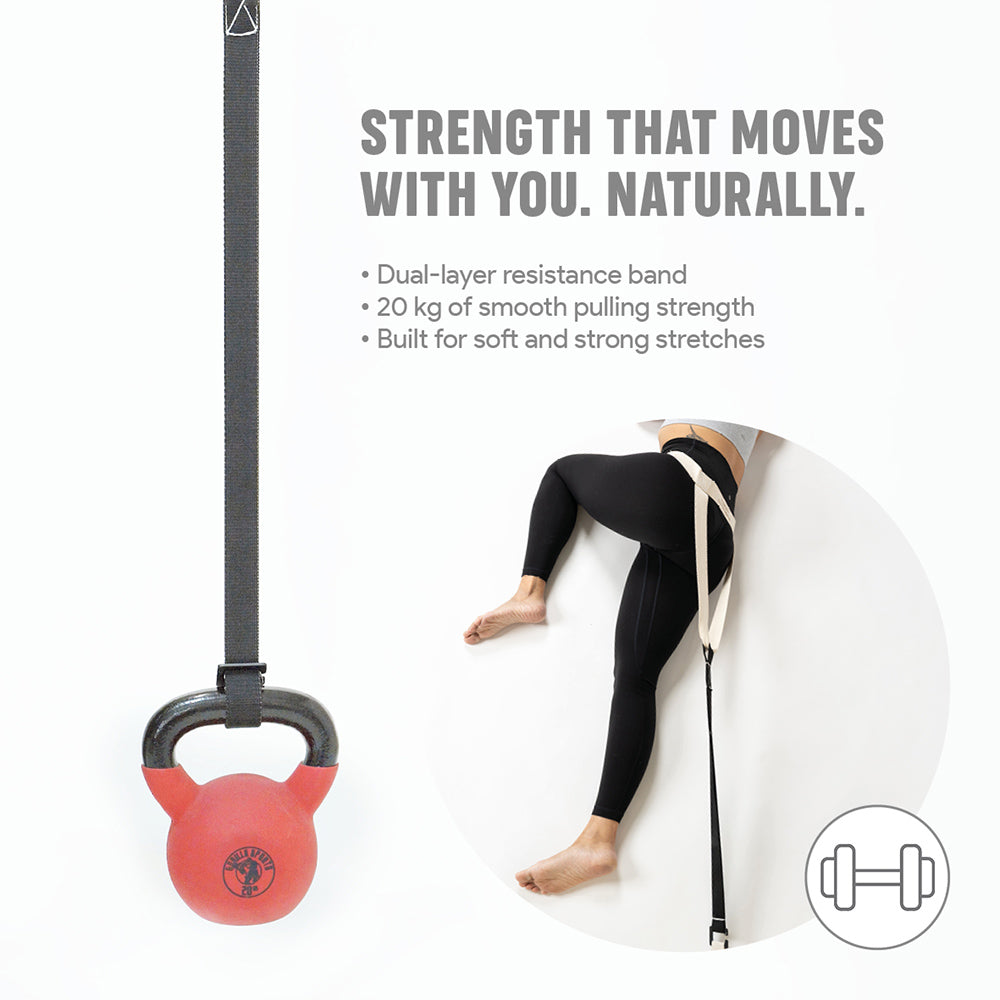
- FlexBuddy® takes care of the hamstring half. It holds your spine long while you tip the pelvis forward from the hips, in two minutes a day.
What is pelvic tilt?
Think of the pelvis as a bowl sitting on top of your thigh bones. Pelvic tilt is which way that bowl tips when seen from the side. Two bony landmarks make it measurable, one at each end of the iliac crest, the upper rim of the hip bone [10]: the anterior superior iliac spine (ASIS), the hard point at the front of each hip, and the posterior superior iliac spine (PSIS), under the two dimples above your bottom.
Clinicians measure tilt as the angle between a line joining those two points and the horizontal [2]. Front point lower than the back one: the bowl is tipped forwards, an anterior pelvic tilt. Front lifted and tailbone tucked under: a posterior tilt [1].
The lower spine rides on the pelvis, so the two move together: tip the pelvis forward and the inward curve of the lower back (the lumbar lordosis) deepens; tip it backwards and the curve flattens. A mild tilt can come with no symptoms at all [1].
Tilt is also a movement: the pelvis is meant to tip forward when you hinge to pick something up and backwards when you sink into a sofa. In the Cleveland Clinic's words, "There's no such thing as perfect posture" [1]. A pelvis that moves freely both ways is the goal.
How common is anterior pelvic tilt in people without pain?
Very. It is the rule, not the exception. In the study most often cited, of healthy young adults with no symptoms, an anterior tilt was found in 85% of the men and 75% of the women, and only 9% of the men and 18% of the women were "neutral" [2]. The reference value usually given for a healthy pelvis is a forward tilt of about 8 degrees [9].
Part of your tilt is simply how you are built. When the same research group set 30 bare pelvic bones in one fixed position, the ASIS to PSIS angle ranged from 0 to 23 degrees [5]. What you can change, and quickly, is how your hips move and how your back feels.
Does anterior pelvic tilt cause lower back pain?
Here is the part nobody tells you: the angle of your pelvis does not decide how your back feels. How well you move does, and you can train that.
People with back pain do not have more tilt. A systematic review of 43 studies found no average difference in standing pelvic tilt or lumbar curve between adults with and without low back pain. What differed was movement: less range, less speed and a poorer sense of position in the people with pain [3]. A meta-analysis of 13 X-ray studies even found the smaller lumbar curve in the back-pain group [4].
Your shape is not your fate. An umbrella review of 41 systematic reviews found no consensus that spinal posture causes low back pain [11], and a review of 54 studies found no strong evidence linking the spine's front-to-back curves with any health outcome, spinal pain included [12]. About 90% of low back pain is non-specific, with no identifiable cause [13]. You do not need a perfect posture for a comfortable back. You need to move it.
Where the exercises earn their place. The Cleveland Clinic notes that a pelvis held far from neutral for long periods can cause discomfort in the surrounding muscles, often felt in the lower back [1], and a systematic review lists excessive forward tilt as a suspected contributor to hip impingement and sacroiliac joint pain [9]. If your back aches after long standing and eases when you tuck the pelvis slightly, the programme below is made for you. Expect your hips to feel freer within the first week. The wider picture is in posture correction: what actually works.
How to check for anterior pelvic tilt at home
The signs usually listed are an arched lower back and a bottom that sits further back [1]. What sends people searching is an aching lower back after standing or tight hips after sitting.
The wall test
Stand with your bottom and shoulder blades against a wall and slide a flat hand behind your lower back. Room for a fist suggests a deeper curve; treat it as a rough guide. Now tuck the tailbone under to close the gap, then let it go. Moving easily between the two matters more than where the pelvis rests.
The lying test
Lie on your back at the edge of a bed, hug one knee to your chest and let the other leg hang. This is a version of the Thomas test, which researchers use to measure how far the hip extends [14]. If the hanging thigh floats above the level of the bed, the hip flexors on that side are short or stiff. The hip-flexor stretch below is made for them.
What the checks give you
Not an angle, and you do not need one: even a clinician's reading includes the shape of your bones [5], and where the pelvis rests is only loosely tied to hip-flexor length [15]. What you get is more useful: whether your hip flexors are short and whether you control your pelvis. Both improve with practice.
The muscles that tilt the pelvis
Hip flexors: the front pull
The iliopsoas is two muscles with one tendon: the psoas major from the lumbar vertebrae and the iliacus from inside the pelvis, attaching together to the top of the thigh bone. The rectus femoris, the one quadriceps muscle that crosses the hip, starts just below the ASIS [16]. When short, they pull the front of the pelvis down, and sitting holds them at their shortest. Adults who sat more than seven hours a day and exercised little had 6.1 degrees less hip extension than active people who sat under four hours [14]. More in tight hips from sitting.
Glutes and abdominals: the opposing pair
The gluteus maximus, the main extensor of the hip, runs from the back of the pelvis and the sacrum to the thigh bone [17] and pulls the back of the pelvis down. The rectus abdominis runs from the pubic bone up to the breastbone and ribs [18] and lifts the front. Both tip the bowl backwards. When healthy people tucked the pelvis under with their muscles recorded, they used four different strategies, and the gluteus maximus was active in every one [19].
Hamstrings: the misunderstood ones
The hamstrings start on the sitting bone and attach just below the knee [20]. They pull the back of the pelvis down, so short hamstrings favour a posterior tilt, not an anterior one. In a forward tilt they are held on a mild stretch all day, the likely reason they feel tight. Either way they respond well to a straight-backed stretch, the one FlexBuddy was built for.
The "lower crossed" idea, and what the studies add
Put the four together and you get the pattern taught as lower crossed syndrome: tight hip flexors and lower-back muscles on one diagonal, weak glutes and abdominals on the other. The studies show what changes when you train.
- Hips open at once. One session of hip-flexor stretching added 2.6 degrees of hip extension and reduced standing tilt by 1.2 degrees [8].
- Abdominals get stronger. Eight weeks of abdominal strengthening built strength in healthy adults [9].
- No single muscle runs the pelvis. In healthy adults, abdominal performance was unrelated to pelvic tilt [21], and hip-flexor length, abdominal performance, age and activity explained little of the standing angle [22]. So train all four groups together.
- Hamstrings lengthen. In people with tight hamstrings, stretching improved the straight-leg raise [23].
Train for full hip extension, strength and control of the pelvis in both directions. Your hips and your back will tell you it is working.
Anterior pelvic tilt exercises: a programme for both sides of the pelvis
| Exercise | Position | Hold / tempo | Reps | What it gives you |
|---|---|---|---|---|
| Lying pelvic tilts | On your back, knees bent; flatten the lower back, then let it arch | Slow, 3 s each way | 10 | Control of the pelvis |
| Half-kneeling hip-flexor stretch with a tuck | One knee down; squeeze that glute, tuck the tailbone, shift forward | 30 s | 2 per side | Open hips |
| Glute bridge | On your back, knees bent; lift the hips level with knees and shoulders | Hold 3 s at the top | 10–15, 2 sets | Strong glutes |
| Dead bug (or front plank) | On your back, hips and knees at 90°; lower opposite arm and leg | Slow (plank: 20–30 s) | 6–8 per side, 2 sets (plank: 3 holds) | Strong abdominals |
| Hamstring stretch, long spine | Sit tall, legs straight, FlexBuddy or a strap round the feet; tip the pelvis forward | 10 breaths (~30 s) | 2–3 | Long hamstrings, a clean hip hinge |
1. Lying pelvic tilts
Lie on your back with knees bent. Press the lower back gently into the floor by drawing the front of the pelvis towards your ribs, then roll the other way so a small arch opens under your waist. It comes first: once you can feel the movement, every other exercise works better. FlexBuddy's own guide has a seated version: Cat-Cow in the basic posture, ten times.
2. Half-kneeling hip-flexor stretch with a posterior tilt
Kneel on one knee, on a cushion, with the other foot in front. Before moving, squeeze the glute on the kneeling side and tuck your tailbone under. Hold that tuck and shift the hips a few centimetres forward until the front of the kneeling hip pulls. Keep it small: lunging deep lets the back arch and the stretch escape. Progressions are in the hip flexor stretch guide.
3. Glute bridge
On your back with knees bent, tuck the pelvis slightly, press through the heels and lift until knees, hips and shoulders are in one line. Stop there: pushing higher only arches the lower back. Lower slowly; when 15 are easy, use one leg at a time.
4. Dead bug, or front plank
Lie on your back, arms pointing at the ceiling, hips and knees at right angles, lower back pressed lightly into the floor. Slowly lower one arm overhead and the opposite leg towards the floor, as far as the back stays down, then swap. In a plank, squeeze the glutes and stop when the hips sag.
5. Hamstring stretch with a straight spine
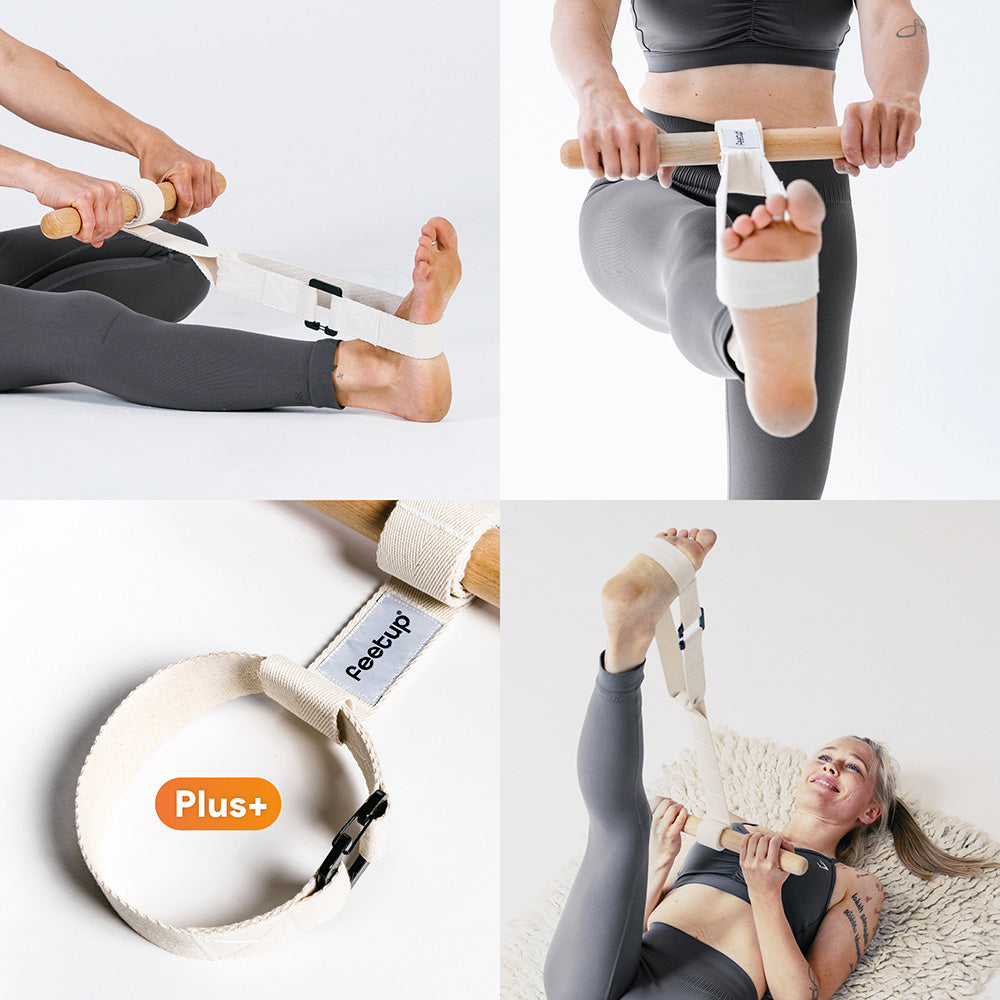
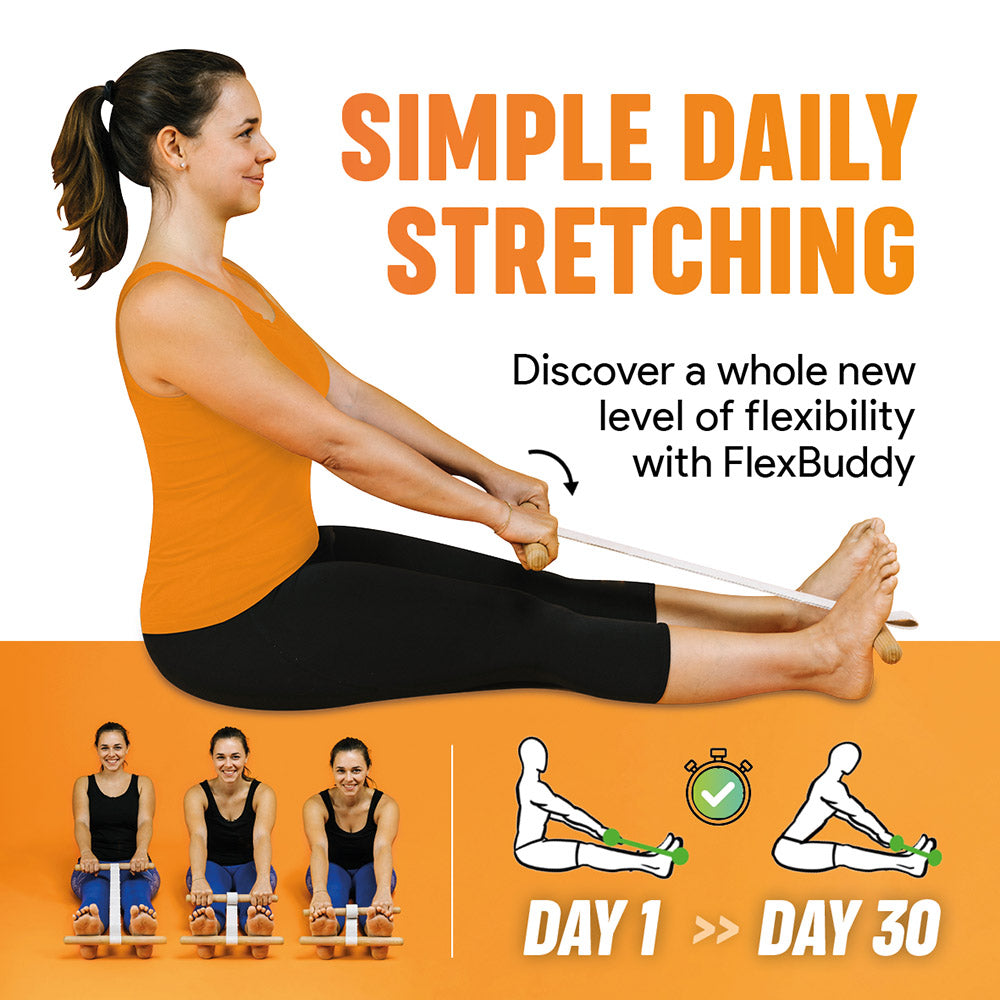
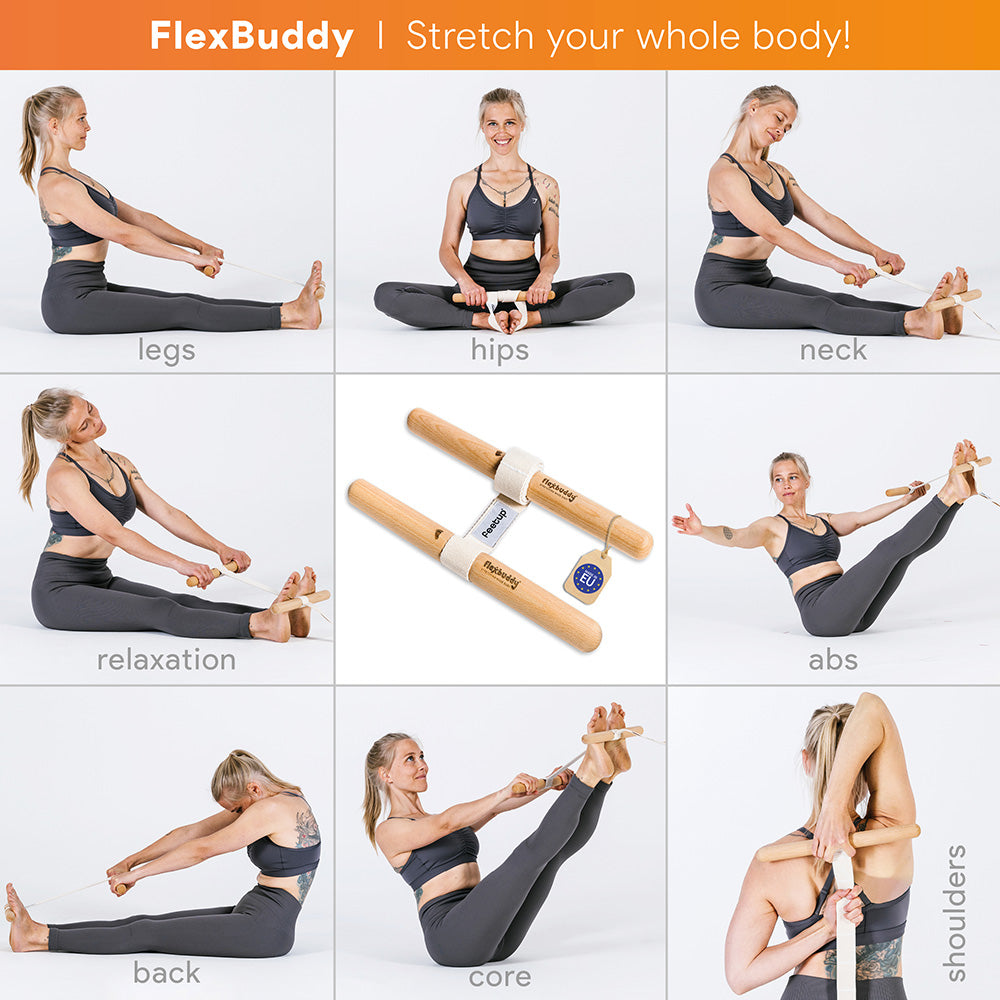
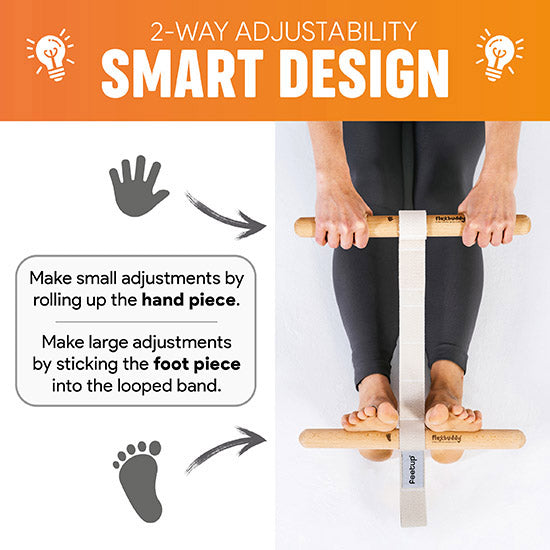
Sit with your legs straight. Put the FlexBuddy foot bar under the soles of your feet and hold the other bar in both hands, or loop a strap round your feet. Sit tall, then tip the pelvis forward from the hip crease with the chest lifted, stopping at a mild pull behind the thighs. Hamstrings are half of the pelvis and usually feel tight, and they respond: stretching improved the straight-leg raise in the trial above [23]. The stretch also practises the hip hinge: the pelvis moves while the lower back stays quiet. With FlexBuddy the strap carries the pull, so you hold that tall position without fighting for it. Technique is in tight hamstrings and lower back pain.
How often
The American College of Sports Medicine recommends a total of 60 seconds per flexibility exercise on at least two days a week, and resistance exercise for each major muscle group on two to three days a week [6]. Harvard Health adds that 15 seconds four times or 20 seconds three times both reach the 60 seconds [7]. In practice: the whole programme three times a week, the hip-flexor stretch on any day of long sitting, always to mild tension and never pain.
The hamstring stretch is the one to do daily. Keep FlexBuddy next to the sofa and take your ten slow breaths before you sit down for the evening. Give it two weeks and you will notice the difference every time you stand up.
Posterior pelvic tilt and "flat back", briefly
A posterior tilt is the reverse: the tailbone tucks under and the lumbar curve flattens [1]. In standing it is uncommon in young adults, 6% to 7% in the study above [2]. In sitting it is what almost everyone does on a sofa.
A flat back deserves as much care as an arched one: on average, low back pain goes with a smaller lumbar curve [4]. If you sit tucked under all day and your hamstrings are short, the work that pays is hamstring stretching with a long spine, home ground for FlexBuddy, plus the forward half of the lying pelvic tilt drill, and bridges. It is also why "tuck your tailbone" is a cue for one exercise, not for the whole day. If sitting is where your back complains, start with lower back pain from sitting.
What matters, and what you can let go
- Let go of the angle. Laboratories count the degrees that a stretching session takes off [8]. You will notice something better: hips that open and a back that stands easily.
- Let go of standing "neutral" all day. Most pain-free people do not [2]. Change position often.
- Let go of braces and belts. There are no brace trials to lean on [9], and you already own the better belt: your glutes and abdominals, stronger every week you train them.
What deserves your attention: hips that extend fully, a pelvis you can tip both ways, and a comfortable back.
When to get it checked
See a doctor or physiotherapist if back or hip pain lasts more than a few days in a row or makes you change your routine [1], or if it travels down a leg. Numbness, weakness, bladder or bowel changes, fever, or pain after a fall need prompt medical attention.
Train the hinge with FlexBuddy
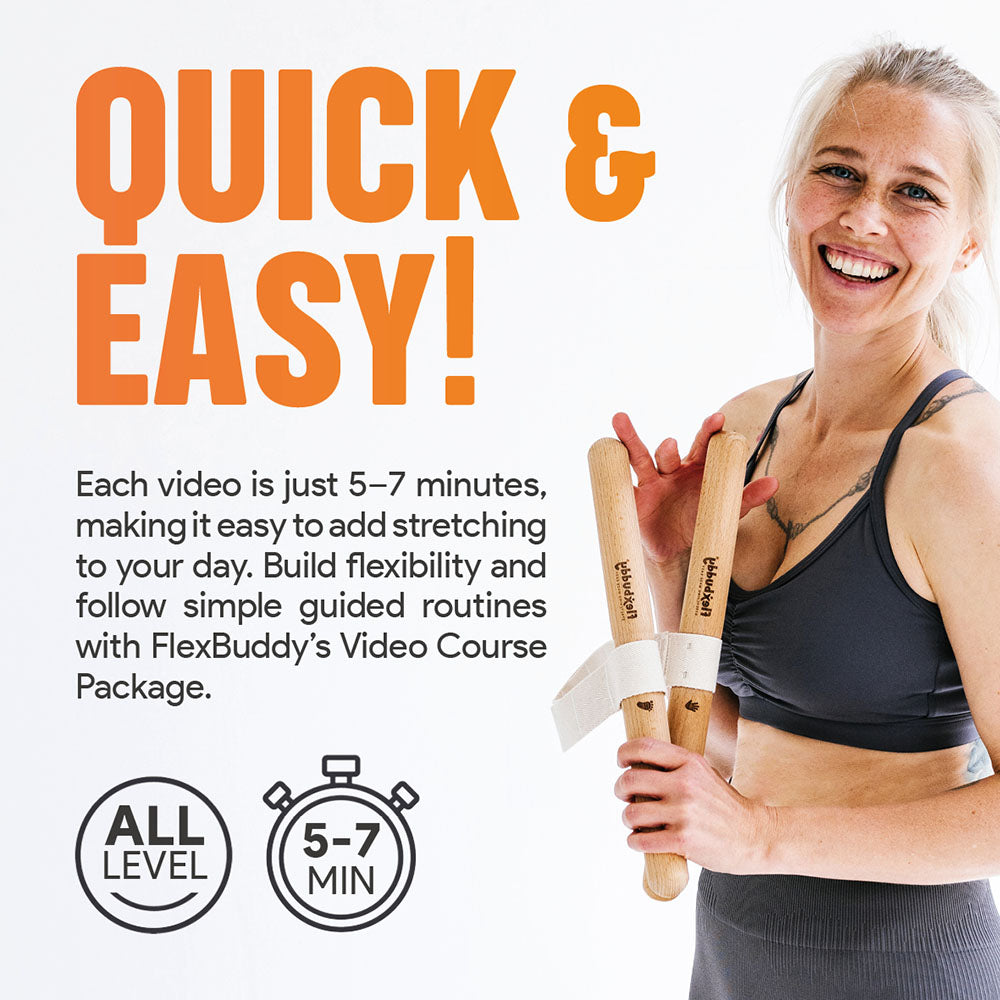
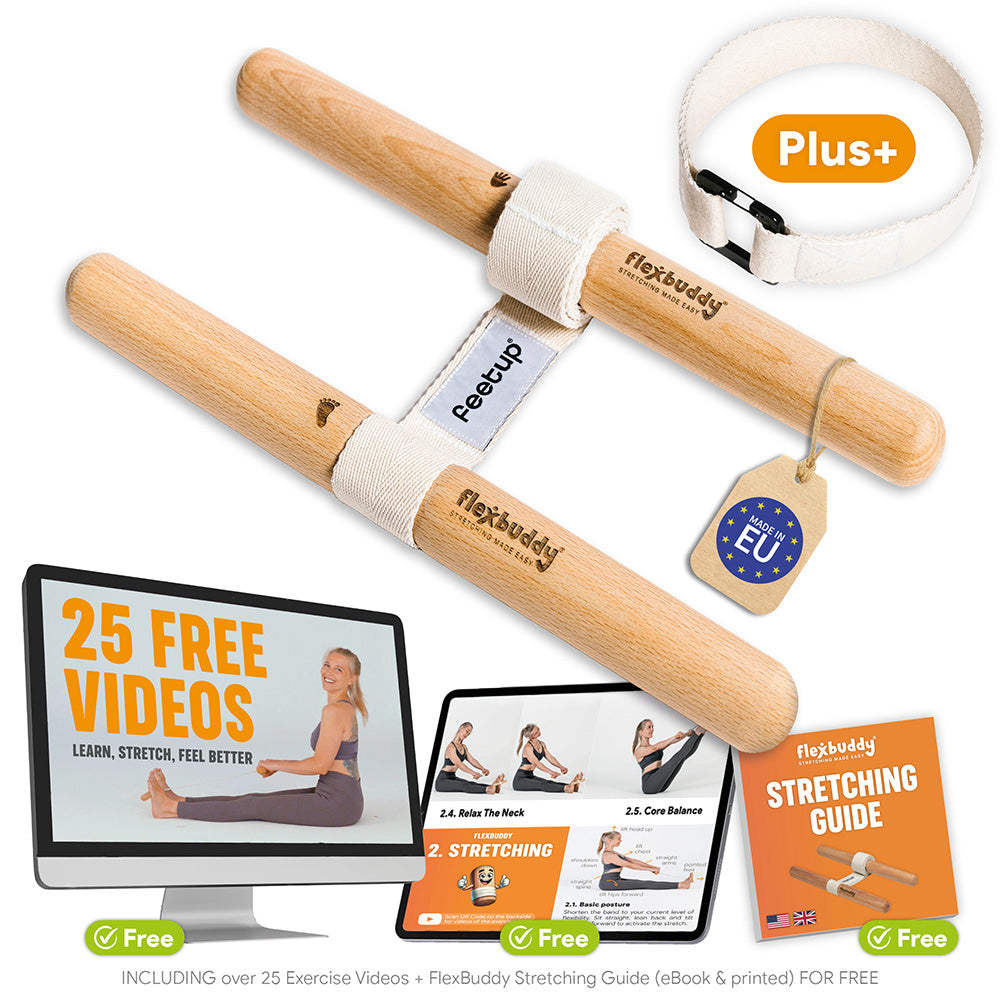
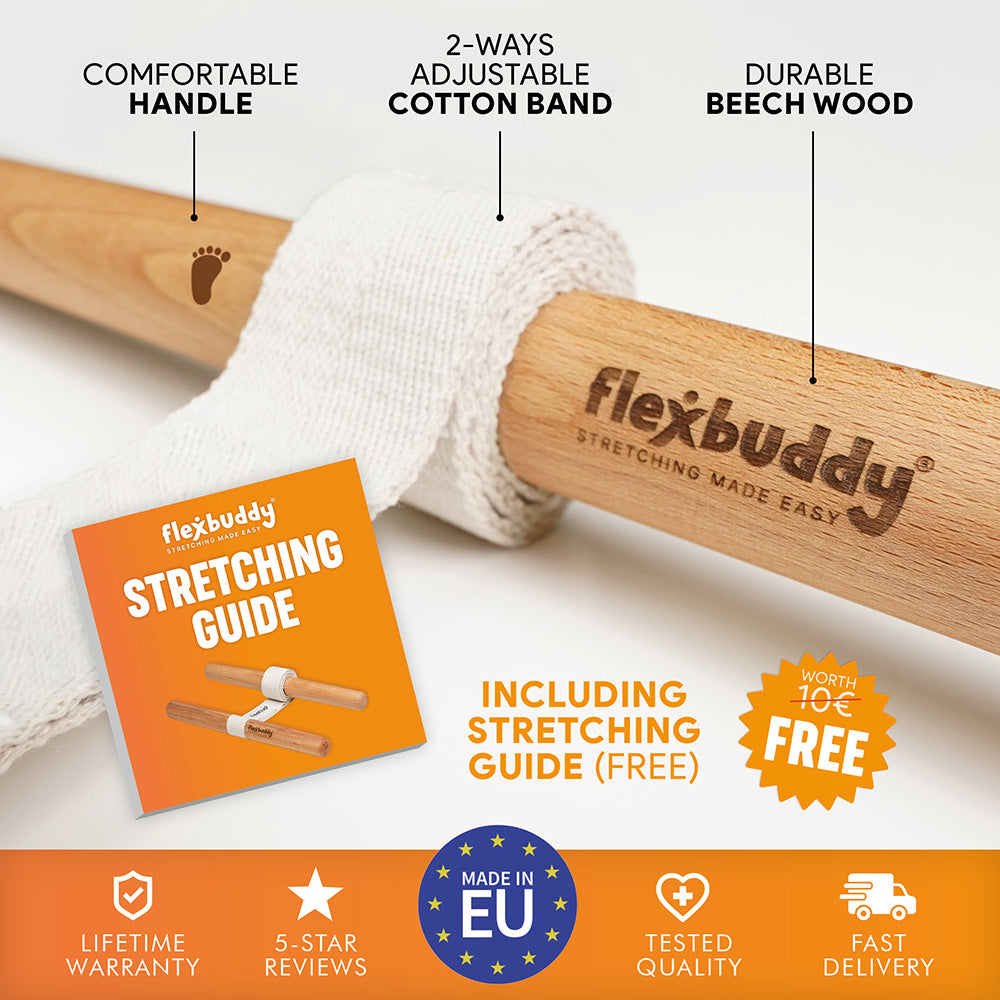
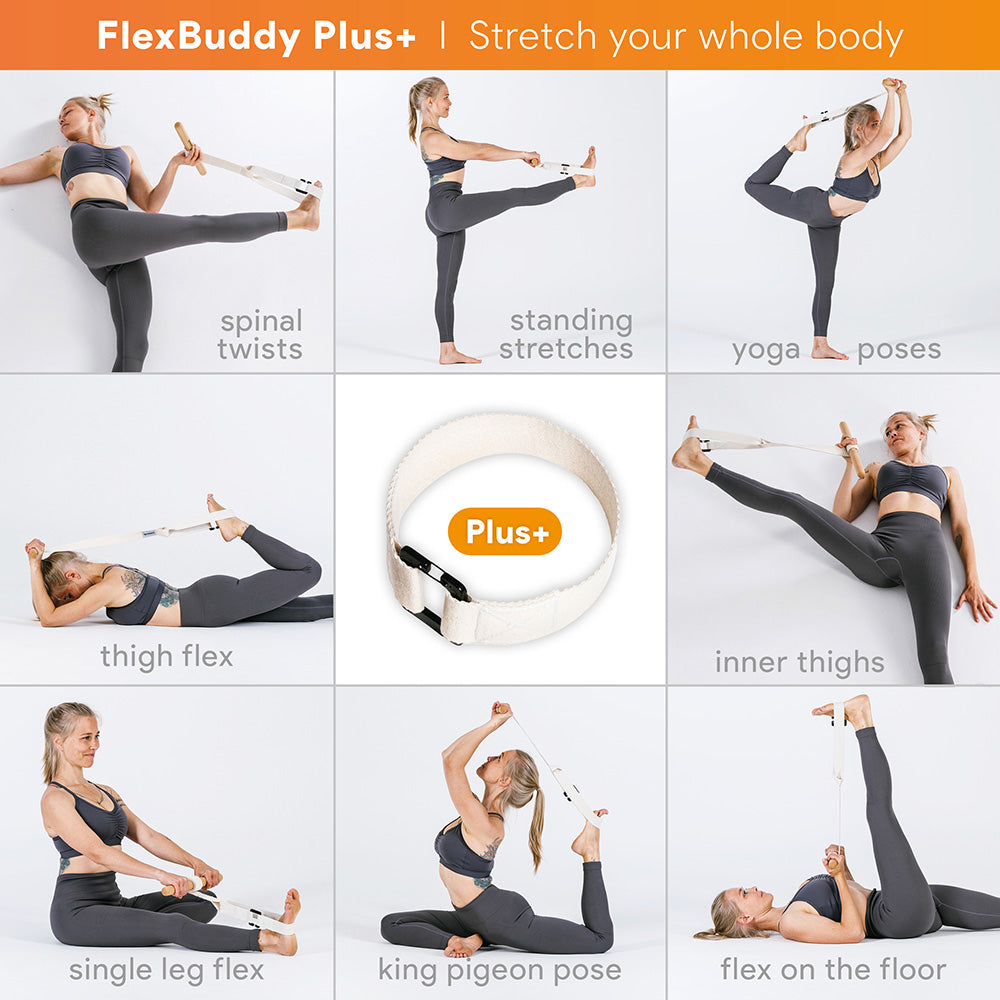
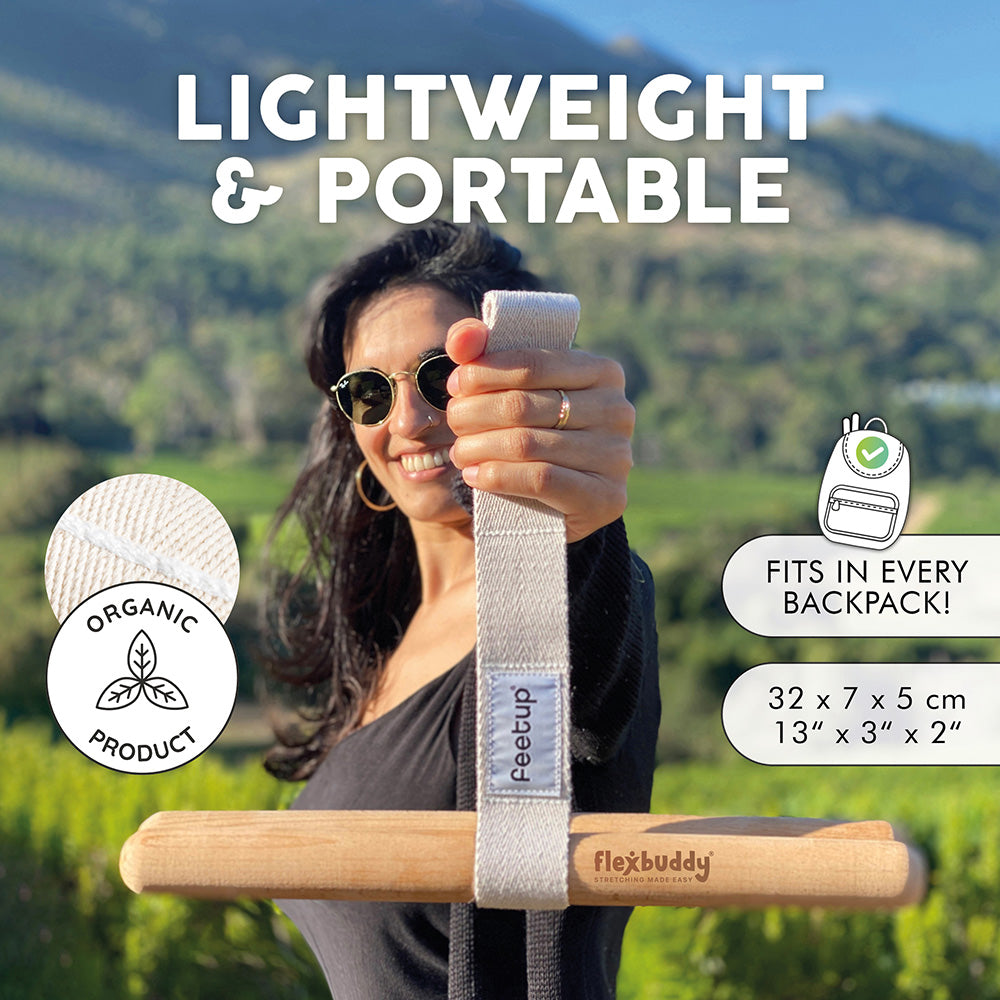
Half of this programme is the hamstrings and the hip hinge, and it is the half most people get wrong: they reach for their toes, the back rounds, and the pelvis never moves. FlexBuddy® solves that. It is a patented stretching device made of two beech-wood bars joined by an adjustable cotton strap. One bar goes under the soles of your feet, the other in your hands. You sit tall, lean back and tilt the hips forward while the strap carries the pull. That is the control this article teaches, felt in the first minute. Comfortable wooden handles, no rope burn.
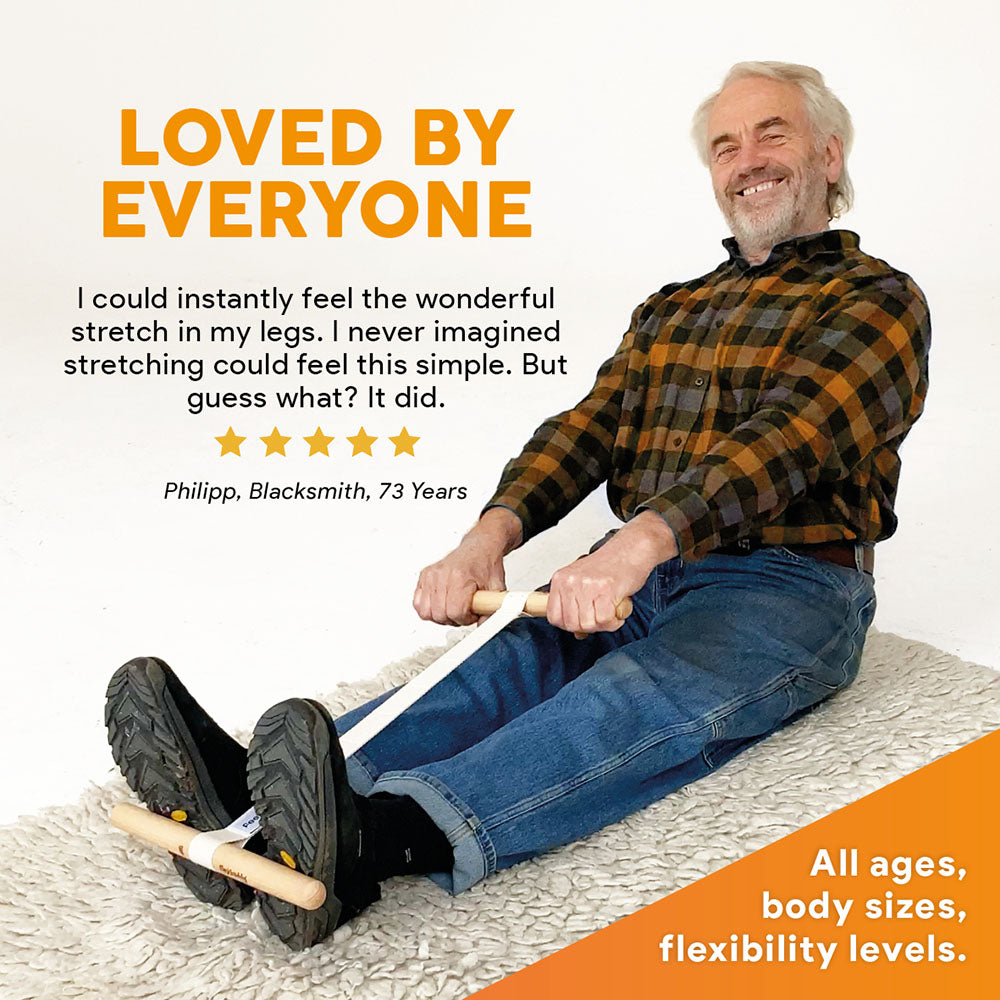
The other four exercises need only a floor and a cushion; FlexBuddy completes the set. Ten slow breaths, three times, takes about two minutes. Scott K., a trainer, calls it "a great tool to help your clients maintain a neutral spine while stretching calves, hamstrings and lower back." It is rated 4.5 by verified buyers and comes with a 30-day money-back guarantee and a lifetime warranty, so you can try it without risk. Get your FlexBuddy, or take the two-minute quiz to find the routine for your kind of stiffness.
Frequently asked questions
How do I fix anterior pelvic tilt?
Stretch the hip flexors with the pelvis tucked, strengthen the glutes and abdominals, and practise tilting the pelvis both ways. Your hips respond from the first session [8]. FlexBuddy adds the hamstring stretch, done well.
Is anterior pelvic tilt bad?
No. It is what a healthy pelvis usually looks like: among healthy, pain-free young adults, 85% of the men and 75% of the women had one [2]. If yours comes with tight hips or an aching lower back, the five exercises here are how you make both feel better.
How long does it take to fix anterior pelvic tilt?
You feel the first change straight away: a single session of hip-flexor stretching added hip extension and reduced standing tilt [8]. Strength follows, and eight weeks of abdominal training was enough to build it [9]. Give the full programme eight weeks and judge by how your hips and back feel.
Can anterior pelvic tilt cause lower back pain?
Not by the angle alone, and that is good news. A review of 43 studies found the same standing pelvic tilt and lumbar curve in people with and without low back pain; what differed was how well they moved [3]. If your back aches when you stand arched for a long time, these exercises are made for you.
What is the difference between anterior and posterior pelvic tilt?
In an anterior tilt the front of the pelvis tips down and the lower back arches. In a posterior tilt the tailbone tucks under and the lower back flattens [1]. Anterior is far more common in standing: 75% to 85% of healthy young adults against 6% to 7% [2].
Does sitting cause anterior pelvic tilt?
Sitting is linked with stiffer hip flexors: people who sat over seven hours a day and exercised little had 6.1 degrees less hip extension [14], and the Cleveland Clinic calls prolonged sitting the most common cause of excessive tilt [1]. The answer: stretch the hip flexors on every long sitting day and get up often.
This article is general information, not medical advice. Tight muscles usually respond well to regular stretching. If your pain is sharp, radiates down a leg, comes with numbness, weakness, fever, bladder or bowel changes, follows an injury, or keeps getting worse, see a doctor or physiotherapist before you stretch.
References
- Cleveland Clinic. Pelvic Tilt: What It Is, Types, Causes & Symptoms. Last updated 16 Mar 2026. https://my.clevelandclinic.org/health/diseases/pelvic-tilt (accessed 10 Nov 2026).
- Herrington L. Assessment of the degree of pelvic tilt within a normal asymptomatic population. Man Ther. 2011;16(6):646–648. doi:10.1016/j.math.2011.04.006. PMID 21658988 (abstract accessed 10 Nov 2026).
- Laird RA, Gilbert J, Kent P, Keating JL. Comparing lumbo-pelvic kinematics in people with and without back pain: a systematic review and meta-analysis. BMC Musculoskelet Disord. 2014;15:229. doi:10.1186/1471-2474-15-229. PMID 25012528 / PMC4096432 (abstract accessed 10 Nov 2026).
- Chun SW, Lim CY, Kim K, Hwang J, Chung SG. The relationships between low back pain and lumbar lordosis: a systematic review and meta-analysis. Spine J. 2017;17(8):1180–1191. doi:10.1016/j.spinee.2017.04.034. PMID 28476690 (abstract accessed 10 Nov 2026).
- Preece SJ, Willan P, Nester CJ, Graham-Smith P, Herrington L, Bowker P. Variation in pelvic morphology may prevent the identification of anterior pelvic tilt. J Man Manip Ther. 2008;16(2):113–117. doi:10.1179/106698108790818459. PMID 19119397 / PMC2565125 (abstract accessed 10 Nov 2026).
- Garber CE, Blissmer B, Deschenes MR, et al.; American College of Sports Medicine. Position stand: quantity and quality of exercise for developing and maintaining cardiorespiratory, musculoskeletal, and neuromotor fitness in apparently healthy adults. Med Sci Sports Exerc. 2011;43(7):1334–1359. doi:10.1249/MSS.0b013e318213fefb. PMID 21694556 (abstract accessed 10 Nov 2026).
- Harvard Health Publishing. The ideal stretching routine. Harvard Medical School, 16 Mar 2026 (reviewed by H. E. LeWine, MD). https://www.health.harvard.edu/staying-healthy/the-ideal-stretching-routine (accessed 10 Nov 2026).
- Preece SJ, Tan YF, Alghamdi TDA, Arnall FA. Comparison of pelvic tilt before and after hip flexor stretching in healthy adults. J Manipulative Physiol Ther. 2021;44(4):289–294. doi:10.1016/j.jmpt.2020.09.006. PMID 34090549 (abstract accessed 10 Nov 2026).
- Falk Brekke A, Overgaard S, Hróbjartsson A, Holsgaard-Larsen A. Non-surgical interventions for excessive anterior pelvic tilt in symptomatic and non-symptomatic adults: a systematic review. EFORT Open Rev. 2020;5(1):37–45. doi:10.1302/2058-5241.5.190017. PMID 32071772. https://pmc.ncbi.nlm.nih.gov/articles/PMC7017593/ (full text accessed 10 Nov 2026).
- Fidoe S. The Hip Bone. TeachMeAnatomy. Last updated 6 Nov 2025. https://teachmeanatomy.info/pelvis/bones/hip-bone/ (accessed 10 Nov 2026).
- Swain CTV, Pan F, Owen PJ, Schmidt H, Belavy DL. No consensus on causality of spine postures or physical exposure and low back pain: a systematic review of systematic reviews. J Biomech. 2020;102:109312. doi:10.1016/j.jbiomech.2019.08.006. PMID 31451200 (abstract accessed 10 Nov 2026).
- Christensen ST, Hartvigsen J. Spinal curves and health: a systematic critical review of the epidemiological literature dealing with associations between sagittal spinal curves and health. J Manipulative Physiol Ther. 2008;31(9):690–714. doi:10.1016/j.jmpt.2008.10.004. PMID 19028253 (abstract accessed 10 Nov 2026).
- Koes BW, van Tulder MW, Thomas S. Diagnosis and treatment of low back pain. BMJ. 2006;332(7555):1430–1434. doi:10.1136/bmj.332.7555.1430. https://pmc.ncbi.nlm.nih.gov/articles/PMC1479671/ (full text accessed 10 Nov 2026).
- Boukabache A, Preece SJ, Brookes N. Prolonged sitting and physical inactivity are associated with limited hip extension: a cross-sectional study. Musculoskelet Sci Pract. 2021;51:102282. doi:10.1016/j.msksp.2020.102282. PMID 33188982 (abstract accessed 10 Nov 2026).
- Heino JG, Godges JJ, Carter CL. Relationship between hip extension range of motion and postural alignment. J Orthop Sports Phys Ther. 1990;12(6):243–247. doi:10.2519/jospt.1990.12.6.243. PMID 18796868 (abstract accessed 10 Nov 2026).
- Jones O. Muscles in the Anterior Compartment of the Thigh. TeachMeAnatomy. Last updated 11 Oct 2026. https://teachmeanatomy.info/lower-limb/muscles/thigh/anterior-compartment/ (accessed 10 Nov 2026).
- Jones O. Muscles of the Gluteal Region. TeachMeAnatomy. Last updated 9 Apr 2026. https://teachmeanatomy.info/lower-limb/muscles/gluteal-region/ (accessed 10 Nov 2026).
- Jones O. The Anterolateral Abdominal Wall. TeachMeAnatomy. Last updated 1 Feb 2026. https://teachmeanatomy.info/abdomen/muscles/abdominal-wall/ (accessed 10 Nov 2026).
- Ludwig O, Dindorf C, Kelm S, Kelm J, Fröhlich M. Muscular strategies for correcting the pelvic position to improve posture: an exploratory study. J Funct Morphol Kinesiol. 2024;9(1):25. doi:10.3390/jfmk9010025. PMID 38390925 / PMC10885056 (abstract accessed 10 Nov 2026).
- Jones O. Muscles in the Posterior Compartment of the Thigh. TeachMeAnatomy. Last updated 9 Apr 2026. https://teachmeanatomy.info/lower-limb/muscles/thigh/hamstrings/ (accessed 10 Nov 2026).
- Walker ML, Rothstein JM, Finucane SD, Lamb RL. Relationships between lumbar lordosis, pelvic tilt, and abdominal muscle performance. Phys Ther. 1987;67(4):512–516. doi:10.1093/ptj/67.4.512. PMID 2951745 (abstract accessed 10 Nov 2026).
- Youdas JW, Garrett TR, Harmsen S, Suman VJ, Carey JR. Lumbar lordosis and pelvic inclination of asymptomatic adults. Phys Ther. 1996;76(10):1066–1081. doi:10.1093/ptj/76.10.1066. PMID 8863760 (abstract accessed 10 Nov 2026).
- Li Y, McClure PW, Pratt N. The effect of hamstring muscle stretching on standing posture and on lumbar and hip motions during forward bending. Phys Ther. 1996;76(8):836–845. doi:10.1093/ptj/76.8.836. PMID 8710963 (abstract accessed 10 Nov 2026).